Month: September 2023

  • Cambridge IELTS 9 Academic Writing Test 2

    Task 1

    You should spend about 20 minutes on this task.

    The chart below shows the total number of minutes (in billions) of telephone calls in the UK, divided into three categories, from 1995-2002.

    Summarise the information by selecting and reporting the main features, and make comparisons where relevant.

    Write at least 150 words.

    Task 2

    You should spend about 40 minutes on this task.

    Write about the following topic:

    Some people believe that unpaid community service should be a compulsory part of high school programmes (for example working for a charity, improving the neighbourhood or teaching sports to younger children).

    To what extent do you agree or disagree?

    Give reasons for your answer and include any relevant examples from your own knowledge or experience.

    Write at least 250 words.

    Cambridge IELTS 9 Academic Writing Test 2 Task 1 Model Answer (159 words)

    The chart shows the time spent by UK residents on different types of telephone calls between 1995 and 2002.

    Local fixed line calls were the highest throughout the period, rising from 72 billion minutes in 1995 to just under 90 billion in 1998. After peaking at 90 billion the following year, these calls had fallen back to the 1995 figure by 2002.

    National and international fixed line calls grew steadily from 38 billion to 61 billion at the end of the period in question, though the growth slowed over the last two years.

    There was a dramatic increase in mobile calls from 2 billion to 46 billion minutes. This rise was particularly noticeable between 1999 and 2002, during which time the use of mobile phones tripled.

    To sum up, although local fixed line calls were still the most popular in 2002, the gap between the three categories had narrowed considerably over the second half of the period in question.

    Cambridge IELTS 9 Academic Writing Test 2 Task 1 Model Answer (278 words)

    The idea of making unpaid community service a compulsory part of high school education sparks considerable debate. Some believe it fosters social responsibility, while others argue it adds unnecessary pressure on students. On balance, I support integrating community service into high school programs for several key reasons.

    Firstly, mandatory community service promotes social responsibility and civic engagement. By participating in activities such as working for a charity or improving their neighborhood, students gain a firsthand understanding of societal needs and the importance of contributing to their communities. For instance, helping at a local shelter can develop empathy and a sense of civic duty.

    Secondly, community service provides valuable life skills beyond the classroom. It enhances teamwork, communication, and problem-solving abilities. Teaching sports to younger children, for example, can build leadership and organizational skills. These experiences not only enrich students’ personal development but also enhance their resumes, giving them an edge in college or job applications.

    However, it’s crucial to balance this requirement with students’ academic and personal commitments. Schools should offer flexible programs that allow students to select activities aligned with their interests and manage their time effectively. Proper support and guidance are also essential to ensure meaningful engagement rather than a burdensome obligation.

    While critics argue that compulsory service undermines voluntary spirit, this can be mitigated through effective implementation. Emphasizing the benefits and framing service as an educational opportunity can motivate students to participate willingly and derive satisfaction from their contributions.

    In conclusion, making unpaid community service a mandatory part of high school education offers significant benefits by fostering civic responsibility and practical skills. With thoughtful implementation, it can be a valuable component of holistic student development.
  • Cambridge IELTS 9 Academic Writing Test 1

    Writing Task 1

    You should spend about 40 minutes on this task. Write about the following topic:

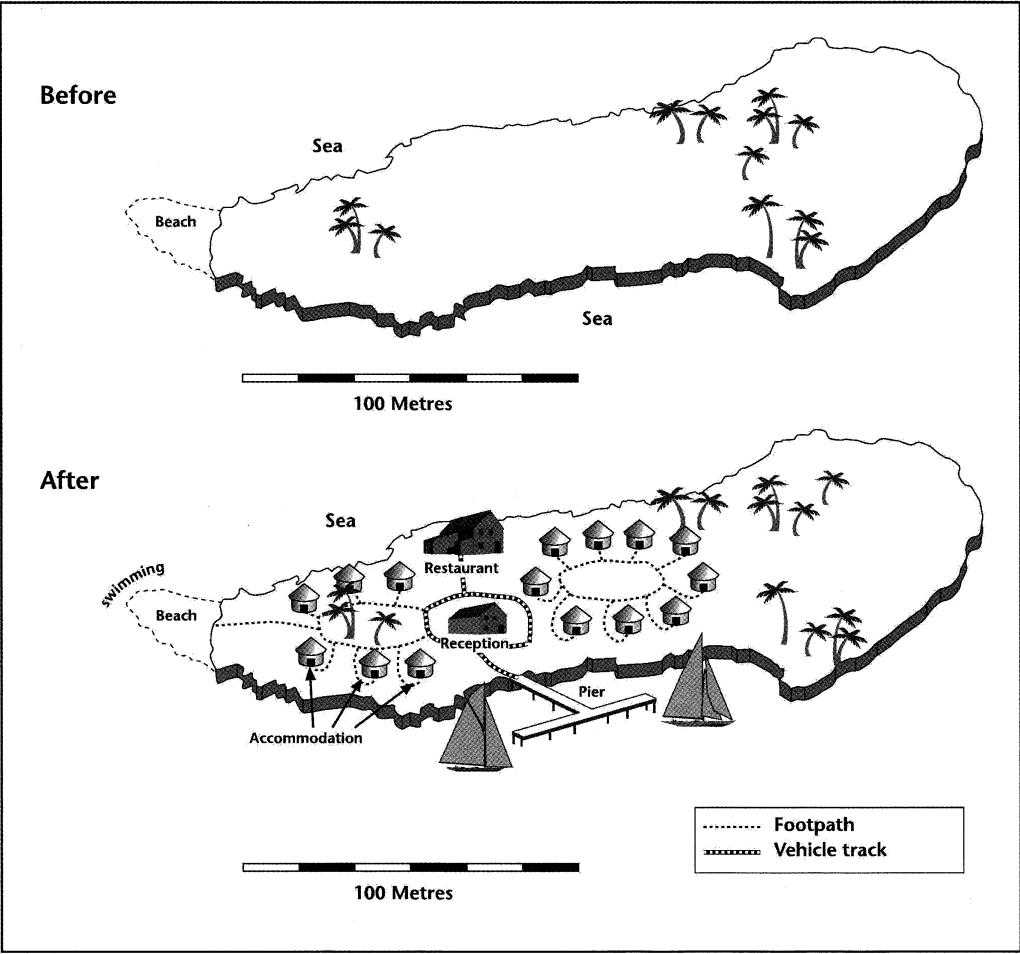
    The two maps below show an island, before and after the construction of some tourist facilities.

    Summarise the information by selecting and reporting the main features, and make comparisons where relevant.

    Write at least 150 words.

    Map of Island tourist facilities construction Cambridge IELTS 9 Academic Writing Test 1

    Writing Task 2

    You should spend about 40 minutes on this task. Write about the following topic:

    Some experts believe that it is better for children to begin learning a foreign language at primary school rather than secondary school

    Do the advantages of this outweigh the disadvantages?

    Give reasons for your answer and include any relevant examples from your own knowledge or experience.

    Write at least 250 words.

    Cambridge IELTS 9 Academic Writing Test 1 Task 2 Model Answer (166 words)

    The two maps illustrate an island before and after the development of tourist facilities.

    In the initial state, the island is largely undeveloped, featuring a natural landscape with some trees, a beach on the western side, and no significant infrastructure.

    Post-development, the island undergoes substantial changes, becoming a tourist destination with various amenities. The central part of the island now hosts several accommodations arranged in a circular pattern around a newly established reception area. A restaurant is constructed to the north of the reception. Footpaths link the reception with the accommodations and the restaurant, while vehicle tracks connect the reception to a newly built pier on the southern coast.

    Additional accommodations are added near the pier, and two sailboats are docked beside it. The beach area is designated for swimming. Despite these developments, the island retains some of its natural greenery, particularly towards the eastern end.

    Overall, the transformation enhances the island’s infrastructure significantly, making it suitable for tourists while maintaining parts of its natural environment.

    Cambridge IELTS 9 Academic Writing Test 1 Task 2 Model Answer (267 words)

    Traditionally, children have begun studying foreign languages at secondary school, but introducing them earlier is recommended by some educationalists. This policy has been adopted by some educational authorities or individual schools, with both positive and negative outcomes.

    The obvious argument in its favour is that young children pick up languages much more easily than teenagers. Their brains are still programmed to acquire their mother tongue, which facilitates learning another language, and unlike adolescents, they are not inhibited by self-consciousness.

    The greater flexibility of the primary timetable allows for more frequent, shorter sessions and for a play-centred approach, thus maintaining learners’ enthusiasm and progress. Their command of the language in later life will benefit from this early exposure, while learning other languages subsequently will be easier for them. They may also gain a better understanding of other cultures.

    There are, however, some disadvantages. Primary school teachers are generalists, and may not have the necessary language skills themselves. If specialists have to be brought in to deliver these sessions, the flexibility referred to above is diminished. If primary language teaching is not standardised, secondary schools could be faced with a great variety of levels in different languages within their intake, resulting in a classroom experience which undoes the earlier gains. There is no advantage if enthusiastic primary pupils become demotivated as soon as they change schools. However, these issues can be addressed strategically within the policy adopted.

    Anything which encourages language learning benefits society culturally and economically, and early exposure to language learning contributes to this. Young children’s innate abilities should be harnessed to make these benefits more achievable.

  • Cambridge IELTS 10 Academic Writing Test 4

    Writing Task 1

    You should spend no more than 20 minutes on this task.

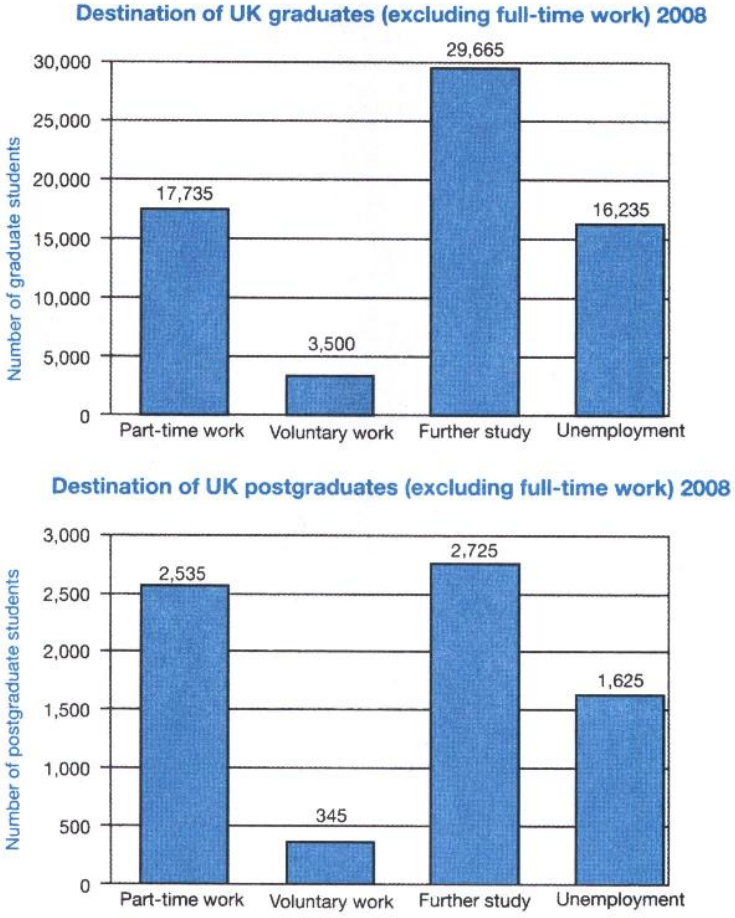
    The charts below show what UK graduate and postgraduate students who did not go into full-time work did after leaving college in 2008.

    Summarise the information by selecting and reporting the main features, and make comparisons where relevant.

    You should write at least 150 words.

    Writing Task 2

    You should spend no more than 40 minutes on this task.

    Write about the following topic.

    Countries are becoming more and more similar because people are able to buy the same products anywhere in the world.

    Do you think this is a positive or negative development?

    Give reasons for your answer and include any relevant examples from your own knowledge or experience.

    You should write at least 250 words.

  • Cambridge IELTS 10 Listening Test 4

    Section 1Questions 1-10

    Questions 1-6

    Complete the notes below.

    Write NO MORE THAN one word only for each answer.

    THORNDYKE’S BUILDERS

    Example
    Customer heard about Thorndyke’s from a
    ……………………friend……………………….
    Name:Eddith (1)……………………………………………………
    Address:Flat 4, (2)……………………………………………………
    Park Flats,
    Behind the (3)……………………………………………………
    Phone number:875934
    Best time to contact customer: during the (4) ……………………………………………………
    Where to park: opposite entrance next to the (5) ……………………………………………………
    Need full quote showing all the jobs and the (6) ……………………………………………………
    Questions 7-10

    Complete the notes below.

    Write NO MORE THAN one word only for each answer.

    AreaWork to be doneNotes
    Kitchen– replace the (7)……………..in the door
    – paint wall above the (8)…………….
    – fix tomorrow
    – strip paint and plaster approximately one (9)……………in advance
    Gardenone (10)………………..needs replacing (end of garden)

    SECTION 2Questions 11-20

    Questions 11-15

    Choose the correct letter, A, B or C.

    MANHAM PORT

    1. Why did a port originally develop at Manham?
      1.  It was safe from enemy attack
      2.  It was convenient for river transport
      3.  It had a good position on the sea coast
    1. What caused Manham’s sudden expansion during the Industrial Revolution?
      1.  the improvement in mining techniques
      2.  the increase in demand for metals
      3.  the discovery of tin in the area
    1. Why did rocks have to be sent away from Manham to be processed?
      1.  shortage of fuel
      2.  poor transport systems
      3.  lack of skills among local people
    1. What happened when the port declined in the twentieth century?
      1.  The workers went away
      2.  Traditional skills were lost
      3.  Buildings were used for new purposes
    1. What did the Manham Trust hope to do?
      1.  discover the location of the original port
      2.  provide jobs for the unemployed
      3.  rebuild the port complex
    Questions 16-20

    complete the notes below

    Choose SIX answers from the box and write the correct letter, A-l, next to questions 15-20.

    Write NO MORE THAN TWO WORDS.

    TOURIST ATTRACTIONS IN MUSEUM

    PlaceFeatures and activitiesAdvice
    Copper minespecially adapted miners’ (16)………………….take visitors into the mountainthe mine is (17)……………..and enclosed – unsuitable for children and animals
    Village schoolclassrooms and a special exhibition of (18)……………….a (19)…………………..is recommended
    ‘The George’ (old sailing ship)the ship’s wheel (was lost but has now been restored)children should not use the (20)………………

    SECTION 3Questions 21 – 30

    Questions 21 and 22

    Choose two letters, A-E.

    Which TWO skills did Laura improve as a result of her work placement?

    1.  communication
    2.  design
    3.  IT
    4.  marketing
    5.  organisation
    Questions 23 and 24

    Choose two letters, A-E.

    Which TWO immediate benefits did the company get from Laura’s work placement?

    1.  updates for its software
    2.  cost savings
    3.  an improved image
    4.  new clients
    5.  a growth in sales
    Questions 25-30

    What source of information should Tim use at each of the following stages of the work placement?

    Choose SIX answers from the box and write the correct letter, A-G, next to questions 25-30.

    Source of information

    1. company manager
    2. company’s personnel department
    3. personal tutor
    4. psychology department
    5. mentor
    6. university careers officer
    7. internet

    Stages of work placement procedure

    1. obtaining booklet 
    2. discussing options 
    3. getting updates 
    4. responding to invitation for interview 
    5. informing about outcome of interview 
    6. requesting a reference

    SECTION 4Questions 31 – 40

    Questions 31-33

    Choose the correct letter A, B or C.

    Nanotechnology: technology on a small scale

    1. The speaker says that one problem with nanotechnology is that
      1. it could threaten our way of life
      2. it could be used to spy on people
      3.  t is misunderstood by the public
    1. According to the speaker, some scientists believe that nano-particles
      1.  should be restricted to secure environments
      2.  should be used with more caution
      3.  should only be developed for essential products
    1. In the speaker’s opinion, research into nanotechnology
      1.  has yet to win popular support
      2.  could be seen as unethical
      3.  ought to be continued
    Questions 34-40

    Complete the notes below.

    Write ONE WORD ONLY.

    Uses of Nanotechnology

    Transport
    • Nanotechnology could allow the development of stronger (34)……………………………………………..
    • Planes would be much lighter in weight.
    • (35) …………………………………………….. travel will be made available to the masses.

    Technology
    • Computers will be even smaller, faster, and will have a greater (36)……………………………………………..
    • (37) …………………………………………….. energy will become more affordable.

    The Environment
    • Nano-robots could rebuild the ozone layer.
    • Pollutants such as (38)……………………………………………..  could be removed from water more easily.
    • There will be no (39) …………………………………………….. from manufacturing.

    Health and Medicine
    • New methods of food production could eradicate famine.
    • Analysis of medical (40) …………………………………………….. will be speeded up.
    • Life expectancy could be increased.

    Section 1 Answers Cambridge 10 Listening Test 4
    1. Pargetter
    2. east
    3. library
    4. morning(s)
    5. postbox
    6. prices
    7. glass
    8. cooker
    9. week
    10. fence
    Section 2 Answers Cambridge 10 Listening Test 4
    1. B
    2. B
    3. A
    4. A
    5. C
    6. trains
    7. dark
    8. games
    9. guided tours
    10. ladder(s)
    Section 3 Answers Cambridge 10 Listening Test 4
    1. A, E (in any order)
    2. A, E (in any order)
    3. B, C (in any order)
    4. B, C (in any order)
    5. D
    6. F
    7. G
    8. B
    9. E
    10. C
    Section 4 Answers Cambridge 10 Listening Test 4
    1. C
    2. B
    3. C
    4. metal(s)
    5. space
    6. memory
    7. solar
    8. oil
    9. waste
    10. tests
  • Cambridge IELTS 10 Listening Test 3

    Section 1Questions 1-10

    Complete the notes below.

    Write NO MORE THAN TWO WORDS AND/OR A NUMBER for each answer.

    Early Learning Children Centre Enrolment Form

    Example
    Parent or guardian: ……………Carol Smith…………….
    Personal details:
    Child’s name: Kate
    Age: (1) ………………………………………………….
    Address: (2) …………………………………………………. Road, Woodside 4032
    Phone: 33459865
    Childcare information
    Days enrolled for: Monday and (3) ………………………………………………….
    Start time: (4)…………………………………………………. am
    Childcare group: the (5)…………………………………………………. group
    Which meals are required each day? ………………………………………………….(6) 
    Medical conditions: need ………………………………………………….(7) 
    Emergency contact: Jenny ………………………………………………….(8) 
    Relationship to child: ………………………………………………….(9) 
    Fees
    Will pay each ………………………………………………….(10) 

    SECTION 2Questions 11-20

    Questions 11 and 12

    Choose TWO letters, A-E.

    Which TWO things does Alice say about the Dolphin Conservation Trust?

    1.  Children make up most of the membership
    2.  It’s the country’s largest conservation organisation
    3.  It helps finance campaigns for changes in fishing practices
    4.  It employs several dolphin experts full-time
    5.  Volunteers help in various ways
    Questions 13-15

    Choose TWO letters, A-E.

    1. Why is Alice so pleased the Trust has won the Charity Commission award?
      1.  It has brought in extra money
      2.  It made the work of the trust better known
      3.  It has attracted more members.
    1. Alice says oil exploration causes problems to dolphins because of
      1.  noise
      2.  oil leaks
      3.  movement of ships
    1. Alice became interested in dolphins when
      1.  she saw one swimming near her home
      2.  she heard a speaker at her school
      3.  she read a book about them
    Questions 16-20

    Which dolphin does Alice make each of the following comments about?

    Write the correct letters A, B, C or D, next to questions 16-20.

    Dolphins

    1. Moondancer
    2. Echo
    3. Kiwi
    4. Samson

    Comments

    1. It has not been seen this year 
    2. It is photographed more than the others 
    3. It is always very energetic 
    4. It is the newest one in the scheme 
    5. It has an unusual shape

    SECTION 3Questions 21 – 30

    Questions 21-25

    Choose the correct letter, A, B or C.

    Theatre Studies Course

    1. What helped Rob to prepare to play the character of a doctor?
      1. the stories his grandfather told him
      2. the times when he watched his grandfather working
      3. the way he imagined his grandfather at work
    2. In the play’s first scene, the boredom of village life was suggested by
      1. repetition of words and phrases
      2. scenery painted in dull colours
      3. long pauses within conversations
    3. What has Rob learned about himself through working in a group?
      1. He likes to have clear guidelines
      2. He copes well with stress
      3. He thinks he is a good leader
    4. To support the production, research material was used which described
      1. political developments
      2. changing social attitudes
      3. economic transformations
    5. What problem did the students overcome in the final rehearsal?
      1. one person forgetting their words
      2. an equipment failure
      3. the injury of one character
    Questions 26-30

    What action is needed for the following stages in doing the ‘year abroad’ option?

    Choose FIVE answers from the box given and write the correct letter, A-G, next to questions 26-30

    Action

    1. be on time
    2. get a letter of recommendation
    3. plan for the final year
    4. make sure the institution’s focus is relevant
    5. show ability in Theatre Studies
    6. make travel arrangements and bookings
    7. ask for help

    Stages in doing the ‘year abroad’ option

    1. in the second year of the course 
    2. when first choosing where to go 
    3. when sending in your choice 
    4. when writing your personal statement 
    5. when doing the year abroad

    SECTION 4Questions 31 – 40

    Complete the notes below.

    Write one world only for each answer

    ‘Self-regulatory focus theory’ and leadership

    • Self-regulatory focus theory
      • People’s focus is to approach pleasure or avoid pain
      • Promotion goals focus on (31) …………………………………………
      • Prevention goals emphasise avoiding punishment
    • Factors that affect people’s focus
      • The Chronic Factor
        • • comes from one’s (32) …………………………………………
        • The (33) ………………………………………… Factor
        • • we are more likely to focus on promotion goals when with a (34) …………………………………………
        • • we are more likely to focus on prevention goals with our boss
    • How people’s focus affects them
      • Promotion Focus: People think about an ideal version of themselves, their (35)  and their gains.
      • Prevention Focus: People think about their ‘ought’ self and their obligations
    • Leaders
      • Leadership behaviour and (36) ………………………………………… affects people’s focus
      • Transformational Leaders:
        • • pay special attention to the (37)…………………………………………  of their followers
        • • passionately communicate a clear (38)………………………………………… 
        • • inspire promotion focus in followers
      • Transactional Leaders:
        • create (39) ………………………………………… to make expectations clear
        • emphasise the results of a mistake
        • inspire prevention focus in followers
    • Conclusion
      • Promotion Focus is good for jobs requiring (40) …………………………………………
      • Prevention Focus is good for work such as a surgeon Leaders’ actions affect which focus people use.
    Section 1 Answers Cambridge 10 Listening Test 3
    1. 4
    2. 46 wombat
    3. thursday
    4. 8.30
    5. red
    6. lunch
    7. glasses
    8. BALL
    9. aunt
    10. month
    Section 2 Answers Cambridge 10 Listening Test 3
    1. C, E (In any order)
    2. C, E (In any order)
    3. B
    4. A
    5. C
    6. B
    7. C
    8. D
    9. D
    10. A
    Section 3 Answers Cambridge 10 Listening Test 3
    1. C
    2. A
    3. A
    4. B
    5. B
    6. E
    7. D
    8. A
    9. G
    10. C
    Section 4 Answers Cambridge 10 Listening Test 3
    1. achievement(s)
    2. personality / character
    3. situational
    4. friend
    5. aspirations / ambitions
    6. style
    7. development
    8. vision
    9. structures
    10. innovation(s)
  • Cambridge IELTS 10 Listening Test 2

    Section 1Questions 1-10

    Complete the notes below.

    Write NO MORE THAN TWO WORDS AND/OR A NUMBER for each answer.

    Transport Survey

    Example
    Travelled to town today:
    by …………….bus………………..
    Name:Lusia (1)…………………………………………..
    Address”(2) ……………………………………White Stone Road
    Area:Bradfield
    Postcode:(3) ……………………………………
    Occupation:(4) ……………………………………
    Reason for visit to town:to go to the (5) ……………………………………
    Suggestions for improvement:
    – better (6) ……………………………………
    – Have more footpaths
    – More frequent (7) ……………………………………
    Things that would encourage cycling to work:
    – Having (8) …………………………………… parking places for bicycles
    – Being able to use a (9) …………………………………… at work
    – The opportunity to have cycling (10) ……………………………………  on busy roads

    SECTION 2Questions 11-20

    Questions 11-14

    Choose the correct letter, A, B or C.

    New city developments

    1. The idea for the two new developments in the city came from
      1.  local people
      2.  the City Council
      3.  the SWRDC
    1. What is unusual about Brackenside pool?
      1.  its architectural style
      2.  its heating system
      3.  its method of water treatment
    1. Local newspapers have raised worries about
      1.  the late opening date
      2.  the post of the project
      3.  the size of the facilities
    1. What decision has not yet been made about the pool?
      1.  whose statue will be at the door
      2.  the exact opening times
      3.  who will open it
    Questions 15-20

    Which feature is related to each of the following areas of the world represented in the playground?

    Choose SIX answers from the box and write the correct letter, A-l, next to questions 15-20.

    FEATURES

    A ancient fortsB waterwaysC ice and snow
    D jewelsE local animalsF mountains
    music and filmspace travelI volcanoes

    Areas of the world

    1. Asia 
    2. Antarctica 
    3. South America 
    4. North America 
    5. Europe 
    6. Africa 

    SECTION 3Questions 21 – 30

    Questions 21 and 22

    Choose THREE letters, A-E.

    Which TWO hobbies was Thor Heyerdahl very interested in as a youth?

    1.  camping
    2.  climbing
    3.  collecting
    4.  hunting
    5.  reading
    Questions 23 and 24

    Choose THREE letters, A-E.

    Which do the speakers say are the TWO reasons why Heyerdahl went to live on an island?

    1. to examine ancient carvings
    2.  to experience an isolated place
    3.  to formulate a new theory
    4.  to learn survival skills
    5.  to study the impact of an extreme environment
    Questions 25-30

    Choose the correct letter, A, B or C.

    The later life of Thor Heyerdahl

    1. According to Victor and Olivia, academics thought that Polynesian migration from the east was impossible due to
      1.  the fact that Eastern countries were far away
      2.  the lack of materials for boat building
      3.  the direction of the winds and currents
    1. Which do the speakers agree was the main reason for Heyerdahl’s raft journey?
      1.  to overcome a research setback
      2.  to demonstrate a personal quality
      3.  to test a new theory
    1. What was most important to Heyerdahl about his raft journey?
      1.  the fact that he was the first person to do it
      2.  the speed of crossing the Pacific
      3.  the use of authentic construction methods
    1. Why did Heyerdahl go to Easter Island?
      1.  to build a stone statue
      2.  to sail a reed boat
      3.  to learn the local language
    1. In Olivia’s opinion, Heyerdahl’s greatest influence was on
      1.  theories about Polynesian origins
      2.  the development of archaeological methodology
      3.  establishing archaeology as an academic subject
    1. Which criticism do the speakers make of William Oliver’s textbook?
      1.  Its style is out of date
      2.  Its content is over-simplified
      3.  Its methodology is flawed

    SECTION 4Questions 31 – 40

    Complete the notes below.

    Write one world only for each answer

    THE FUTURE OF MANAGEMENT

    Business markets

    • greater (31)…………………………………………   among companies
    • increase in power of large (32)…………………………………………   companies
    • rising (33)…………………………………………  in certain countries

    External influences on businesses

    • more discussion with (34) ………………………………………… before making business decisions
    • environmental concerns which may lead to more (35)…………………………………………

    Business structures

    • more teams will be formed to work on a particular (36)…………………………………………
    • businesses may need to offer hours that are (37)…………………………………………  , or the chance to work remotely

    Management styles

    • increasing need for managers to provide good (38)…………………………………………
    • changes influenced by (39)…………………………………………  taking senior roles

    Changes in the economy

    • service sector continues to be important
    • increasing value of intellectual property
    • more and more (40)…………………………………………  workers
    Section 1 Answers Cambridge 10 Listening Test 2
    1. Hardie
    2. 19
    3. GT82LC
    4. hairdresser
    5. dentist
    6. lighting
    7. trains
    8. safe
    9. shower
    10. training
    Section 2 Answers Cambridge 10 Listening Test 2
    1. A
    2. C
    3. C
    4. A
    5. E
    6. F
    7. D
    8. H
    9. A
    10. B
    Section 3 Answers Cambridge 10 Listening Test 2
    1. B, C (In any order)
    2. B, C (In any order)
    3. B, E (In any order)
    4. B, E (In any order)
    5. A
    6. C
    7. C
    8. A
    9. B
    10. A
    Section 4 Answers Cambridge 10 Listening Test 2
    1. competition
    2. global
    3. demand
    4. customers
    5. regulation
    6. project
    7. flexible
    8. leadership
    9. women
    10. self-employed
  • Cambridge IELTS 10 Academic Writing Test 3

    Writing Task 1

    You should spend no more than 20 minutes on this task.

    The table below shows the sales made by a coffee shop in an office building on a typical weekday.

    Summarize the information by selecting and reporting the main features, and make comparisons where relevant. Vou should write at least 150 words.

    Writing Task 2

    You should spend no more than 40 minutes on this task. Write about the following topic.

    Some people believe that good leaders are born, whereas others hold the opinion that leadership qualities could be obtained during life. Who represents the good leader qualities indeed?

    Give reasons for your answer and include any relevant examples from your own knowledge or experience. Vou should write at least 250 words.

  • Cambridge IELTS 10 Academic Writing Test 2

    Writing Task 1

    You should spend no more than 20 minutes on this task.

    The table below shows the sales made by a coffee shop in an office building on a typical weekday.

    Summarize the information by selecting and reporting the main features, and make comparisons where relevant.

    You should write at least 150 words.

    CoffeeTeaPastriesSandwiches
    7:30-10:3026511027550
    10:30-2:301855095200
    2:30-5:301453515010
    5:30-8:302007580110

    Writing Task 2

    You should spend no more than 40 minutes on this task. Write about the following topic.

    More and more people are relying on the private car as their major meant of transportations. Describe some of the problems overreliance on cars can cause, and suggest at least one possible solution.

    Give reasons for your answer and include any relevant examples from your own knowledge or experience. Vou should write at least 250 words.

    The two tables contain sales data for Fairtrade coffee and bananas in 1999 and 2004, in five nations of Europe.

    The first table shows low-level coffee sales increasing in all five countries, albeit to widely varying degrees. In two places sales increased by the same small amount: 1.8-2 million euros in Denmark, and 0.8.1 million in Sweden. The increment was slightly larger in Belgium, from 1-1.7 million euros. Meanwhile, in Switzerland sales doubled from 3-6 million euros. Finally, in the UK there was an enormous increase, from 1.5-20 million euros.

    In the second table, it is Switzerland which stands out as buying far more Fairtrade bananas than the other four countries. Swiss sales figures jumped from 15—47 million euros across these five years, while in the UK and Belgium sales only grew from 1-5.5 and from 0.6-4 million euros respectively. Sweden and Denmark showed a different pattern, with falls in banana sales from 1.8-1 and 2-0.9 million euros.

    Comparing the two tables, it is clear that in 1999 Fairtrade coffee sales ranged from 0.8-3 million euros in these five countries, while banana sales also mostly clustered between 0.6 and 2 million euros, with Switzerland the outlier at a huge 15 million euros. By 2004, sales figures for both products had risen across the board, except for Sweden and Demark which recorded drops in banana sales.