Author: Admin

  • Cambridge IELTS 14 Academic Reading Test 2

    Reading Passage 1

    Alexander Henderson

    Alexander Henderson was born in Scotland in 1831 and was the son of a successful merchant. His grandfather, also called Alexander, had founded the family business, and later became the first chairman of the National Bank of Scotland. The family had extensive landholdings in Scotland. Besides its residence in Edinburgh, it owned Press Estate, 650 acres of farmland about 35 miles southeast of the city. The family often stayed at Press Castle, the large mansion on the northern edge of the property, and Alexander spent much of his childhood in the area, playing on the beach near Eyemouth or fishing in the streams nearby.

    Even after he went to school at Murcheston Academy on the outskirts of Edinburgh, Henderson returned to Press at weekends. In 1849 he began a three-year apprenticeship to become an accountant. Although he never liked the prospect of a business career, he stayed with it to please his family. In October 1855, however, he emigrated to Canada with his wife Agnes Elder Robertson and they settled in Montreal.

    Henderson learned photography in Montreal around the year 1857 and quickly took it up as a serious amateur. He became a personal friend and colleague of the Scottish-Canadian photographer William Notman. The two men made a photographic excursion to Niagara Falls in 1860 and they cooperated on experiments with magnesium flares as a source of artificial light in 1865. They belonged to the same societies and were among the founding members of the Art Association of Montreal. Henderson acted as chairman of the association’s first meeting, which was held in Notman’s studio on 11 January 1860.

    In spite of their friendship, their styles of photography were quite different. While Notman’s landscapes were noted for their bold realism, Henderson for the first 20 years of his career produced romantic images, showing the strong influence of the British landscape tradition. His artistic and technical progress was rapid and in 1865 he published his first major collection of landscape photographs. The publication had limited circulation (only seven copies have ever been found), and was called Canadian Views and Studies. The contents of each copy vary significantly and have proved a useful source for evaluating Henderson’s early work.

    In 1866, he gave up his business to open a photographic studio, advertising himself as a portrait and landscape photographer. From about 1870 he dropped portraiture to specialize in landscape photography and other views. His numerous photographs of city life revealed in street scenes, houses, and markets are alive with human activity, and although his favourite subject was landscape he usually composed his scenes around such human pursuits as farming the land, cutting ice on a river, or sailing down a woodland stream. There was sufficient demand for these types of scenes and others he took depicting the lumber trade, steamboats and waterfalls to enable him to make a living. There was little competing hobby or amateur photography before the late 1880s because of the time-consuming techniques involved and the weight of the equipment. People wanted to buy photographs as souvenirs of a trip or as gifts, and catering to this market, Henderson had stock photographs on display at his studio for mounting, framing, or inclusion in albums.

    Henderson frequently exhibited his photographs in Montreal and abroad, in London, Edinburgh, Dublin, Paris, New York, and Philadelphia. He met with greater success in 1877 and 1878 in New York when he won first prizes in the exhibition held by E and H T Anthony and Company for landscapes using the Lambertype process. In 1878 his work won second prize at the world exhibition in Paris.

    In the 1870s and 1880s Henderson travelled widely throughout Quebec and Ontario, in Canada, documenting the major cities of the two provinces and many of the villages in Quebec. He was especially fond of the wilderness and often travelled by canoe on the Blanche, du Lievre, and other noted eastern rivers. He went on several occasions to the Maritimes and in 1872 he sailed by yacht along the lower north shore of the St Lawrence River. That same year, while in the lower St Lawrence River region, he took some photographs of the construction of the Intercolonial Railway. This undertaking led in 1875 to a commission from the railway to record the principal structures along the almost-completed line connecting Montreal to Halifax. Commissions from other railways followed. In 1876 he photographed bridges on the Quebec, Montreal, Ottawa and Occidental Railway between Montreal and Ottawa. In 1885 he went west along the Canadian Pacific Railway (CPR) as far as Rogers Pass in British Columbia, where he took photographs of the mountains and the progress of construction.

    In 1892 Henderson accepted a full-time position with the CPR as manager of a photographic department which he was to set up and administer. His duties included spending four months in the field each year. That summer he made his second trip west, photographing extensively along the railway line as far as Victoria. He continued in this post until 1897, when he retired completely from photography.

    When Henderson died in 1913, his huge collection of glass negatives was stored in the basement of his house. Today collections of his work are held at the National Archives of Canada, Ottawa, and the McCord Museum of Canadian History, Montreal.

    Questions 1 – 8

    Do the following statements agree with the information given in Reading Passage 1?

    In boxes 1-8 on your answer sheet, write

    • TRUE                      if the statement agrees with the information
    • FALSE                    if the statement contradicts the information
    • NOT GIVEN         if there is no information on this
    1. Henderson rarely visited the area around Press estate when he was younger.
    2. Henderson pursued a business career because it was what his family wanted.
    3. Henderson and Notman were surprised by the results of their 1865 experiment.
    4. There were many similarities between Henderson’s early landscapes and those of Notman.
    5. The studio that Henderson opened in 1866 was close to his home.
    6. Henderson gave up portraiture so that he could focus on taking photographs of scenery.
    7. When Henderson began work for the Intercolonial Railway, the Montreal to Halifax line had been finished.
    8. Henderson’s last work as a photographer was with the Canadian Pacific Railway.
    Questions 9 – 13

    Complete the notes below.

    Choose ONE WORD ONLY from the passage for each answer.

    Write your answers in boxes 9-13 on your answer sheet.

    Alexander Henderson

    Early life
    • was born in Scotland in 1831 – father was a (9)…………….
    • trained as an accountant, emigrated to Canada in 1855

    Start of a photographic career
    • opened up a photographic studio in 1866
    • took photos of city life, but preferred landscape photography
    • people bought Henderson’s photos because photography took up considerable time and the (10)…………… was heavy
    • the photographs Hederson sold were (11)……………….or souvenirs

    Travelling as a professional photographer
    • travelled widely in Quebec and Ontario in 1870s and 1880s
    • took many trips along eastern rivers in a (12)……………..
    • worked for Canadian railways between 1875 and 1897
    • worked for CPR in 1885 and photographed the (13)…………….and the railway at Rogers Pass

    Reading Passage 2

    Back to the future of skyscraper design

    A The Recovery of Natural Environments in Architecture by Professor Alan Short is the culmination of 30 years of research and award-winning green building design by Short and colleagues in Architecture, Engineering, Applied Maths and Earth Sciences at the University of Cambridge. The crisis in building design is already here,’ said Short. ‘Policy makers think you can solve energy and building problems with gadgets. You can’t. As global temperatures continue to rise, we are going to continue to squander more and more energy on keeping our buildings mechanically cool until we have run out of capacity.’

    B Short is calling for a sweeping reinvention of how skyscrapers and major public buildings are designed – to end the reliance on sealed buildings which exist solely via the ‘life support’ system of vast air conditioning units. Instead, he shows it is entirely possible to accommodate natural ventilation and cooling in large buildings by looking into the past, before the widespread introduction of air conditioning systems, which were ‘relentlessly and aggressively marketed’ by their inventors.

    C Short points out that to make most contemporary buildings habitable, they have to be sealed and air conditioned. The energy use and carbon emissions this generates is spectacular and largely unnecessary. Buildings in the West account for 40-50% of electricity usage, generating substantial carbon emissions, and the rest of the world is catching up at a frightening rate. Short regards glass, steel and air-conditioned skyscrapers as symbols of status, rather than practical ways of meeting our requirements.

    D Short’s book highlights a developing and sophisticated art and science of ventilating buildings through the 19th and earlier-20th centuries, including the design of ingeniously ventilated hospitals. Of particular interest were those built to the designs of John Shaw Billings, including the first Johns Hopkins Hospital in the US city of Baltimore (1873-1889). ‘We spent three years digitally modelling Billings’ final designs,’ says Short. ‘We put pathogens in the airstreams, modelled for someone with tuberculosis (TB) coughing in the wards and we found the ventilation systems in the room would have kept other patients safe from harm.

    E ‘We discovered that 19th-century hospital wards could generate up to 24 air changes an hour – that’s similar to the performance of a modern-day, computer-controlled operating theatre. We believe you could build wards based on these principles now. Single rooms are not appropriate for all patients. Communal wards appropriate for certain patients – older people with dementia, for example – would work just as well in today’s hospitals, at a fraction of the energy cost.’ Professor Short contends the mindset and skill-sets behind these designs have been completely lost, lamenting the disappearance of expertly designed theatres, opera houses, and other buildings where up to half the volume of the building was given over to ensuring everyone got fresh air.

    F Much of the ingenuity present in 19th-century hospital and building design was driven by a panicked public clamouring for buildings that could protect against what was thought to be the lethal threat of miasmas – toxic air that spread disease. Miasmas were feared as the principal agents of disease and epidemics for centuries, and were used to explain the spread of infection from the Middle Ages right through to the cholera outbreaks in London and Paris during the 1850s. Foul air, rather than germs, was believed to be the main driver of ‘hospital fever’, leading to disease and frequent death. The prosperous steered clear of hospitals. While miasma theory has been long since disproved, Short has for the last 30 years advocated a return to some of the building design principles produced in its wake.

    G Today, huge amounts of a building’s space and construction cost are given over to air conditioning. ‘But I have designed and built a series of buildings over the past three decades which have tried to reinvent some of these ideas and then measure what happens. To go forward into our new low-energy, low-carbon future, we would be well advised to look back at design before our high-energy, high-carbon present appeared. What is surprising is what a rich legacy we have abandoned.’

    H Successful examples of Short’s approach include the Queen’s Building at De Montfort University in Leicester. Containing as many as 2,000 staff and students, the entire building is naturally ventilated, passively cooled and naturally lit, including the two largest auditoria, each seating more than 150 people. The award-winning building uses a fraction of the electricity of comparable buildings in the UK. Short contends that glass skyscrapers in London and around the world will become a liability over the next 20 or 30 years if climate modelling predictions and energy price rises come to pass as expected.

    I He is convinced that sufficiently cooled skyscrapers using the natural environment can be produced in almost any climate. He and his team have worked on hybrid buildings in the harsh climates of Beijing and Chicago – built with natural ventilation assisted by back-up air conditioning – which, surprisingly perhaps, can be switched off more than half the time on milder days and during the spring and autumn. Short looks at how we might reimagine the cities, offices and homes of the future. Maybe it’s time we changed our outlook.

    Questions 14 – 18
    Reading Passage 2 has nine sections, A-l.

    Which section contains the following information?

    Write the correct letter, A-l, in boxes 14-18 on your answer sheet.

    1. why some people avoided hospitals in the 19th century
    2. a suggestion that the popularity of tall buildings is linked to prestige
    3. a comparison between the circulation of air in a 19th-century building and modern standards
    4. how Short tested the circulation of air in a 19th-century building
    5. an implication that advertising led to the large increase in the use of air conditioning
    Questions 19 – 26

    Complete the summary below.

    Choose ONE WORD ONLY from the passage for each answer.

    Write your answers in boxes 19-26 on your answer sheet.

    Ventilation in 19th-century hospital wards

    Professor Alan Short examined the work of John Shaw Billings, who influenced the architectural (19)…………….. of hospitals to ensure they had good ventilation. He calculated that (20)……………in the air coming from patients suffering from (21)……………..would not have harmed other patients. He also found that the air in (22)…………………in hospitals could change as often as in a modern operating theatre. He suggests that energy use could be reduced by locating more patients in (23)……………..areas. A major reason for improving ventilation in 19th-century hospitals was the demand from the (24)……………for protection against bad air, known as (25)………………..These were blamed for the spread of disease for hundreds of years, including epidemics of (26)……………..in London and Paris in the middle of the 19th century.

    Reading Passage 3

    Why companies should welcome disorder

    A Organisation is big business. Whether it is of our lives – all those inboxes and calendars – or how companies are structured, a multi-billion dollar industry helps to meet this need. We have more strategies for time management, project management and self-organisation than at any other time in human history. We are told that we ought to organise our company, our home life, our week, our day and even our sleep, all as a means to becoming more productive. Every week, countless seminars and workshops take place around the world to tell a paying public that they ought to structure their lives in order to achieve this. This rhetoric has also crept into the thinking of business leaders and entrepreneurs, much to the delight of self-proclaimed perfectionists with the need to get everything right. The number of business schools and graduates has massively increased over the past 50 years, essentially teaching people how to organise well.

    B Ironically, however, the number of businesses that fail has also steadily increased. Work-related stress has increased. A large proportion of workers from all demographics claim to be dissatisfied with the way their work is structured and the way they are managed. This begs the question: what has gone wrong? Why is it that on paper the drive for organisation seems a sure shot for increasing productivity, but in reality falls well short of what is expected?

    C This has been a problem for a while now. Frederick Taylor was one of the forefathers of scientific management. Writing in the first half of the 20th century, he designed a number of principles to improve the efficiency of the work process, which have since become widespread in modern companies. So the approach has been around for a while.

    D New research suggests that this obsession with efficiency is misguided. The problem is not necessarily the management theories or strategies we use to organise our work; it’s the basic assumptions we hold in approaching how we work. Here it’s the assumption that order is a necessary condition for productivity. This assumption has also fostered the idea that disorder must be detrimental to organisational productivity. The result is that businesses and people spend time and money organising themselves for the sake of organising, rather than actually looking at the end goal and usefulness of such an effort.

    E What’s more, recent studies show that order actually has diminishing returns. Order does increase productivity to a certain extent, but eventually the usefulness of the process of organisation, and the benefit it yields, reduce until the point where any further increase in order reduces productivity. Some argue that in a business, if the cost of formally structuring something outweighs the benefit of doing it, then that thing ought not to be formally structured. Instead, the resources involved can be better used elsewhere.

    F In fact, research shows that, when innovating, the best approach is to create an environment devoid of structure and hierarchy and enable everyone involved to engage as one organic group. These environments can lead to new solutions that, under conventionally structured environments (filled with bottlenecks in terms of information flow, power structures, rules, and routines) would never be reached.

    G In recent times companies have slowly started to embrace this disorganisation. Many of them embrace it in terms of perception (embracing the idea of disorder, as opposed to fearing it) and in terms of process (putting mechanisms in place to reduce structure). For example, Oticon, a large Danish manufacturer of hearing aids, used what it called a ‘spaghetti’ structure in order to reduce the organisation’s rigid hierarchies. This involved scrapping formal job titles and giving staff huge amounts of ownership over their own time and projects. This approach proved to be highly successful initially, with clear improvements in worker productivity in all facets of the business. In similar fashion, the former chairman of General Electric embraced disorganisation, putting forward the idea of the ‘boundaryless’ organisation. Again, it involves breaking down the barriers between different parts of a company and encouraging virtual collaboration and flexible working. Google and a number of other tech companies have embraced (at least in part) these kinds of flexible structures, facilitated by technology and strong company values which glue people together.

    H A word of warning to others thinking of jumping on this bandwagon: the evidence so far suggests disorder, much like order, also seems to have diminishing utility, and can also have detrimental effects on performance if overused. Like order, disorder should be embraced only so far as it is useful. But we should not fear it – nor venerate one over the other. This research also shows that we should continually question whether or not our existing assumptions work.

    Questions 27 – 34

    Reading Passage 3 has eight sections, A-H.

    Choose the correct heading for each section from the list of headings below.

    Write the correct number, i-ix, in boxes 27-34 on your answer sheet.

    List of Headings

    1. Complaints about the impact of a certain approach
    2. Fundamental beliefs that are in fact incorrect
    3. Early recommendations concerning business activities
    4. Organisations that put a new approach into practice
    5. Companies that have suffered from changing their approach
    6. What people are increasingly expected to do
    7. How to achieve outcomes that are currently impossible
    8. Neither approach guarantees continuous improvement
    9. Evidence that a certain approach can have more disadvantages than advantages
    1. Section A
    2. Section B
    3. Section C
    4. Section D
    5. Section E
    6. Section F
    7. Section G
    8. Section H
    Questions 35 – 37

    Complete the sentences below.

    Choose ONE WORD ONLY from the passage for each answer.
    Write your answers in boxes 35-37 on your answer sheet.

    1. Numerous training sessions are aimed at people who feel they are not…………….enough.
    2. Being organised appeals to people who regard themselves as………………
    3. Many people feel…………….with aspects of their work.
    Questions 38 – 40

    Do the following statements agree with the information given in Reading Passage 3?

    In boxes 38-40 on your answer sheet, write:

    • TRUE                       if the statement agrees with the information
    • FALSE                     if the statement contradicts the information
    • NOT GIVEN          if there is no information on this
    1. Both businesses and people aim at order without really considering its value.
    2. Innovation is most successful if the people involved have distinct roles.
    3. Google was inspired to adopt flexibility by the success of General Electric.
    Cambridge IELTS 14 Academic Reading Test 2 Reading Passage 1 Alexander Henderson Answers
    1. False
    2. True
    3. Not Given
    4. False
    5. Not Given
    6. True
    7. False
    8. True
    9. merchant
    10. equipment
    11. gifts
    12. canoe
    13. mountains
    Cambridge IELTS 14 Academic Reading Test 2 Reading Passage 2 Back to the future of skyscraper design Answers
    1. F
    2. C
    3. E
    4. D
    5. B
    6. designs
    7. pathogens
    8. tuberculosis
    9. wards
    10. communal
    11. public
    12. miasmas
    13. cholera
    Cambridge IELTS 14 Academic Reading Test 2 Reading Passage 3 Why companies should welcome disorder Answers
    1. vi
    2. i
    3. iii
    4. ii
    5. ix
    6. vii
    7. iv
    8. viii
    9. productive
    10. perfectionists
    11. dissatisfied
    12. True
    13. False
    14. Not given


  • Cambridge IELTS 14 Academic Reading Test 3

    Reading passage 1

    The concept of intelligence

    A Looked at in one way, everyone knows what intelligence is; looked at in another way, no one does. In other words, people all have unconscious notions – known as ‘implicit theories’ – of intelligence, but no one knows for certain what it actually is. This chapter addresses how people conceptualize intelligence, whatever it may actually be. But why should we even care what people think intelligence is, as opposed only to valuing whatever it actually is? There are at least four reasons people’s conceptions of intelligence matter.

    B First, implicit theories of intelligence drive the way in which people perceive and evaluate their own intelligence and that of others. To better understand the judgments people make about their own and others’ abilities, it is useful to learn about people’s implicit theories. For example, parents’ implicit theories of their children’s language development will determine at what ages they will be willing to make various corrections in their children’s speech. More generally, parents’ implicit theories of intelligence will determine at what ages they believe their children are ready to perform various cognitive tasks. Job interviewers will make hiring decisions on the basis of their implicit theories of intelligence. People will decide who to be friends with on the basis of such theories. In sum, knowledge about implicit theories of intelligence is important because this knowledge is so often used by people to make judgments in the course of their everyday lives.

    C Second, the implicit theories of scientific investigators ultimately give rise to their explicit theories. Thus it is useful to find out what these implicit theories are. Implicit theories provide a framework that is useful in defining the general scope of a phenomenon – especially a not-well-understood phenomenon. These implicit theories can suggest what aspects of the phenomenon have been more or less attended to in previous investigations.

    D Third, implicit theories can be useful when an investigator suspects that existing explicit theories are wrong or misleading. If an investigation of implicit theories reveals little correspondence between the extant implicit and explicit theories, the implicit theories may be wrong. But the possibility also needs to be taken into account that the explicit theories are wrong and in need of correction or supplementation. For example, some implicit theories of intelligence suggest the need for expansion of some of our explicit theories of the construct.

    E Finally, understanding implicit theories of intelligence can help elucidate developmental and cross-cultural differences. As mentioned earlier, people have expectations for intellectual performances that differ for children of different ages. How these expectations differ is in part a function of culture. For example, expectations for children who participate in Western-style schooling are almost certain to be different from those for children who do not participate in such schooling.

    F I have suggested that there are three major implicit theories of how intelligence relates to society as a whole (Sternberg, 1997). These might be called Hamiltonian, Jeffersonian, and Jacksonian. These views are not based strictly, but rather, loosely, on the philosophies of Alexander Hamilton, Thomas Jefferson, and Andrew Jackson, three great statesmen in the history of the United States.

    G The Hamiltonian view, which is similar to the Platonic view, is that people are born with different levels of intelligence and that those who are less intelligent need the good offices of the more intelligent to keep them in line, whether they are called government officials or, in Plato’s term, philosopher-kings. Herrnstein and Murray (1994) seem to have shared this belief when they wrote about the emergence of a cognitive (high-IQ) elite, which eventually would have to take responsibility for the largely irresponsible masses of non-elite (low-IQ) people who cannot take care of themselves. Left to themselves, the unintelligent would create, as they always have created, a kind of chaos.

    H The Jeffersonian view is that people should have equal opportunities, but they do not necessarily avail themselves equally of these opportunities and are not necessarily equally rewarded for their accomplishments. People are rewarded for what they accomplish, if given equal opportunity. Low achievers are not rewarded to the same extent as high achievers. In the Jeffersonian view, the goal of education is not to favor or foster an elite, as in the Hamiltonian tradition, but rather to allow children the opportunities to make full use of the skills they have. My own views are similar to these (Sternberg, 1997).

    I The Jacksonian view is that all people are equal, not only as human beings but in terms of their competencies – that one person would serve as well as another in government or on a jury or in almost any position of responsibility. In this view of democracy, people are essentially intersubstitutable except for specialized skills, all of which can be learned. In this view, we do not need or want any institutions that might lead to favoring one group over another.

    J Implicit theories of intelligence and of the relationship of intelligence to society perhaps need to be considered more carefully than they have been because they often serve as underlying presuppositions for explicit theories and even experimental designs that are then taken as scientific contributions. Until scholars are able to discuss their implicit theories and thus their assumptions, they are likely to miss the point of what others are saying when discussing their explicit theories and their data.

    Questions 1–3

    Reading Passage 1 has ten sections, A-J.

    Which section contains the following information?

    Write the correct letter, A-J, in boxes 1-3 on your answer sheet.

    1. information about how non-scientists’ assumptions about intelligence influence their behaviour towards others
    2. a reference to lack of clarity over the definition of intelligence
    3. the point that a researcher’s implicit and explicit theories may be very different
    Questions 4 – 6

    Do the following statements agree with the claims of the writer in Reading Passage 1?

    In boxes 4-6 on your answer sheet, write

    • YES                          if the statement agrees with the claims of the writer
    • NO                            if the statement contradicts the claims of the writer
    • NOT GIVEN         if it is impossible to say what the writer thinks about this
    1. Slow language development in children is likely to prove disappointing to their parents.
    2. People’s expectations of what children should gain from education are universal.
    3. Scholars may discuss theories without fully understanding each other.
    Questions 7 – 13

    Look at the following statements (Questions 7-13) and the list of theories below.

    Match each statement with the correct theory, A, B, or C.

    Write the correct letter, A, B, or C, in boxes 7-13 on your answer sheet.

    NB You may use any letter more than once.

    1. It is desirable for the same possibilities to be open to everyone.
    2. No section of society should have preferential treatment at the expense of another.
    3. People should only gain benefits on the basis of what they actually achieve.
    4. Variation in intelligence begins at birth.
    5. The more intelligent people should be in positions of power.
    6. Everyone can develop the same abilities.
    7. People of low intelligence are likely to lead uncontrolled lives.

    List of Theories

    1. Hamiltonian
    2. Jeffersonian
    3. Jacksonian

    Reading Passage 2

    Saving bugs to find new drugs

    A More drugs than you might think are derived from, or inspired by, compounds found in living things. Looking to nature for the soothing and curing of our ailments is nothing new – we have been doing it for tens of thousands of years. You only have to look at other primates – such as the capuchin monkeys who rub themselves with toxin-oozing millipedes to deter mosquitoes, or the chimpanzees who use noxious forest plants to rid themselves of intestinal parasites – to realise that our ancient ancestors too probably had a basic grasp of medicine.

    B Pharmaceutical science and chemistry built on these ancient foundations and perfected the extraction, characterisation, modification and testing of these natural products. Then, for a while, modern pharmaceutical science moved its focus away from nature and into the laboratory, designing chemical compounds from scratch. The main cause of this shift is that although there are plenty of promising chemical compounds in nature, finding them is far from easy. Securing sufficient numbers of the organism in question, isolating and characterising the compounds of interest, and producing large quantities of these compounds are all significant hurdles.

    C Laboratory-based drug discovery has achieved varying levels of success, something which has now prompted the development of new approaches focusing once again on natural products. With the ability to mine genomes for useful compounds, it is now evident that we have barely scratched the surface of nature’s molecular diversity. This realisation, together with several looming health crises, such as antibiotic resistance, has put bioprospecting – the search for useful compounds in nature – firmly back on the map.

    D Insects are the undisputed masters of the terrestrial domain, where they occupy every possible niche. Consequently, they have a bewildering array of interactions with other organisms, something which has driven the evolution of an enormous range of very interesting compounds for defensive and offensive purposes. Their remarkable diversity exceeds that of every other group of animals on the planet combined. Yet even though insects are far and away the most diverse animals in existence, their potential as sources of therapeutic compounds is yet to be realised.

    E From the tiny proportion of insects that have been investigated, several promising compounds have been identified. For example, alloferon, an antimicrobial compound produced by blow fly larvae, is used as an antiviral and antitumor agent in South Korea and Russia. The larvae of a few other insect species are being investigated for the potent antimicrobial compounds they produce. Meanwhile, a compound from the venom of the wasp Polybia paulista has potential in cancer treatment.

    F Why is it that insects have received relatively little attention in bioprospecting? Firstly, there are so many insects that, without some manner of targeted approach, investigating this huge variety of species is a daunting task. Secondly, insects are generally very small, and the glands inside them that secrete potentially useful compounds are smaller still. This can make it difficult to obtain sufficient quantities of the compound for subsequent testing. Thirdly, although we consider insects to be everywhere, the reality of this ubiquity is vast numbers of a few extremely common species. Many insect species are infrequently encountered and very difficult to rear in captivity, which, again, can leave us with insufficient material to work with.

    G My colleagues and I at Aberystwyth University in the UK have developed an approach in which we use our knowledge of ecology as a guide to target our efforts. The creatures that particularly interest us are the many insects that secrete powerful poison for subduing prey and keeping it fresh for future consumption. There are even more insects that are masters of exploiting filthy habitats, such as faeces and carcasses, where they are regularly challenged by thousands of micro¬organisms. These insects have many antimicrobial compounds for dealing with pathogenic bacteria and fungi, suggesting that there is certainly potential to find many compounds that can serve as or inspire new antibiotics.

    H Although natural history knowledge points us in the right direction, it doesn’t solve the problems associated with obtaining useful compounds from insects. Fortunately, it is now possible to snip out the stretches of the insect’s DNAthat carry the codes for the interesting compounds and insert them into cell lines that allow larger quantities to be produced. And although the road from isolating and characterising compounds with desirable qualities to developing a commercial product is very long and full of pitfalls, the variety of successful animal-derived pharmaceuticals on the market demonstrates there is a precedent here that is worth exploring.

    I With every bit of wilderness that disappears, we deprive ourselves of potential medicines. As much as I’d love to help develop a groundbreaking insect-derived medicine, my main motivation for looking at insects in this way is conservation. I sincerely believe that all species, however small and seemingly insignificant, have a right to exist for their own sake. If we can shine a light on the darker recesses of nature’s medicine cabinet, exploring the useful chemistry of the most diverse animals on the planet, I believe we can make people think differently about the value of nature.

    Questions 14 – 20

    Reading Passage 2 has nine paragraphs, A-l.

    Which paragraph contains the following information?

    Write the correct letter, A-l, in boxes 14-20 on your answer sheet.

    1. mention of factors driving a renewed interest in natural medicinal compounds
    2. how recent technological advances have made insect research easier
    3. examples of animals which use medicinal substances from nature
    4. reasons why it is challenging to use insects in drug research
    5. reference to how interest in drug research may benefit wildlife
    6. a reason why nature-based medicines fell out of favour for a period
    7. an example of an insect-derived medicine in use at the moment
    Questions 21 and 22

    Choose TWO letters, A-E.

    Write the correct letters in boxes 21 and 22 on your answer sheet.

    Which TWO of the following make insects interesting for drug research?

    1. the huge number of individual insects in the world
    2. the variety of substances insects have developed to protect themselves
    3. the potential to extract and make use of insects’ genetic codes
    4. the similarities between different species of insect
    5. the manageable size of most insects
    Questions 23 – 26

    Complete the summary below.

    Choose ONE WORD ONLY from the passage for each answer.

    Write your answers in boxes 23-26 on your answer sheet.

    Research at Aberystwyth University

    Ross Piper and fellow zoologists at Aberystwyth University are using their expertise in (23)……………..when undertaking bioprospecting with insects. They are especially interested in the compounds that insects produce to overpower and preserve their (24)…………………They are also interested in compounds which insects use to protect themselves from pathogenic bacteria and fungi found in their (25)………………Piper hopes that these substances will be useful in the development of drugs such as (26)………………

    Reading Passage 3

    The power of play

    Virtually every child, the world over, plays. The drive to play is so intense that children will do so in any circumstances, for instance when they have no real toys, or when parents do not actively encourage the behavior. In the eyes of a young child, running, pretending, and building are fun. Researchers and educators know that these playful activities benefit the development of the whole child across social, cognitive, physical, and emotional domains. Indeed, play is such an instrumental component to healthy child development that the United Nations High Commission on Human Rights (1989) recognized play as a fundamental right of every child.

    Yet, while experts continue to expound a powerful argument for the importance of play in children’s lives, the actual time children spend playing continues to decrease. Today, children play eight hours less each week than their counterparts did two decades ago (Elkind 2008). Under pressure of rising academic standards, play is being replaced by test preparation in kindergartens and grade schools, and parents who aim to give their preschoolers a leg up are led to believe that flashcards and educational ‘toys’ are the path to success. Our society has created a false dichotomy between play and learning.

    Through play, children learn to regulate their behavior, lay the foundations for later learning in science and mathematics, figure out the complex negotiations of social relationships, build a repertoire of creative problem-solving skills, and so much more. There is also an important role for adults in guiding children through playful learning opportunities.

    Full consensus on a formal definition of play continues to elude the researchers and theorists who study it. Definitions range from discrete descriptions of various types of play such as physical, construction, language, or symbolic play (Miller & Almon 2009), to lists of broad criteria, based on observations and attitudes, that are meant to capture the essence of all play behaviors (e.g. Rubin et al. 1983).

    A majority of the contemporary definitions of play focus on several key criteria. The founder of the National Institute for Play, Stuart Brown, has described play as ‘anything that spontaneously is done for its own sake’. More specifically, he says it ‘appears purposeless, produces pleasure and joy, [and] leads one to the next stage of mastery’ (as quoted in Tippett 2008). Similarly, Miller and Almon (2009) say that play includes ‘activities that are freely chosen and directed by children and arise from intrinsic motivation’. Often, play is defined along a continuum as more or less playful using the following set of behavioral and dispositional criteria (e.g. Rubin et al. 1983):

    Play is pleasurable: Children must enjoy the activity or it is not play. It is intrinsically motivated: Children engage in play simply for the satisfaction the behavior itself brings. It has no extrinsically motivated function or goal. Play is process oriented: When children play, the means are more important than the ends. It is freely chosen, spontaneous and voluntary. If a child is pressured, they will likely not think of the activity as play. Play is actively engaged: Players must be physically and/or mentally involved in the activity. Play is non-literal. It involves make-believe.

    According to this view, children’s playful behaviors can range in degree from 0% to 100% playful. Rubin and colleagues did not assign greater weight to any one dimension in determining playfulness; however, other researchers have suggested that process orientation and a lack of obvious functional purpose may be the most important aspects of play (e.g. Pellegrini 2009).

    From the perspective of a continuum, play can thus blend with other motives and attitudes that are less playful, such as work. Unlike play, work is typically not viewed as enjoyable and it is extrinsically motivated (i.e. it is goal oriented). Researcher Joan Goodman (1994) suggested that hybrid forms of work and play are not a detriment to learning; rather, they can provide optimal contexts for learning. For example, a child may be engaged in a difficult, goal-directed activity set up by their teacher, but they may still be actively engaged and intrinsically motivated. At this mid-point between play and work, the child’s motivation, coupled with guidance from an adult, can create robust opportunities for playful learning.

    Critically, recent research supports the idea that adults can facilitate children’s learning while maintaining a playful approach in interactions known as ‘guided play’ (Fisher et al. 2011). The adult’s role in play varies as a function of their educational goals and the child’s developmental level (Hirsch-Pasek et al. 2009).

    Guided play takes two forms. At a very basic level, adults can enrich the child’s environment by providing objects or experiences that promote aspects of a curriculum. In the more direct form of guided play, parents or other adults can support children’s play by joining in the fun as a co-player, raising thoughtful questions, commenting on children’s discoveries, or encouraging further exploration or new facets to the child’s activity. Although playful learning can be somewhat structured, it must also be child-centered (Nicolopolou et al. 2006). Play should stem from the child’s own desire.

    Both free and guided play are essential elements in a child-centered approach to playful learning. Intrinsically motivated free play provides the child with true autonomy, while guided play is an avenue through which parents and educators can provide more targeted learning experiences. In either case, play should be actively engaged, it should be predominantly child-directed, and it must be fun.

    Questions 27 – 31

    Look at the following statements (Questions 27-31) and the list of researchers below.

    Match each statement with the correct researcher, A-G.

    Write the correct letter, A-G, in boxes 27-31 on your answer sheet.

    1. Play can be divided into a number of separate categories.
    2. Adults’ intended goals affect how they play with children.
    3. Combining work with play may be the best way for children to learn.
    4. Certain elements of play are more significant than others.
    5. Activities can be classified on a scale of playfulness.

    List of Researchers

    1. Elkind
    2. Miller &Almon
    3. Rubin et al.
    4. Stuart Brown
    5. Pellegrini
    6. Joan Goodman
    7. Hirsch-Pasek et al.
    Questions 32 – 36

    Do the following statements agree with the claims of the writer in Reading Passage 3?

    In boxes 32-36 on your answer sheet, write

    • YES                       if the statement agrees with the claims of the writer
    • NO                         if the statement contradicts the claims of the writer
    • NOT GIVEN      if it is impossible to say what the writer thinks about this
    1. Children need toys in order to play.
    2. It is a mistake to treat play and learning as separate types of activities.
    3. Play helps children to develop their artistic talents.
    4. Researchers have agreed on a definition of play.
    5. Work and play differ in terms of whether or not they have a target.
    Questions 37 – 40

    Complete the summary below.

    Choose ONE WORD ONLY from the passage for each answer.

    Write your answers in boxes 37-40 on your answer sheet.

    Guided play

    In the simplest form of guided play, an adult contributes to the environment in which the child is playing. Alternatively, an adult can play with a child and develop the play, for instance by (37)…………….the child to investigate different aspects of their game. Adults can help children to learn through play, and may make the activity rather structured, but it should still be based on the child’s (38)………………..to play. Play without the intervention of adults gives children real (39)…………………..; with adults, play can be (40)…………………at particular goals. However, all forms of play should be an opportunity for children to have fun.

    Cambridge IELTS 14 Academic Reading Test 3 Reading Passage 1 The concept of intelligence Answers
    1. B
    2. A
    3. D
    4. Not given
    5. No
    6. Yes
    7. B
    8. C
    9. B
    10. A
    11. A
    12. C
    13. A
    Cambridge IELTS 14 Academic Reading Test 3 Reading Passage 2 Saving bugs to find new drugs Answers
    1. C
    2. H
    3. A
    4. F
    5. I
    6. B
    7. E
    8. B
    9. C
    10. ecology
    11. prey
    12. habitats
    13. antibiotics
    Cambridge IELTS 14 Academic Reading Test 3 Reading Passage 3 The power of play Answers
    1. B
    2. G
    3. F
    4. E
    5. C
    6. No
    7. Yes
    8. Not given
    9. No
    10. Yes
    11. encouraging
    12. desire
    13. autonomy
    14. targeted


  • Cambridge IELTS 14 Listening Test 1

    Section 1: Questions 1-10

    Complete the form below.

    Write ONE WORD AND/OR A NUMBER for each answer.

    CRIME REPORT FORM

    Type of crime: theft

    Personal information

    Example: Name – Louise Taylor

    Nationality:                    (1) ……………………….
    Date of birth:                  14 December 1977
    Occupation:                   interior designer
    Reason for visit:            business (to buy antique (2)  ……………………….)
    Length of stay:               two months
    Current address:           (3) ………………………. Apartments (No 15)

    Details of theft
    Items stolen:                 – a wallet containing approximately (4) ……………………….£ 
    – a (5) 
    Date of theft: (6) ……………………….

    Possible time and place of theft
    Location:     outside the (7) ……………………….  at about 4 pm
    Details of suspect:  – some boys asked for the (8) ………………………. then ran off
    – one had a T-shirt with a picture of a tiger
    – he was about 12, slim build with (9) ………………………. hair

    Crime reference number allocated – (10) ……………………….

    Section 2: Questions 11 – 20

    Questions 11 and 12

    Choose TWO letters, A-E.

    Induction talk for new apprentices

    Which TWO pieces of advice for the first week of an apprenticeship does the manager give?

    1. get to know colleagues
    2. learn from any mistakes
    3. ask lots of questions
    4. react positively to feedback
    5. enjoy new challenges
    Questions 13 and 14

    Choose TWO letters, A-E.

    Which TWO things does the manager say mentors can help with?

    1. confidence-building
    2. making career plans
    3. completing difficult tasks
    4. making a weekly timetable
    5. reviewing progress
    Questions 15 – 20

    Write the correct letter, A, B or C, next to Questions 15-20.

    What does the manager say about each of the following aspects of the company policy for apprentices?

    1. It is encouraged.
    2. There are some restrictions.
    3. It is against the rules.

    Company policy for apprentices

    1. Using the internet 
    2. Flexible working 
    3. Booking holidays 
    4. Working overtime 
    5. Wearing trainers 
    6. Bringing food to work 

    Section 3: Questions 21-30

    Questions 21 – 25

    Choose the correct letter, A, B or C.

    Cities built by the sea

    1. Carla and Rob were surprised to learn that coastal cities
      1. contain nearly half the world’s population.
      2. include most of the world’s largest cities.
      3. are growing twice as fast as other cities.
    2. According to Rob, building coastal cities near to rivers
      1. may bring pollution to the cities.
      2. may reduce the land available for agriculture.
      3. may mean the countryside is spoiled by industry.
    3. What mistake was made when building water drainage channels in Miami in the 1950s?
      1. There were not enough of them.
      2. They were made of unsuitable materials.
      3. They did not allow for the effects of climate change.
    4. What do Rob and Carla think that the authorities in Miami should do immediately?
      1. take measures to restore ecosystems
      2. pay for a new flood prevention system
      3. stop disposing of waste materials into the ocean
    5. What do they agree should be the priority for international action?
      1. greater coordination of activities
      2. more sharing of information
      3. agreement on shared policies
    Questions 26 – 30

    What decision do the students make about each of the following parts of their presentation?

    Choose FIVE answers from the box and write the correct letter, A-G, next to Questions 26-30.

    Decisions

    1. use visuals
    2. keep it short
    3. involve other students
    4. check the information is accurate
    5. provide a handout
    6. focus on one example
    7. do online research

    Parts of the presentation

    1. Historical background 
    2. Geographical factors 
    3. Past mistakes 
    4. Future risks 
    5. International implications 

    Section 4: Questions 31 – 40

    Complete the notes below.

    Write ONE WORD ONLY for each answer.

    Marine renewable energy (ocean energy)

    Introduction
    More energy required because of growth in population and (31) ……………………….
    What’s needed:
    • renewable energy sources
    • methods that won’t create pollution

    Wave energy
    Advantage: waves provide a (32)  ………………………. source of renewable energy
    Electricity can be generated using offshore or onshore systems
    Onshore systems may use a reservoir

    Problems:
    • waves can move in any (33) ……………………….
    • movement of sand, etc. on the (34) ………………………. of the ocean may be affected

    Tidal energy
    Tides are more (35) ………………………. than waves
    Planned tidal lagoon in Wales:
    • will be created in a (36)  ………………………. at Swansea
    • breakwater (dam) containing 16 turbines
    • rising tide forces water through turbines, generating electricity
    • stored water is released through (37) ………………………. , driving the turbines in the reverse direction

    Advantages:
    • not dependent on weather
    • no (38) ………………………. is required to make it work
    • likely to create a number of (39) ……………………….

    Problem:
    • may harm fish and birds, e.g. by affecting (40) ………………………. and building up silt

    Ocean thermal energy conversion
    Uses a difference in temperature between the surface and lower levels Water brought to the surface in a pipe.

    Cambridge IELTS 14 Listening Test 1 Section 1 Answers
    1. Canadian
    2. furniture
    3. park
    4. 250
    5. phone
    6. 10(th) September
    7. museum
    8. time
    9. blond(e)
    10. 87954 82361
    Cambridge IELTS 14 Listening Test 1 Section 2 Answers
    1. A, C (IN EITHER ORDER)
    2. A, C (IN EITHER ORDER)
    3. B, E (IN EITHER ORDER)
    4. B, E (IN EITHER ORDER)
    5. B
    6. B
    7. C
    8. A
    9. A
    10. C
    Cambridge IELTS 14 Listening Test 1 Section 3 Answers
    1. B
    2. A
    3. C
    4. B
    5. A
    6. B
    7. A
    8. F
    9. G
    10. C
    Cambridge IELTS 14 Listening Test 1 Section 4 Answers
    1. industry
    2. constant
    3. direction
    4. floor
    5. predictable
    6. bay
    7. gates
    8. fuel
    9. jobs
    10. migration


  • Cambridge IELTS 12 Listening Test 3

    Section 1: Questions 1-10

    Complete the notes below.

    Write NO MORE THAN ONE WORD OR A NUMBER for each answer.

    Public Library
    The library re-opened last month

    The library now has
    • A seating area with magazines
    • An expanded section for books on (1) ……………………….
    • A new section on local (2) ……………………….
    • A community room for meetings (also possible to (3)  ………………………. there)
    • A new section of books for (4) ……………………….

    For younger children
    • The next Science club meeting: experiments using things from your (5) ……………………….
    • Reading challenge: read six books during the holidays

    For adults
    • This Friday: a local author talks about a novel based on a real (6) ……………………….
    • IT support is available on Tuesday-no (7) ……………………….  is necessary
    • Free check of blood (8) ………………………. and cholesterol levels

    Other information
    • The library shop sells wall charts, cards and (9) ……………………….
    • Evenings and weekends: free (10) ………………………. is available

    Section 2: Questions 11-20

    Questions 11 and 12

    Choose TWO letters A-E.

    Which TWO age groups are taking increasing numbers of holidays with BC Travel?

    1. 16-30 years
    2. 31-42 years
    3. 43-54 years
    4. 55-64 years
    5. over 65 years
    Questions 13 and 14

    Choose TWO letters A-E.

    Which TWO are the main reasons given for the popularity of activity holidays?

    1. clients make new friends
    2. clients learn a useful skill
    3. clients learn about a different culture
    4. clients are excited by the risk involved
    5. clients find them good value for money
    Questions 15-17

    Choose the correct letter A, B or C.

    1. How does BC Travel plan to expand the painting holidays?
      1. by adding to the number of locations
      2. by increasing the range of levels
      3. by employing more teachers
    2. Why are BC Travel’s cooking holidays unusual?
      1. they only use organic foods
      2. they have an international focus
      3. they mainly involve vegetarian dishes
    3. What does the speaker say about the photography holidays?
      1. clients receive individual tuition
      2. the tutors are also trained guides
      3. advice is given on selling photographs
    Questions 18-20

    Complete the table below.

    Write ONE WORD ONLY for each answer.

    FITNESS HOLIDAY

    LocationMain focusOther comments
    Ireland and ItalyGeneral fitness– personally designed programme
    – also reduces (18)……………
    Greece(19)……………….control– includes exercise on the beach
    MoroccoMountain biking– wide variety of levels
    – one holiday that is specially designed for (20)…………………


    Section 3: Questions 21-26

    Complete the flow chart below.

    Choose SIX answers from the options A-H given below.

    A. PatternsB. NamesC. SourcesD. Questions
    E. EmployeesF. SolutionsG. HeadingsH. Officials

    STAGES IN DOING A TOURISM CASE STUDY
    RESEARCH

    • Locate and read relevant articles, noting key information and also (21) ………………………. identify a problem or need
    • Select interviewees – these may be site (22) ………………………. , visitors for city (23) ……………………….
    • Prepare and carry out interview. If possible collect statistics.
    • Check whether (24)  of interviewees can be used

    ANALYSIS
    • Select relevant information and try to identify (25) ……………………….
    • Decide on the best form of visuals

    WRITING THE CASE STUDY
    • Give some background writing the main sections
    • Do not end with (26) ……………………….

    Questions 27-30

    Choose the correct letter A, B or C.

    The Horton Castle Site

    1. Natalie and Dave agree one reason why so few people visit Horton Castle is that
      1. the publicity is poor
      2. it is difficult to get to
      3. there is little there of interest
    2. Natalie and Dave agree that the greatest problem with a visitor centre could be
      1. covering the investment costs
      2. finding a big enough space for it
      3. dealing with planning restrictions
    3. What does Dave say about conditions in the town of Horton?
      1. there is a lot of unemployment
      2. there are few people of working age
      3. there are opportunities for skilled worker
    4. According to Natalie, one way to prevent damage to the castle site would be to
      1. insist visitors have a guide
      2. make visitors keep to the paths
      3. limit visitor numbers

    Section 4: Questions 31-40

    Complete the notes below.

    Write ONE WORD ONLY for each answer.

    The effects of environmental change on birds

    Mercury (Hg)
    • Highly toxic
    • Released into the atmosphere from coal
    • In water it may be consumed by fish
    • It has also recently been found to affect birds which feed on (31) ……………………….

    Research on effects of mercury on birds
    • Claire Varian Ramos is investigating:
    o The effects on birds’ (32)  ………………………. or mental processes e.g. memory
    o The effects on bird song (usually learned from a bird’s (33) ………………………. )
    • Findings:
    o Songs learned by birds exposed to mercury are less (34) ……………………….
    o This may have a negative effect on birds’ (35) ……………………….
    • Lab based studies:
    o Allow more (36) ……………………….  for the experimenter

    Implications for humans
    • Migrating birds such as (37)  ………………………. containing mercury may be eaten by humans
    • Mercury also causes problems in learning (38) ……………………….
    • Mercury in a mother’s body from (39)  ………………………. may affect the unborn child
    • New regulations for mercury emissions will affect everyone’s energy (40) ……………………….

    Cambridge IELTS 12 Listening Test 3 Section 1 Answers
    1. travel
    2. history
    3. study
    4. teenagers
    5. kitchen
    6. crime
    7. appointment/ booking
    8. sugar
    9. stamps
    10. parking
    Cambridge IELTS 12 Listening Test 3 Section 2 Answers
    1. D
    2. E
    3. A
    4. C
    5. C
    6. B
    7. A
    8. stress
    9. weight
    10. families
    Cambridge IELTS 12 Listening Test 3 Section 3 Answers
    1. C
    2. E
    3. H
    4. B
    5. A
    6. F
    7. A
    8. C
    9. B
    10. B
    Cambridge IELTS 12 Listening Test 3 Section 4 Answers
    1. insects
    2. behaviour
    3. father
    4. complex
    5. reproduction
    6. control
    7. ducks
    8. language
    9. food
    10. cost/ price
  • Cambridge IELTS 6 Listening Test 2

    Part 1: Questions 1-5

    Complete the notes below.

    Write NO MORE THAN TWO WORDS AND/OR A NUMBER for each answer.

    Children’s Art and Craft Workshops
    • Adults must accompany children under (1) ……………
    • Cost: £2.50
    • Workshops held in: Winter House, (2) …………… Street
    • Security device: must push the (3) …………… to open door
    • Should leave car behind the (4) ……………
    • Book workshops by phoning the (5) …………… (on 200765)

    Questions 6-10

    Complete the table below.

    Write NO MORE THAN TWO WORDS for each answer.

    DateWorkshop titleChildren advised to wearPlease bring (if possible)
    16/11building (6)……………..(7)………………….(8)…………………..
    23/11(9)………………nothing special(10)…………………

    Section 2: Questions 11-14

    Complete the sentences below.

    Write NO MORE THAN TWO WORDS AND/OR A NUMBER for each answer.

    TRAIN INFORMATION

    1. Local services depart from  railway station.
    2. National services depart from the  railway station.
    3. Trains for London depart every  each day during the week.
    4. The price of a first class ticket includes 
    Questions 15-17

    Complete the form below.

    Write NO MORE THAN TWO WORDS AND/OR A NUMBER for each answer.

    Type of ticketDetails
    Standard opneno restrictions
    Supersavetravel after 8.45
    Specialtravel after (15)……………….and at weekends
    (16)…………………buy at least six days ahead limited numbers (17)………………essential
    Questions 18-20

    Which THREE attractions can you visit at present by train from Trebirch?

    1. a science museum
    2. a theme park
    3. a climbing wall
    4. a mining museum
    5. an aquarium
    6. a castle
    7. a zoo

    Section 3: Questions 21-30

    Complete the form below.

    Write NO MORE THAN THREE WORDS AND/OR A NUMBER for each answer.

    Target previously agreedWork completedFurther action suggested
    Investigate suitable data analysis software– read IT (21)……………
    – spoken to Jane Prince, Head of the (22)……………
    sign up for some software practice sessions
    Prepare a (23)……………….for survery– completed and sent for reviewadd questions in section three on (24)…………
    Further reading about discipline– read Banerjee
    – N.B. could not find Ericsson’s essays on managing the (25)……………………
    obtain from library through special loans service
    New targetWork completedTiming
    Do further work on Chapter 1 (give the title: Context (26)………………– add statistics on the (27)………… in various zones
    – include more references to works dated after (28)………………
    by the (29)………………….
    Prepare list of main sections for Chapter 2– use index cards to help in oranisationbefore stating the (30)………………..

    Section 4: Questions 31-37

    1. Some photographs of a horse running showed
      1. all feet off the ground
      2. at least one foot on the ground
      3. two feet off the ground
    2. The Scotsman employed by Edison
      1. designed a system to use the technology Edison had invited
      2. used available technology to make a new system
      3. was already an expert in motion picture technology
    3. One major problem with the first system was that
      1. only one person could be filmed
      2. people could only see very short films
      3. the camera was very heavy
    4. Rival systems started to appear in Europe after people had
      1. been told about the American system
      2. seen the American system
      3. used the American system
    5. In 1895, a famous new system was developed by
      1. a French team working alone
      2. a Fernch and German team working together
      3. a German team who invented the word ‘cinema’
    6. Longer filmes were not made at the time because of problems involving
      1. the subject matters
      2. the camera
      3. the film projector
    7. The ‘Lantham Loop’ invention relied on
      1. removing tension between the film reels
      2. adding three more films reels to the system
      3. making one of the film reels more effective
    Questions 38-40

    Complete the sentences below.

    Write NO MORE THAN THREE WORDS for each answer.

    1. The first motion picture was called The 
    2. were used for the first time on film in 1926.
    3. Subtitles were added to The Lights of New York because of its 
    Cambridge IELTS 6 Listening Test 2 Section 1 Answers
    1. 8
    2. (in/on) Tamer
    3. green button
    4. library
    5. education department
    6. castles
    7. old clothes
    8. bottle tops
    9. undersea worlds
    10. silver paper
    Cambridge IELTS 6 Listening Test 2 Section 2 Answers
    1. king street
    2. central
    3. half hour / 30 minutes
    4. refreshments
    5. 10.15
    6. advance
    7. (seat) reservations
    8. C OR D OR G (in any order)
    9. C OR D OR G (in any order)
    10. C OR D OR G (in any order)
    Cambridge IELTS 6 Listening Test 2 Section 3 Answers
    1. catalog(ue)s
    2. computer centre
    3. checklist
    4. teaching experience
    5. classroom
    6. review
    7. schools
    8. ((the) year) 2000
    9. end of term
    10. research
    Cambridge IELTS 6 Listening Test 2 Section 4 Answers
    1. A
    2. B
    3. C
    4. A
    5. A
    6. C
    7. A
    8. great train robbery
    9. sound effects
    10. poor sound quality
  • Cambridge IELTS 7 Listening Test 2

    Section 1: Questions 1-10

    Complete the form below.

    Write NO MORE THAN THREE WORDS OR A NUMBER.

    CAR INSURANCE

    Name: Patrick Jones
    Address: (1) …………………… , Greendale
    Contact number: (2) ……………………
    Size of car engine: 1200cc
    Type of car: Manufacturer: Hewton
    Model: (3) ……………………
    Year: 1997
    Previous insurance company: (4) ……………………
    Any insurance claims in the last five year? Yes
    If yes, give brief details: Car was (5)  in 1999
    Name(s) of other driver(s): Simon (6) ……………………
    Relationship to main driver: (7) ……………………
    Uses of car: Social and (8) ……………………
    Start date: 31st January
    Recommended insurance arrangement: Name of company: (9) ……………………
    Annual Cost: (10) ……………………  $ 

    Part 2: Questions 11-20

    Questions 11 and 12

    Label the map below.

    Write NO MORE THAN TWO WORDS.

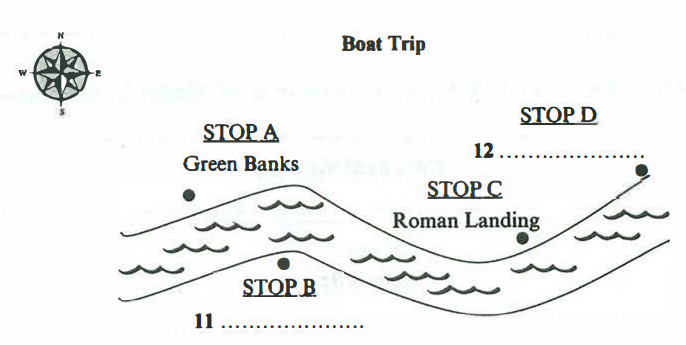
    Cambridge IELTS 7 Listening Test 2 Boat trip road map
    Questions 13-18

    Complete the table below.

    Write NO MORE THAN TWO WORDS OR A NUMBER.

    AttractionFurther information
    STOP A:
    Main booking office
    First boat: 8 am
    Last boat: (13)………….pm
    Palace– has lovely (14)……………..
    STOP B:(15)……………..– has good (16)……………….of city centre
    STOP C:Museum– bookshop specializing in the (17)………………of the local area
    STOP D:Entertainment Complex(18)……………….cinema
    – bowling alley
    – video games arcade
    Questions 19 and 20

    Write NO MORE THAN THREE WORDS AND/OR A NUMBER for each answer.

    1. How often do the Top Bus Company tours run? 
    2. Where can you catch a Number One Sightseeing Tour from? 

    Section 3: Questions 21-26

    Questions 21-26

    Choose the correct letter A, B or C.

    1. The Antarctic Centre was established in Christchurch because
      1. New Zealand is a member of the Antarctic Treaty
      2. Christchurch is geographically well positioned
      3. the climate of Christchurch is suitable
    2. One role of the Antarctic Centre is to
      1. provide expeditions with suitable equipment
      2. provide researchers with financial assistance
      3. ensure that research is internationally relevant
    3. The purpose of the Visitors’ Centre is to
      1. provide accommodation
      2. run training sessions
      3. show people what Antarctica is like
    4. Dr Merrywhether says that Antarctica is
      1. unlike any other country
      2.  extremely beautiful
      3. too cold for tourists
    5. According to Dr Merrywhether, Antarctica is very cold because
      1. of the shape of the continent
      2. it is surrounded by a frozen sea
      3. it is an extremely dry continent
    6. Dr Merrywhether thinks Antarctica was part of another continent because
      1. he has done his own research in the area
      2. there is geological evidence of this
      3. it is very close to South America
    Questions 27 and 28

    Complete the table below.

    Write ONE WORD OR TWO NUMBERS.

    ANTARCTIC TREATY

    DateEvent
    1870polar search meeting
    (27)……………to………….1st international polar year
    1957Antarctic treaty was proposed
    1959Antarctic treaty was (28)…………………….
    Questions 29 and 30

    Choose TWO letters A-E.

    Which TWO achievements of the Antarctic Treaty are mentioned by the speakers?

    1. no military use
    2.  animals protected
    3.  historic sites reserved
    4.  no nuclear testing
    5.  fishing rites protected

    Section 4: Questions 31-40

    Questions 31-35

    Choose the correct letter A, B or C.

    Left and Right Handedness in Sport

    1. Anita first felt the Matthews article was of value when she realised
      1. how it would help her difficulties with left-handedness
      2. the relevance of connections he made with music
      3. the impressive size of his research project
    2. Anita feels that the findings on handedness will be of value in
      1. helping sportspeople identify their weaknesses
      2. aiding sportspeople as they plan tactics for each game
      3. developing suitable training programmes for sportspeople
    3. Anita feels that most sports coaches
      1. know nothing about the influence of handedness
      2. focus on the wrong aspects of performance
      3. underestimate what science has to offer sport
    4. A German study showed there was greater ‘mixed handedness’ in musicians who
      1. started playing instruments in early youth
      2. Blplay a string instrument such as the violin
      3. practise a great deal on their instrument
    5. Studies on ape behaviour show that
      1. apes which always use the same hand to get food are most successful
      2. apes have the same proportion of left- and right-handers as humans
      3. more apes are left-handed than right-handed
    Questions 36-40

    Complete the table below.

    Write NO MORE THAN TWO WORDS OR A NUMBER.

    SportBest lateralityComments
    Hockeymixed laterality– hockey stick has to be used in (36)……………
    – mixed-handed players found to be much more (37)……………than others
    Tennissingle laterality– gives a larger relevant field of (38)…………..
    – cross lateral players make (39)……………….too late
    Gymnasticscross laterality– gymnasts’ (40)………………..is important for performances
    Cambridge IELTS 7 Listening Test 2 Section 1 Answers
    1. 27 bank road
    2. (a) dentist
    3. sable
    4. northern star
    5. stolen
    6. Paynter
    7. brother-in-law
    8. (travel(ling/ing)) (to) work
    9. red flag
    10. 450
    Cambridge IELTS 7 Listening Test 2 Section 2 Answers
    1. city bridge
    2. newton
    3. 6.30
    4. (formal) garden
    5. (tower) restaurant
    6. view(s)
    7. history
    8. 7 screen
    9. every 20 minutes
    10. (from/ the) Central Station
    Cambridge IELTS 7 Listening Test 2 Section 3 Answers
    1. B
    2. A
    3. C
    4. B
    5. A
    6. B
    7. 1882 (to / -) (18)83
    8. signed
    9. A or D (In either order)
    10. A or D (In either order)
    Cambridge IELTS 7 Listening Test 2 Section 4 Answers
    1. C
    2. B
    3. C
    4. A
    5. A
    6. 2 directions
    7. confident
    8. lvision
    9. corrections
    10. balance
  • Cambridge IELTS 2 Listening Test 3

    Section 1: Questions 1-10

    Questions 1-4
    1. The respondent works in
      1. the professions
      2. business
      3. other
    2. The respondent has a salary of
      1. £ 0-15,000 a year
      2. £ 15,000-35,000 a year
      3. over £35,000 a year
    3. The respondent watched TV for
      1. relaxation
      2. entertainment
      3. information
    4. Every day the respondent watches TV for
      1. 30 min – 1 hour
      2. 1 hour – 2 hours
      3. more than 2 hours
    Questions 5-7

    Choose TWO letters A-E

    1. The respondent mainly watches TV
      1. in the early morning
      2. around midday
      3. in the afternoon
      4. in the early evening
      5. at night
    2. 6. On the new channel the respondent would like to see more
      1. children’s programmes
      2. documentaries
      3. local service programmes
      4. travel programmes
      5. health programmes
    3. The respondent would advise the new channel to
      1. spend more money on drama
      2. train their broadcasters to higher standards
      3. improve sound quality
      4. broadcast interviews with famous people
      5. talk more to customers
    Questions 8-10

    Circle the correct letter A-C.

    1. The respondent feels that adverts should occur only
      1. 10 minutes
      2. 15 minutes
      3. 20 minutes
    2. The respondent would like to attend special promotions if
      1. expenses are paid
      2. he is invited specially
      3. they are held locally
    3. The respondent would like to receive
      1. no mail
      2. requested mail
      3. all mail

    Section 2: Questions 11-14

    Questions 11-14

    Circle FOUR letters A-G.

    Which FOUR activities of the Union are mentioned by the speaker?

    1. raising money for good causes
    2. political campaigning
    3. running a new agency
    4. running a supermarket
    5. providing cheap tickets
    6. helping with accommodation
    7. providing catering services
    Questions 15 and 16

    Circle TWO letters A-E.

    Which TWO of the following can you get advice about from the Union?

    1. immigration
    2. grants
    3. medical problems
    4. personal problems
    5. legal matters
    Questions 17-20

    Write the appropriate letters A-C against questions 17-20.

    What are the locations of the following places in Radford?

    1. part of the Metro Tower Building
    2. in the main square in the centre of the town
    3. some distance from the centre of the town
    1. the hi-tech fitness centre 
    2. the ice rink 
    3. the new cinema 
    4. the Theatre Royal 

    Section 3: Questions 21-30

    Questions 21-23

    Complete the notes below.

    Write NO MORE THAN THREE WORDS OR A NUMBER for each answer.

    DISSERTATION INFORMATION
    Hand-in-date: (21) ……………………….
    Length: (22) ………………………. to 
    Extra programme offered on: (23) ……………………….

    Question 24-26

    Complete the table below.

    DISSERTATION TIMETABLE

    DateAction
    31 Januarybasic bibliography
    7 February(24)………………..
    February – March(25)……………….
    (26)……………….to……………….write up work
    21 Mayhand in work
    Questions 27-30

    What is Dr Simon’s opinions on the following points?

    Tick column A if he is in favour
    Tick column B if he has no strong opinion either way
    Tick column C if he is against

    ABC
    27. Buying a computer…..…..…..
    28. Reading previous year’s dissertation…..…..…..
    29. Using questionnaires as main research instrument…..…..…..
    30. Interviewing tutors…..…..…..

    Section 4: Questions 31-40

    Questions 31-37

    Circle the correct letters A-C.

    1. The driest continent is
      1. Australia
      2. Africa
      3. Antarctica
    2. The evaporation rate in Australia is
      1. lower than Africa
      2. higher than Africa
      3. about the same as Africa
    3. Rainfall in Australia hardly penetrates the soil because
      1. the soil is too hard
      2. the soil is too hot
      3. plants use it up
    4. In sandy soils water can
      1. evaporate quickly
      2. seep down to rock
      3. wash the soil away
    5. Water is mainly pumped up for
      1. people to drink
      2. animals to drink
      3. watering crops
    6. Natural springs are located
      1. in unexplored parts of Australia
      2. quite commonly over all Australia
      3. in a few areas of Australia
    7. Underground water supplies
      1. 18% of Australia’s water
      2. 48% of Australia’s water
      3. 80% of Australia’s water
    Questions 38-40

    Circle THREE letters A-E.

    Which THREE of the following uses of dam water are mentioned?

    1. providing water for livestock
    2. watering farmland
    3. providing water for industry
    4. controlling flood water
    5. producing hydro-electric power
    Cambridge IELTS 2 Listening Test 3 Section 1 Answers
    1. B
    2. C
    3. A
    4. B
    5. A, E
    6. A, C
    7. C, E
    8. B
    9. C
    10. B
    Cambridge IELTS 2 Listening Test 3 Section 2 Answers
    1. A
    2. C
    3. E
    4. G
    5. B
    6. E
    7. C
    8. A
    9. A
    10. B
    Cambridge IELTS 2 Listening Test 3 Section 3 Answers
    1. 21 May
    2. 18000-20000
    3. research methods
    4. plan
    5. research
    6. march to may
    7. A
    8. A
    9. C
    10. B
    Cambridge IELTS 2 Listening Test 3 Section 4 Answers
    1. C
    2. B
    3. C
    4. B
    5. B
    6. C
    7. A
    8. B
    9. D
    10. E


  • Cambridge IELTS 13 Listening Test 2

    Section 1: Questions 1-10

    Complete the notes below.

    Write ONE WORD OR A NUMBER.

    South city cycling club

    Name of club secretary: Jim Hunter

    Membership
    • Full membership costs $260; this covers cycling and (1) ………………………. all over Australia
    • Recreational membership costs $108
    • Cost of membership includes the club fee and ………………………. (2) 
    • The club kit is made by a company called (3) ……………………….

    Training rides
    • Chance to improve cycling skills and fitness
    • Level B: speed about (4) ………………………. kph
    • Weekly sessions
    o Tuesdays at 5.30 am, meet at the (5) ……………………….
    o Thursdays at 5.30 am, meet at the entrance to the (6) ……………………….

    Further information
    • Rides are about an hour and half
    • Members often have (7) ……………………….  together afterwards
    • There is not always a (8) ……………………….  with the group on these rides
    • Check and print the (9) ………………………. on the website beforehand
    • Bikes must have (10) ……………………….

    Section 2: Questions 11-20

    Questions 11-16

    Choose the correct letter A, B or C.

    Information on company volunteering projects

    1. How much time for volunteering does the company allow per employee?
      1. two hours per week
      2. one day per month
      3. 8 hours per year
    2. In feedback almost all employees said that volunteering improved their
      1. chances of promotion
      2. job satisfaction
      3. relationships with colleagues
    3. Last year some staff helped unemployed people with their
      1. literacy skills
      2. job applications
      3. communication skills
    4. This year the company will start a new volunteering project with a local
      1. school
      2. park
      3. charity
    5. Where will the Digital inclusion Day be held?
      1. at the company’s training facility
      2. at a college
      3. in a community centre
    6. What should staff do if they want to take part in the Digital Inclusion Day?
      1. fill in a form
      2. attend a training workshop
      3. get permission from their managers
    Questions 17 and 18

    Choose TWO letters A-E.

    Which TWO things are mentioned about the participants on the last Digital Inclusion Day?

    1. they were all over 70
    2. they never used their computer
    3. their phones were mostly old fashioned
    4. they only used their phones for making calls
    5. they initially showed little interest
    Questions 19 and 20

    Choose TWO letters A-E.

    What TWO activities on the last Digital Inclusion Day did participants describe as useful?

    1. learning to use tablets
    2. communicating with family
    3. shopping online
    4. playing online games
    5. sending emails

    Section 3: Questions 21-30

    Questions 21-25

    Choose the correct letter A, B or C.

    Planning a presentation on nanotechnology

    1. Russ says that his difficulty in planning the presentation is due to
      1. his lack of knowledge about the topic.
      2. his uncertainty about what he should try to achieve.
      3. the short time that he has for preparation.
    2. Russ and his tutor agree that his approach in the presentation will be
      1. to concentrate on how nanotechnology is used in one field.
      2. to follow the chronological development of nanotechnology.
      3. to show the range of applications of nanotechnology.
    3. In connection with slides, the tutor advises Russ to
      1. talk about things that he can find slides to illustrate.
      2. look for slides to illustrate the points he makes.
      3. consider omitting slides altogether.
    4. They both agree that the best way for Russ to start his presentation is
      1. to encourage the audience to talk.
      2. to explain what Russ intends to do.
      3. to provide an example.
    5. What does the tutor advise Russ to do next while preparing his presentation?
      1. summarise the main point he wants to make
      2. read the notes he has already made
      3. list the topics he wants to cover
    Questions 26-30

    Choose FIVE answers from the box and write the correct letter A-G next to questions 26-30.

    What comments do the speakers make about each of the following aspects of Russ’s previous presentation?

    Comments

    1. lacked a conclusion
    2. useful in the future
    3. not enough
    4. sometimes distracting
    5. showed originality
    6. covered a wide range
    7. not too technical

    Aspects of Russ’s previous presentation

    1. structure 
    2. eye contact 
    3. body language 
    4. choice of words 
    5. handouts 

    Section 4: Questions 31-40

    Complete the notes below.

    Write ONE WORD ONLY for each answer.

    Episodic memory
    • The ability to recall details e.g. the time and (31) ………………………. of past events
    • Different to semantic memory- the ability to remember general information about the
    (32)
    ……………………….  which does not involve recalling (33) ………………………. information

    Forming episodic memories involves three steps:
    Encoding
    • Involves receiving and processing information
    • The more (34) ………………………. given to an event the more successfully it can be encoded
    • To remember a (35) ………………………. it is useful to have a strategy for encoding such information

    Consolidation
    • How memories are strengthened and stored
    • Most effective when memories can be added to a (36) ……………………….
    • The (37)  ………………………. of retrieval affects the strength of memories

    Retrieval
    • Memory retrieval often depends on using a prompt e.g. the (38)  ………………………. of an object near to the place where you left your car

    Episodic memory impairments
    • These affect people with a wide range of medical conditions
    • Games which stimulate the (39)  ………………………. have been found to help people with schizophrenia
    • Children with autism may have difficulty forming episodic memories – possibly because their concept of the (40)  ………………………. may be absent
    • Memory training may help autistic children to develop social skills

    Cambridge IELTS 13 Listening Test 2 Section 1 Answers
    1. races
    2. insurance
    3. Jerriz
    4. 25
    5. stadium
    6. park
    7. coffee
    8. leader
    9. route
    10. lights
    Cambridge IELTS 13 Listening Test 2 Section 2 Answers

    1. 11. C
    2. 12. B
    3. 13. C
    4. 14. B
    5. 15. B
    6. 16. A
    7. 17. C
    8. 18. E
    9. 19. B
    10. 20. D
    Cambridge IELTS 13 Listening Test 2 Section 3 Answers
    1. 21. B
    2. 22. A
    3. 23. C
    4. 24. C
    5. 25. A
    6. 26. A
    7. 27. C
    8. 28. D
    9. 29. G
    10. 30. B
    Cambridge IELTS 13 Listening Test 2 Section 4 Answers

    1. 31. location
    2. 32. world
    3. 33. personal
    4. 34. attention
    5. 35. name
    6. 36. network
    7. 37. frequency
    8. 38. color
    9. 39. brain
    10. 40. self