Category: Academic Reading Tests

  • Cambridge IELTS 10 Academic Reading Test 1

    Reading Passge 1

    stepwells

    During the sixth and seventh centuries, the inhabitants of the modern-day states of Gujarat and Rajasthan in north-western India developed a method of gaining access to clean, fresh groundwater during the dry season for drinking, bathing, watering animals and irrigation. However, the significance of this invention – the stepwell – goes beyond its utilitarian application.

    Unique to this region, stepwells are often architecturally complex and vary widely in size and shape. During their heyday, they were places of gathering, of leisure and relaxation and of worship for villagers of all but the lowest classes. Most stepwells are found dotted round the desert areas of Gujarat (where they are called vav) and Rajasthan (where they are called baori), while a few also survive in Delhi. Some were located in or near villages as public spaces for the community; others were positioned beside roads as resting places for travellers.

    As their name suggests, stepwells comprise a series of stone steps descending from ground level to the water source (normally an underground aquifer) as it recedes following the rains. When the water level was high, the user needed only to descend a few steps to reach it; when it was low, several levels would have to be negotiated.

    Some wells are vast, open craters with hundreds of steps paving each sloping side, often in tiers. Others are more elaborate, with long stepped passages leading to the water via several storeys. Built from stone and supported by pillars, they also included pavilions that sheltered visitors from the relentless heat. But perhaps the most impressive features are the intricate decorative sculptures that embellish many stepwells, showing activities from fighting and dancing to everyday acts such as women combing their hair or churning butter.

    Down the centuries, thousands of wells were constructed throughout northwestern India, but the majority have now fallen into disuse; many are derelict and dry, as groundwater has been diverted for industrial use and the wells no longer reach the water table. Their condition hasn’t been helped by recent dry spells: southern Rajasthan suffered an eight-year drought between 1996 and 2004.

    However, some important sites in Gujarat have recently undergone major restoration, and the state government announced in June last year that it plans to restore the stepwells throughout the state.

    In Patan, the state’s ancient capital, the stepwell of Rani Ki Vav (Queen’s Stepwell) is perhaps the finest current example. It was built by Queen Udayamati during the late 11th century, but became silted up following a flood during the 13th century. But the Archaeological Survey of India began restoring it in the 1960s, and today it is in pristine condition. At 65 metres long, 20 metres wide and 27 metres deep, Rani Ki Vav features 500 sculptures carved into niches throughout the monument. Incredibly, in January 2001, this ancient structure survived an earthquake that measured 7.6 on the Richter scale.

    Another example is the Surya Kund in Modhera, northern Gujarat, next to the Sun Temple, built by King Bhima I in 1026 to honour the sun god Surya. It actually resembles a tank (kund means reservoir or pond) rather than a well, but displays the hallmarks of stepwell architecture, including four sides of steps that descend to the bottom in a stunning geometrical formation. The terraces house 108 small, intricately carved shrines between the sets of steps.

    Rajasthan also has a wealth of wells. The ancient city of Bundi, 200 kilometres south of Jaipur, is renowned for its architecture, including its stepwells. One of the larger examples is Raniji Ki Baori, which was built by the queen of the region, Nathavatji, in 1699. At 46 metres deep, 20 metres wide and 40 metres long, the intricately carved monument is one of 21 baoris commissioned in the Bundi area by Nathavatji.

    In the old ruined town of Abhaneri, about 95 kilometres east of Jaipur, is Chand Baori, one of India’s oldest and deepest wells; aesthetically it’s perhaps one of the most dramatic. Built in around 850 AD next to the temple of Harshat Mata, the baori comprises hundreds of zigzagging steps that run along three of its sides, steeply descending 11 storeys, resulting in a striking pattern when seen from afar. On the fourth side, verandas which are supported by ornate pillars to overlook the steps.

    Still in public use is Neemrana Ki Baori, located just off the Jaipur-Delhi highway. Constructed in around 1700, it is nine storeys deep, with the last two being underwater. At ground level, there are 86 colonnaded openings from where the visitor descends 170 steps to the deepest water source.

    Today, following years of neglect, many of these monuments to medieval engineering have been saved by the Archaeological Survey of India, which has recognised the importance of preserving them as part of the country’s rich history. Tourists flock to wells in far-flung corners of northwestern India to gaze in wonder at these architectural marvels from hundreds of years ago, which serve as a reminder of both the ingenuity and artistry of ancient civilisations and of the value of water to human existence.

    Questions 1-5

    Do the following statements agree with the information given in Reading Passage 1?

    In boxes 1-5 write:

    • TRUE                               if the statement agrees with the information
    • FALSE                             if the statement contradicts the information
    • NOT GIVEN                  if there is no information on this
    1. Examples of ancient stepwells can be found all over the world.
    2. Stepwells had a range of functions, in addition to those related to water collection.
    3. The few existing stepwells in Delhi are more attractive than those found elsewhere.
    4. It took workers many years to build the stone steps characteristic of stepwells.
    5. The number of steps above the water level in a stepwell altered during the course of a year.
    Questions 6-8

    Answer the questions below.

    Choose ONE WORD ONLY from the passage.

    1. Which part of some stepwells provided shade for people?
    2. What type of serious climatic event, which took part in southern Rajasthan is mentioned in the article?
    3. Who are frequent visitors to stepwells nowadays?
    Questions 9-13

    Complete the table below.

    Choose ONE WORD OR A NUMBER from the passage.

    StepwellDateFeaturesOther notes
    Rani ki vavlate 11th centuryas many as 500 sculpture decorate the monumentrestored in the 1960s, excellent condition despite the (9)………………….of 2001
    Surya kund1026steps on the (10)…………….produce a geometrical patternlooks more like a (11)………………….than a well
    Rani ki baori1699intricately carved monumentone of 21 baoris in the area commissioned by Queen Nathavatji
    Chand baori850 ADsteps taken you down 11 storeys to the bottomold deep and very dramatic, has (12)……………which provide a view of the steps
    Neemrana ki baori1700has two (13)……………..levelsused by public today

    Reading Passage 2

    European Transport Systems 1990-2010

    A It is difficult to conceive of vigorous economic growth without an efficient transport system. Although modern information technologies can reduce the demand for physical transport by facilitating teleworking and teleservices, the requirement for transport continues to increase. There are two key factors behind this trend. For passenger transport, the determining factor is the spectacular growth in car use. The number of cars on European Union (EU] roads saw an increase of three million cars each year from 1990 to 2010, and in the next decade the EU will see a further substantial increase in its fleet.

    B As far as goods transport is concerned, growth is due to a large extent to changes in the European economy and its system of production. In the last 20 years, as internal frontiers have been abolished, the EU has moved from a ‘stock’ economy to a ‘flow’ economy. This phenomenon has been emphasised by the relocation of some industries, particularly those which are labour intensive, to reduce production costs, even though the production site is hundreds or even thousands of kilometres away from the final assembly plant or away from users.

    C The strong economic growth expected in countries which are candidates for entry to the EU will also increase transport flows, in particular road haulage traffic. In 1998, some of these countries already exported more than twice their 1990 volumes and imported more than five times their 1990 volumes. And although many candidate countries inherited a transport system which encourages rail, the distribution between modes has tipped sharply in favour of road transport since the 1990s. Between 1990 and 1998, road haulage increased by 19.4%, while during the same period rail haulage decreased by 43.5%, although – and this could benefit the enlarged EU – it is still on average at a much higher level than in existing member states.

    D However, a new imperative – sustainable development – offers an opportunity for adapting the EU’s common transport policy. This objective, agreed by the Gothenburg European Council, has to be achieved by integrating environmental considerations into Community policies, and shifting the balance between modes of transport lies at the heart of its strategy. The ambitious objective can only be fully achieved by 2020, but proposed measures are nonetheless a first essential step towards a sustainable transport system which will ideally be in place in 30 years’ time, that is by 2040.

    E In 1998, energy consumption in the transport sector was to blame for 28% of emissions of C02, the leading greenhouse gas. According to the latest estimates, if nothing is done to reverse the traffic growth trend, CO2 emissions from transport can be expected to increase by around 50% to 1,113 billion tonnes by 2020, compared with the 739 billion tonnes recorded in 1990. Once again, road transport is the main culprit since it alone accounts for 84% of the CO2 emissions attributable to transport. Using alternative fuels and improving energy efficiency is thus both an ecological necessity and a technological challenge.

    F At the same time greater efforts must be made to achieve a modal shift. Such a change cannot be achieved overnight, all the less so after over half a century of constant deterioration in favour of road. This has reached such a pitch that today rail freight services are facing marginalisation, with just 8% of market share, and with international goods trains struggling along at an average speed of 18km/h. Three possible options have emerged.

    G The first approach would consist of focusing on road transport solely through pricing. This option would not be accompanied by complementary measures in the other modes of transport. In the short term it might curb the growth in road transport through the better loading ratio of goods vehicles and occupancy rates of passenger vehicles expected as a result of the increase in the price of transport. However, the lack of measures available to revitalise other modes of transport would make it impossible for more sustainable modes of transport to take up the baton.

    H The second approach also concentrates on road transport pricing but is accompanied by measures to increase the efficiency of the other modes [better quality of services, logistics, technology). However, this approach does not include investment in new infrastructure, nor does it guarantee better regional cohesion, It could help to achieve greater uncoupling than the first approach, but road transport would keep the lion’s share of the market and continue to concentrate on saturated arteries, despite being the most polluting of the modes. It is therefore not enough to guarantee the necessary shift of the balance.

    I The third approach, which is not new, comprises a series of measures ranging from pricing to revitalising alternative modes of transport and targeting investment in the trans-European network. This integrated approach would allow the market shares of the other modes to return to their 1998 levels and thus make a shift of balance. It is far more ambitious than it looks, bearing in mind the historical imbalance in favour of roads for the last fifty years, but would achieve a marked break in the link between road transport growth and economic growth, without placing restrictions on the mobility of people and goods.

    Questions 14-21

    Reading Passage 2 has nine paragraphs A-I.

    Choose the correct heading for paragraphs A-E and G-I from the list of headings below.

    List of headings

    1. A fresh and important long-term goal
    2. Charging for roads and improving other transport methods
    3. Changes affecting the distances goods may be transported
    4. Taking all the steps necessary to change transport patterns
    5. The environmental costs of road transport
    6. The escalating cost of rail transport
    7. The need to achieve transport rebalance
    8. The rapid growth of private transport
    9. Plans to develop major road networks
    10. Restricting road use through charging policies alone
    11. Transport trends in countries awaiting EU admission

    Example

    Paragraph F  answer  vii
    1. Paragraph A
    2. Paragraph B
    3. Paragraph C
    4. Paragraph D
    5. Paragraph E
    6. Paragraph G
    7. Paragraph H
    8. Paragraph I
    Questions 22-26

    Do the following statements agree with the information given in Reading Passage 2?

    In boxes 22-26 on your answer sheet, write

    • TRUE                        if the statement agrees with the information
    • FALSE                      if the statement contradicts the information
    • NOT GIVEN           if there is no information on this
    1. The need for transport is growing, despite technological developments.
    2. To reduce production costs, some industries have been moved closer to their relevant consumers.
    3. Cars are prohibitively expensive in some EU candidate countries.
    4. The Gothenburg European Council was set up 30 years ago.
    5. By the end of this decade, CO2 emissions from transport are predicted to reach 739 billion tonnes.

    Reading Passage 3

    The Psychology Of Innovation

    Innovation is key to business survival, and companies put substantial resources into inspiring employees to develop new ideas. There are, nevertheless, people working in luxurious, state-of-the-art centres designed to stimulate innovation who find that their environment doesn’t make them feel at all creative. And there are those who don’t have a budget, or much space, but who innovate successfully.

    For Robert B. Cialdini, Professor of Psychology at Arizona State University, one reason that companies don’t succeed as often as they should is that innovation starts with recruitment. Research shows that the fit between an employee’s values and a company’s values makes a difference to what contribution they make and whether, two years after they join, they’re still at the company. Studies at Harvard Business School show that, although some individuals may be more creative than others, almost every individual can be creative in the right circumstances.

    One of the most famous photographs in the story of rock’n’roll emphasises Cialdini’s views. The 1956 picture of singers Elvis Presley, Carl Perkins, Johnny Cash and Jerry Lee Lewis jamming at a piano in Sun Studios in Memphis tells a hidden story. Sun’s ‘million-dollar quartet’ could have been a quintet. Missing from the picture is Roy Orbison, a greater natural singer than Lewis, Perkins or Cash. Sam Phillips, who owned Sun, wanted to revolutionise popular music with songs that fused black and white music, and country and blues. Presley, Cash, Perkins and Lewis instinctively understood Phillips’s ambition and believed in it. Orbison wasn’t inspired by the goal, and only ever achieved one hit with the Sun label.

    The value fit matters, says Cialdini, because innovation is, in part, a process of change, and under that pressure we, as a species, behave differently, ‘When things change, we are hard-wired to play it safe.’ Managers should therefore adopt an approach that appears counterintuitive – they should explain what stands to be lost if the company fails to seize a particular opportunity. Studies show that we invariably take more gambles when threatened with a loss than when offered a reward.

    Managing innovation is a delicate art. It’s easy for a company to be pulled in conflicting directions as the marketing, product development, and finance departments each get different feedback from different sets of people. And without a system which ensures collaborative exchanges within the company, it’s also easy for small ‘pockets of innovation’ to disappear. Innovation is a contact sport. You can’t brief people just by saying, ‘We’re going in this direction and I’m going to take you with me.’

    Cialdini believes that this ‘follow-the- leader syndrome’ is dangerous, not least because it encourages bosses to go it alone. ‘It’s been scientifically proven that three people will be better than one at solving problems, even if that one person is the smartest person in the field.’ To prove his point, Cialdini cites an interview with molecular biologist James Watson. Watson, together with Francis Crick, discovered the structure of DNA, the genetic information carrier of all living organisms. ‘When asked how they had cracked the code ahead of an array of highly accomplished rival investigators, he said something that stunned me. He said he and Crick had succeeded because they were aware that they weren’t the most intelligent of the scientists pursuing the answer. The smartest scientist was called Rosalind Franklin who, Watson said, “was so intelligent she rarely sought advice”.’

    Teamwork taps into one of the basic drivers of human behaviour. ‘The principle of social proof is so pervasive that we don’t even recognise it,’ says Cialdini. ‘If your project is being resisted, for example, by a group of veteran employees, ask another old-timer to speak up for it.’ Cialdini is not alone in advocating this strategy. Research shows that peer power, used horizontally not vertically, is much more powerful than any boss’s speech.

    Writing, visualising and prototyping can stimulate the flow of new ideas. Cialdini cites scores of research papers and historical events that prove that even something as simple as writing deepens every individual’s engagement in the project. It is, he says, the reason why all those competitions on breakfast cereal packets encouraged us to write in saying, in no more than 10 words: ‘I like Kellogg’s Corn Flakes because….’ The very act of writing makes us more likely to believe it.

    Authority doesn’t have to inhibit innovation but it often does. The wrong kind of leadership will lead to what Cialdini calls ‘captainitis, the regrettable tendency of team members to opt out of team responsibilities that are properly theirs’. He calls it captainitis because, he says, ‘crew members of multipilot aircraft exhibit a sometimes deadly passivity when the flight captain makes a clearly wrong-headed decision’. This behaviour is not, he says, unique to air travel, but can happen in any workplace where the leader is overbearing.

    At the other end of the scale is the 1980s Memphis design collective, a group of young designers for whom ‘the only rule was that there were no rules’. This environment encouraged a free interchange of ideas, which led to more creativity with form, function, colour and materials that revolutionised attitudes to furniture design.

    Many theorists believe the ideal boss should lead from behind, taking pride in collective accomplishment and giving credit where it is due. Cialdini says:
    ‘Leaders should encourage everyone to contribute and simultaneously assure all concerned that every recommendation is important to making the right decision and will be given full attention.’ The frustrating thing about innovation is that there are many approaches, but no magic formula. However, a manager who wants to create a truly innovative culture can make their job a lot easier by recognising these psychological realities.

    Questions 27-30

    Choose the correct letter, A, B, C or D.

    1. The example of the ‘million-dollar quartet’ underlines the writer’s point about
      1. recognising talent
      2. working as a team
      3. having a shared objective
      4. being an effective leader
    2. James Watson suggests that he and Francis Crick won the race to discover the DNA code because they
      1. were conscious of their own limitations
      2. brought complementary skills to their partnership
      3. were determined to outperform their brighter rivals
      4. encouraged each other to realise their joint ambition
    3. The writer mentions competitions on breakfast cereal packets as an example of how to
      1. inspire creative thinking
      2. generate concise writing
      3. promote loyalty to a group
      4. strengthen commitment to an idea
    4. In the last paragraph, the writer suggests that it is important for employees to
      1. be aware of their company’s goals
      2. feel that their contributions are valued
      3. have respect for their co-workers’ achievements
      4. understand why certain management decisions are made
    Questions 31-35

    Complete each sentence with the correct ending A-G below.

    1. Employees whose values match those of their employers are more likely to
    2. At times of change, people tend to
    3. If people are aware of what they might lose, they will often
    4. People working under a dominant boss are liable to
    5. Employees working in organisations with few rules are more likely to
    1. take chances
    2. share their ideas
    3. become competitive
    4. get promotion
    5. avoid risk
    6. ignore their duties
    7. remain in their jobs
    Questions 36-40

    Do the following statements agree with the claims of the writer in Reading Passage 3?

    In boxes 36-40 on your answer sheet, write

    • YES                             if the statement agrees with the claims of the writer
    • NO                               if the statement contradicts the claims of the writer
    • NOT GIVEN            if it is impossible to say what the writer thinks about this
    1. The physical surroundings in which a person works play a key role in determining their creativity.
    2. Most people have the potential to be creative.
    3. Teams work best when their members are of equally matched intelligence.
    4. It is easier for smaller companies to be innovative.
    5. A manager’s approval of an idea is more persuasive than that of a colleague.
    Reading Passage 1 stepwells Answers
    1. false
    2. true
    3. not given
    4. not given
    5. true
    6. pavilions
    7. drought
    8. tourists
    9. earthquakes
    10. 4 sides
    11. tank
    12. verandas
    13. underwater
    Reading Passage 2 European transport systems 1990-2010 Answers
    1. viii
    2. iii
    3. xi
    4. i
    5. v
    6. x
    7. ii
    8. iv
    9. true
    10. false
    11. not given
    12. not given
    13. false
    Reading Passage 3 the psychology of innovation Answers
    1. C
    2. A
    3. D
    4. B
    5. G
    6. E
    7. A
    8. F
    9. B
    10. no
    11. yes
    12. not given
    13. not given
    14. no
  • Cambridge IELTS 6 Academic Reading Test 1

    Cambridge IELTS 6 Academic Reading Test 1

    Reading Passage 1

    Australia’s Sporting Success

    Australia's Sporting Success Reading Passage 1 with Answers and Explanation. IELTS Academic Reading Passage Cambridge IELTS 6 Test 1
    Part of the image by: pixabay.com
    1. They play hard, they play often, and they play to win. Australian sports teams win more than their fair share of titles, demolishing rivals with seeming ease. How do they do it? A big part of the secret is an extensive and expensive network of sporting academies underpinned by science and medicine. At the Australian Institute of Sport (AIS), hundreds of youngsters and pros live and train under the eyes of coaches. Another body, the Australian Sports Commission (ASC), finances programmes of excellence in a total of 96 sports for thousands of sportsmen and women. Both provide intensive coaching, training facilities and nutritional advice.
    2. Inside the academies, science takes centre stage. The AIS employs more than 100 sports scientists and doctors, and collaborates with scores of others in universities and research centres. AIS scientists work across a number of sports, applying skills learned in one – such as building muscle strength in golfers – to others, such as swimming and squash. They are backed up by technicians who design instruments to collect data from athletes. They all focus on one aim: winning. ‘We can’t waste our time looking at ethereal scientific questions that don’t help the coach work with an athlete and improve performance.’ says Peter Fricker, chief of science at AIS.
    3. A lot of their work comes down to measurement – everything from the exact angle of a swimmer’s dive to the second-by-second power output of a cyclist. This data is used to wring improvements out of athletes. The focus is on individuals, tweaking performances to squeeze an extra hundredth of a second here, an extra millimetre there. No gain is too slight to bother with. It’s the tiny, gradual improvements that add up to world-beating results. To demonstrate how the system works, Bruce Mason at AIS shows off the prototype of a 3D analysis tool for studying swimmers. A wire-frame model of a champion swimmer slices through the water, her arms moving in slow motion. Looking side-on, Mason measures the distance between strokes. From above, he analyses how her spine swivels. When fully developed, this system will enable him to build a biomechanical profile for coaches to use to help budding swimmers. Mason’s contribution to sport also includes the development of the SWAN (SWimming ANalysis) system now used in Australian national competitions. It collects images from digital cameras running at 50 frames a second and breaks down each part of a swimmer’s performance into factors that can be analysed individually – stroke length, stroke frequency, the average duration of each stroke, velocity, start, lap and finish times, and so on. At the end of each race, SWAN spits out data on each swimmer.
    4. ‘Take a look.’ says Mason, pulling out a sheet of data. He points out the data on the swimmers in second and third place, which shows that the one who finished third actually swam faster. So why did he finish 35 hundredths of a second down? ‘His turn times were 44 hundredths of a second behind the other guy.’ says Mason. ‘If he can improve on his turns, he can do much better.’ This is the kind of accuracy that AIS scientists’ research is bringing to a range of sports. With the Cooperative Research Centre for Micro Technology in Melbourne, they are developing unobtrusive sensors that will be embedded in an athlete’s clothes or running shoes to monitor heart rate, sweating, heat production or any other factor that might have an impact on an athlete’s ability to run. There’s more to it than simply measuring performance. Fricker gives the example of athletes who may be down with coughs and colds 11 or 12 times a year. After years of experimentation, AIS and the University of Newcastle in New South Wales developed a test that measures how much of the immune-system protein immunoglobulin A is present in athletes’ saliva. If IgA levels suddenly fall below a certain level, training is eased or dropped altogether. Soon, IgA levels start rising again, and the danger passes. Since the tests were introduced, AIS athletes in all sports have been remarkably successful at staying healthy
    5. Using data is a complex business. Well before a championship, sports scientists and coaches start to prepare the athlete by developing a ‘competition model’, based on what they expect will be the winning times. ‘You design the model to make that time.’ says Mason. ‘A start of this much, each free-swimming period has to be this fast, with a certain stroke frequency and stroke length, with turns done in these times’. All the training is then geared towards making the athlete hit those targets, both overall and for each segment of the race. Techniques like these have transformed Australia into arguably the world’s most successful sporting nation.
    6. Of course, there’s nothing to stop other countries copying – and many have tried. Some years ago, the AIS unveiled coolant-lined jackets for endurance athletes. At the Atlanta Olympic Games in 1996, these sliced as much as two per cent off cyclists’ and rowers times. Now everyone uses them. The same has happened to the altitude tent’, developed by AIS to replicate the effect of altitude training at sea level. But Australia’s success story is about more than easily copied technological fixes, and up to now no nation has replicated its all-encompassing system.
    Questions 1-7

    Reading Passage 1 has six paragraphs, A-F.

    Which paragraph contains the following information?

    Write the correct letter A-F in boxes 1-7 on your answer sheet.

    NB You may use any letter more than once

    1. a reference to the exchange of expertise between different sports
    2. an explanation of how visual imaging is employed in investigations
    3. a reason for narrowing the scope of research activity
    4. how some AIS ideas have been reproduced
    5. how obstacles to optimum achievement can be investigated
    6. an overview of the funded support of athletes
    7. how performance requirements are calculated before an event
    Questions 8-11

    Classify the following techniques according to whether the writer states they –

    1. are currently exclusively used by Australians
    2. will be used in the future by Australians
    3. are currently used by both Australians and their rivals

    Write the correct letter A, B, C or D in boxes 8-11 on your answer sheet.

    1. cameras  
    2. sensors  
    3. protein tests  
    4. altitude tents 
    Questions 12 and 13

    Choose NO MORE THAN THREE WORDS AND/OR A NUMBER from Reading Passage 1 for each answer.

    Write your answers in boxes 12 and 13 on your answer sheet.

    1. What is produced to help an athlete plan their performance in an event?  
    2. By how much did some cyclists’ performance improve at the 1996 Olympic Games?

    Reading Passage 2

    Delivering The Goods

    Delivering The Goods Reading Passage 2 with Answers and Explanation. IELTS Academic Reading Passage Cambridge IELTS 6 Test 1
    Part of the image by: pixabay.com
    1. The vast expansion in international trade owes much to a revolution in the business of moving freight. International trade is growing at a startling pace. While the global economy has been expanding at a bit over 3% a year, the volume of trade has been rising at a compound annual rate of about twice that.Foreign products, from meat to machinery, play a more important role in almost every economy in the world, and foreign markets now tempt businesses that never much worried about sales beyond their nation’s borders.
    2. What lies behind this explosion in international commerce? The general worldwide decline in trade barriers, such as customs duties and import quotas, is surely one explanation. The economic opening of countries that have traditionally been minor players is another. But one force behind the import-export boom has passed all but unnoticed: the rapidly falling cost of getting goods to market. But one force behind the import-export boom has passed all but unnoticed: the rapidly falling cost of getting goods to market. Theoretically, in the world of trade, shipping costs do not matter. Goods, once they have been made, are assumed to move instantly and at no cost from place to place. The real world, however, is full of frictions. Cheap labour may make Chinese clothing competitive in America, but if delays in shipment tie up working capital and cause winter coats to arrive in spring, trade may lose its advantages.
    3. At the turn of the 20th century, agriculture and manufacturing were the two most important sectors almost everywhere, accounting for about 70% of total output in Germany, Italy and France, and 40-50% in America, Britain and Japan. International commerce was therefore dominated by raw materials, such as wheat, wood and iron ore, or processed commodities, such as meat and steel. But these sorts of products are heavy and bulky and the cost of transporting them relatively high.
    4. Countries still trade disproportionately with their geographic neighbours. Over time, however, world output has shitted into goods whose worth is unrelated to their size and weight. Today, it is finished manufactured products that dominate the flow of trade, and, thanks to technological advances such as lightweight components, manufactured goods themselves have tended to become lighter and less bulky. As a result, less transportation is required for every dollar’s worth of imports or exports.
    5. To see how this influences trade, consider the business of making disk drives for computers. Most of the world’s disk-drive manufacturing is concentrated in South-east Asia. This is possible only because disk drives, while valuable, are small and light and so cost little to ship. Computer manufacturers in Japan or Texas will not face hugely bigger freight bills if they import drives from Singapore rather than purchasing them on the domestic market. Distance therefore poses no obstacle to the globalisation of the disk-drive industry.
    6. This is even more true of the fast-growing information industries. Films and compact discs cost little to transport, even by aeroplane. Computer software can be ‘exported’ without ever loading it onto a ship, simply by transmitting it over telephone lines from one country to another, so freight rates and cargo-handling schedules become insignificant factors in deciding where to make the product. Businesses can locate based on other considerations, such as the availability of labour, while worrying less about the cost of delivering their output.
    7. In many countries deregulation has helped to drive the process along. But, behind the scenes, a series of technological innovations known broadly as containerisation and intermodal transportation has led to swift productivity improvements in cargo-handling. Forty years ago, the process of exporting or importing involved a great many stages of handling, which risked portions of the shipment being damaged or stolen along the way. The invention of the container crane made it possible to load and unload containers without capsizing the ship and the adoption of standard container sizes allowed almost any box to be transported on any ship. By 1967, dual-purpose ships, carrying loose cargo in the hold* and containers on the deck, were giving way to all-container vessels that moved thousands of boxes at a time.
    8. The shipping container transformed ocean shipping into a highly efficient, intensely competitive business.But getting the cargo to and from the dock was a different story. National governments, by and large, kept firmer hand on truck and railroad tariffs than on charges for ocean freight. This started changing, however, in the mid-1970s, when America began to deregulate its transportation industry. First airlines, then road hauliers and railways, were freed from restrictions on what they could carry, where they could haul it and what price they could charge. Big productivity gains resulted. Between 1985 and 1996, for example, America’s freight railways dramatically reduced their employment, trackage, and their fleets of locomotives – while increasing the amount of cargo they hauled. Europe’s railways have also shown marked, albeit smaller, productivity improvements.
    9. In America the period of huge productivity gains in transportation may be almost over, but in most countries the process still has far to go. State ownership of railways and airlines, regulation of freight rates and toleration of anti-competitive practices, such as cargo-handling monopolies, all keep the cost of shipping unnecessarily high and deter international trade. Bringing these barriers down would help the world’s economies grow even closer.
    Questions 14-17

    Reading Passage 2 has six sections, A-I.

    Write the correct letter A-I in boxes 14-17 on your answer sheet.

    Which paragraph contains the following information?

    1. a suggestion for improving trade in the future
    2. the effects of the introduction of electronic delivery
    3. the similar cost involved in transporting a product from abroad or from a local supplier
    4. the weakening relationship between the value of goods and the cost of their delivery
    Questions 18-22

    Do the following statements agree with the information given in Reading Passage 2?

    In boxes 18-22 on your answer sheet, write –

    • TRUE if the statement agrees with the information
    • FALSE if the statement contradicts the information
    • NOT GIVEN if there is no information on this
    1. International trade is increasing at a greater rate than the world economy.  
    2. Cheap labour guarantees effective trade conditions.  
    3. Japan imports more meat and steel than France.  
    4. Most countries continue to prefer to trade with nearby nations.  
    5. Small computer components are manufactured in Germany. 
    Questions 23-26

    Complete the summary using the list of words, A-K, below.

    Write the correct letter, A-K, in boxes 23-26 on your answer sheet.

    THE TRANSPORT REVOLUTION

    Modern cargo-handling methods have had a significant effect on (23)………………….. as the business of moving freight around the world becomes increasingly streamlined.Manufacturers of computers, for instance, are able to import (24)………………….. from overseas, rather than having to rely on a local supplier. The introduction of (25) ………………….. has meant that bulk cargo can be safely and efficiently moved over long distances. While international shipping is now efficient, there is still a need for governments to reduce (26)………………….. in order to free up the domestic cargo sector.

    A tariffsB componentsC container ships
    D outputE employees F insurance costs
    G trade H freightI faresJ software
    K international standards

    Reading Passage 3

    Climate change and the Inuit

    Climate change and the Inuit Reading Passage 3 with Answers and Explanation. IELTS Academic Reading Passage Cambridge IELTS 6 Test 1
    Part of the image by: Pexels.com
    1. Unusual incidents are being reported across the Arctic. Inuit families going off on snowmobiles to prepare their summer hunting camps have found themselves cut off from home by a sea of mud, following early thaws. There are reports of igloos losing their insulating properties as the snow drips and refreezes, of lakes draining into the sea as permafrost melts, and sea ice breaking up earlier than usual, carrying seals beyond the reach of hunters. Climate change may still be a rather abstract idea to most of us, but in the Arctic, it is already having dramatic effects – if summertime ice continues to shrink at its present rate, the Arctic Ocean could soon become virtually ice-free in summer. The knock-on effects are likely to include more warming, cloudier skies, increased precipitation and higher sea levels. Scientists are increasingly keen to find out what’s going on because they consider the Arctic the ‘canary in the mine’ for global warming – a warning of what’s in store for the rest of the world.
    2. For the Inuit the problem is urgent. They live in precarious balance with one of the toughest environments on earth. Climate change, whatever its causes, is a direct threat to their way of life. Nobody knows the Arctic as well as the locals, which is why they are not content simply to stand back and let outside experts tell them what’s happening. In Canada, where the Inuit people are jealously guarding their hard-won autonomy in the country’s newest territory – Nunavut, they believe their best hope of survival in this changing environment lies in combining their ancestral knowledge with the best of modern science. This is a challenge in itself.
    3. The Canadian Arctic is a vast, treeless polar desert that’s covered with snow for most of the year. Venture into this terrain and you get some idea of the hardships facing anyone who calls this home. Farming is out of the question and nature offers meagre pickings. Humans first settled in the Arctic a mere 4,500 years ago, surviving by exploiting sea mammals and fish. The environment tested them to the limits: sometimes the colonists were successful, sometimes they failed and vanished. But around a thousand years ago, one group emerged that was uniquely well adapted to cope with the Arctic environment. These Thule people moved in from Alaska, bringing kayaks, sleds, dogs, pottery and iron tools. They are the ancestors of today’s Inuit people.
    4. Life for the descendants of the Thule people is still harsh. Nunavut is 1.9 million square kilometres of rock and ice, and a handful of islands around the North Pole. It’s currently home to 2,500 people, all but a handful of them indigenous Inuit. Over the past 40 years, most have abandoned their nomadic ways and settled in the territory’s 28 isolated communities, but they still rely heavily on nature to provide food and clothing. Provisions available in local shops have to be flown into Nunavut on one of the most costly air networks in the world, or brought by supply ship during the few ice-free weeks of summer. It would cost a family around £7,000 a year to replace meat they obtained themselves through hunting with imported meat. Economic opportunities are scarce, and for many people state benefits are their only income.
    5. While the Inuit may not actually starve if hunting and trapping are curtailed by climate change, there has certainly been an impact on people’s health. Obesity, heart disease and diabetes are beginning to appear in a people for whom these have never before been problems. There has been a crisis of identity as the traditional skills of hunting, trapping and preparing skins have begun to disappear. In Nunavut’s ‘igloo and email’ society, where adults who were born in igloos have children who may never have been out on the land, there’s a high incidence of depression.
    6. With so much at stake, the Inuit are determined to play a key role in teasing out the mysteries of climate change in the Arctic. Having survived there for centuries, they believe their wealth of traditional knowledge is vital to the task. And Western scientists are starting to draw on this wisdom, increasingly referred to as ‘Inuit Qaujimajatugangit’, or IQ. ‘In the early days, scientists ignored us when they came up here to study anything. They just figured these people don’t know very much so we won’t ask them,’ says John Amagoalik, an Inuit leader and politician. ‘But in recent years IQ has had much more credibility and weight.’ In fact it is now a requirement for anyone hoping to get permission to do research that they consult the communities, who are helping to set the research agenda to reflect their most important concerns. They can turn down applications from scientists they believe will work against their interests or research projects that will impinge too much on their daily lives and traditional activities.
    7. Some scientists doubt the value of traditional knowledge because the occupation of the Arctic doesn’t go back far enough. Others, however, point out that the first weather stations in the far north date back just 50 years. There are still huge gaps in our environmental knowledge, and despite the scientific onslaught, many predictions are no more than best guesses. IQ could help to bridge the gap and resolve the tremendous uncertainty about how much of what we’re seeing is natural capriciousness and how much is the consequence of human activity.
    Questions 27-32

    Reading Passage has seven paragraphs, A-G.

    Choose the correct heading for paragraphs B-G from the list of headings below.

    Write the correct number, i-ix, in boxes 1-6 on your answer sheet.

    List of Headings

    1. The reaction of the limit community to climate change
    2. Understanding of climate change remains limited
    3. Alternative sources of essential supplies
    4. Respect for limit opinion grows
    5. A healthier choice of food
    6. A difficult landscape
    7. Negative effects on well-being
    8. Alarm caused by unprecedented events in the Arctic
    9. The benefits of an easier existence

    Example Answer

    Paragraph A (answer) viii
    1. Paragraph B
    2. Paragraph C
    3. Paragraph D
    4. Paragraph E
    5. Paragraph F
    6. Paragraph G
    Questions 33-40

    Complete the summary of paragraphs C and D below.

    Choose NO MORE THAN TWO WORDS from paragraphs C and D for each answer.

    Write your answers in boxes 33-40 on your answer sheet.

    If you visit the Canadian Arctic, you immediately appreciate the problems faced by people for whom this is home. It would clearly be impossible for the people to engage in (33) ……………….. as a means of supporting themselves. For thousands of years they have had to rely on catching (34)……………….. and (35)……………….. as a means of sustenance. The harsh surroundings saw many who tried to settle there pushed to their limits, although some were successful. The (36) ……………….. people were an example of the latter and for them the environment did not prove unmanageable. For the present inhabitants, life continues to be a struggle. The territory of Nunavut consists of little more than ice, rock and a few (37) ……………….. . In recent years, many of them have been obliged to give up their (38) ……………….. lifestyle, but they continue to depend mainly on (39) ……………….. their food and clothes. (40) ……………….. produce is particularly expensive.

    Reading Passage 1 Australia’s Sporting Success Answers
    1. B
    2. C
    3. B
    4. F
    5. D
    6. A
    7. E
    8. A
    9. B
    10. A
    11. C
    12. competition model
    13. 2%
    Reading Passage 2 Delivering The Goods Answers
    1. I
    2. F
    3. E
    4. D
    5. true
    6. false
    7. not given
    8. true
    9. not given
    10. trade
    11. components
    12. container ships
    13. tariffs
    Reading Passage 3 Climate change and the Inuit Answers
    1. i
    2. vi
    3. iii
    4. vii
    5. iv
    6. ii
    7. farming
    8. sea mammals
    9. fish
    10. thule
    11. islands
    12. nomadic
    13. nature
    14. imported
  • Cambridge IELTS 6 Academic Reading Test 3

    Reading Passage 1

    The power of the big screen

    Part of the image by: pixabay.com
    1. The Lumière Brothers opened their Cinematographe, at 14 Boulevard des Capucines in Paris, to 100 paying customers over 100 years ago, on December 8, 1985. Before the eyes of the stunned, thrilled audience, photographs came to life and moved across a flat screen.
    2. So ordinary and routine has this become to us that it takes a determined leap of imagination to grasp the impact of those first moving images. But it is worth trying, for to understand the initial shock of those images is to understand the extraordinary power and magic of cinema, the unique, hypnotic quality that has made films the most dynamic, effective art form of the 20th century.
    3. One of the Lumière Borthers’ earliest films was a 30-second piece which showed a section of a railway platform flooded with sunshine. A train appears and heads straight for the camera. And that is all that happens. Yet the Russian director Andrei Tarkovsky, one of the greatest of all film artists, described the film as a ‘work of genius’. ‘As the train approached,’ wrote Tarkovsky, ’panic started in the theatre: people jumped and ran away. That was the moment when cinema was born. The frightened audience could not accept that they were watching a mere picture. Pictures were still, only reality moved; this must, therefore, be reality. In their confusion, they feared that a real train was about to crush them.’
    4. Early cinema audiences often experienced the same confusion. In time, the idea of films became familiar, the magic was accepted- but it never stopped being magic. Film has never lost its unique power to embrace its audience and transport them to a different world. For Tarkovsky, the key to that magic dynamic image of the real flow of events, a still picture could only imply the existence of time, while time in a novel passed at the whim of the reader, but in cinema, the real, objective flow of time was captured.
    5. One effect of this realism was to educate the world about itself. For cinema makes the world smaller. Long before people travelled to America or anywhere else, they knew what other places looked like; they knew how other people worked and lived. Overwhelmingly, the lives recorded at least in film fiction- have been American. From the earliest days of the industry, Hollywood has dominated the world film market. American imagery-the cars, the cities, the cowboys became the primary imagery of film. Film carried American life and values around the globe.
    6. And, thanks to film, future generations will know the 20-th century more intimately than any other period. We can only imagine what life was like in the 14th century or in classical Rome. But the life of the modern world has been recorded on film in massive encyclopaedic detail. We shall be known better than any preceding generations.
    7. The ‘star’ was another natural consequence of cinema. The cinema star was effectively born in 1910. Film personalities have such an immediate presence that inevitably, they become super-real. Because we watch them so closely and because everybody in the world seems to know who they are, they appear more real to us than we do ourselves. The star as magnified human self is one of cinema’s most strange and enduring legacies.
    8. Cinema has also given a new lease of life to the idea of the story. When the Lumiere Brothers and other pioneers began showing off this new invention, it was by no means obvious how it would be used. All that mattered at first was the wonder of movement. Indeed, some said that, once this novelty had worn off, cinema would fade away. It was no more than a passing gimmick, a fairground attraction.
    9. Cinema might, for example, have become primarily a documentary form. Or it might have developed like television -as a strange noisy transfer of music, information and narrative. But what happened was that it became, overwhelmingly, a medium for telling stories. Originally these were conceived as short stories- early producers doubted the ability of audiences to concentrate for more than the length of a reel. Then, in 1912, an Italian 2-hour film was hugely successful, and Hollywood settled upon the novel-length narrative that remains the dominant cinematic convention of today.
    10. And it has all happened so quickly. Almost unbelievably, it is a mere 100 years since that train arrived and the audience screamed and fled, convinced by the dangerous reality of what they saw, and, perhaps, suddenly aware that the world could never be the same again -that, maybe, it could be better, brighter, more astonishing, more real than reality.
    Questions 1-5

    Reading Passage 1has ten paragraphs, A-J.

    Which paragraph contains the following information?

    Write the correct letter, A-J. in boxes 1-5 on your answer sheet.

    1. the location of the first cinema
    2. how cinema came to focus on stories
    3. the speed with which cinema has changed
    4. how cinema teaches us about other cultures
    5. the attraction of actors in films
    Questions 6-9

    Do the following statements agree with the views of the writer in Reading Passage 1?

    In boxes 6-9 on your answer sheet, write:

    • YES if the statement agrees with the views of the writer
    • NO if the statement contradicts the views of the writer
    • NOT GIVEN if it is impossible to say what the writer thinks about this
    1. It is important to understand how the first audiences reacted to the cinema.
    2. The Lumiere Brothers’ film about the train was one of the greatest films ever made.
    3. Cinema presents a biased view of other countries.
    4. Storylines were important in very early cinema.
    Questions 10-13

    Choose the correct letter. A, B, C or D.

    Write the correct letter in boxes 10-13 on your answer sheet.

    1. The writer refers to the film of the train in order to demonstrate
      1. the simplicity of early films.
      2. the impact of early films.
      3. how short early films were.
      4. how imaginative early films were.
    2. In Tarkovsky’s opinion, the attraction of the cinema is that it
      1. aims to impress its audience.
      2. tells stories better through books.
      3. illustrates the passing of time.
      4. describes familiar events.
    3. When cinema first began, people thought that
      1. it would always tell stories.
      2. it should be used in fairgrounds.
      3. US audiences were unappreciative.
      4. its future was uncertain.
    4. What is the best title for this passage?
      1. The rise of the cinema star
      2. Cinema and novels compared
      3. The domination of Hollywood
      4. The power of the big screen

    Reading Passage 2

    Motivating Employees under Adverse Condition

    Part of the image by: pixabay.com

    THE CHALLENGE

    It is a great deal easier to motivate employees in a growing organisation than a declining one. When organisations are expanding and adding personnel, promotional opportunities, pay rises, and the excitement of being associated with a dynamic organisation create feelings of optimism. Management is able to use the growth to entice and encourage employees. When an organisation is shrinking, the best and most mobile workers are prone to leave voluntarily. Unfortunately, they are the ones the organisation can least afford to lose- those with the highest skills and experience. The minor employees remain because their job options are limited.

    Morale also suffers during decline. People fear they may be the next to be made redundant. Productivity often suffers, as employees spend their time sharing rumours and providing one another with moral support rather than focusing on their jobs. For those whose jobs are secure, pay increases are rarely possible. Pay cuts, unheard of during times of growth, may even be imposed. The challenge to management is how to motivate employees under such retrenchment conditions. The ways of meeting this challenge can be broadly divided into six Key Points, which are outlined below.

    KEY POINT ONE

    There is an abundance of evidence to support the motivational benefits that result from carefully matching people to jobs. For example, if the job is running a small business or an autonomous unit within a larger business, high achievers should be sought. However, if the job to be filled is a managerial post in a large bureaucratic organisation, a candidate who has a high need for power and a low need for affiliation should be selected. Accordingly, high achievers should not be put into jobs that are inconsistent with their needs. High achievers will do best when the job provides moderately challenging goals and where there is independence and feedback. However, it should be remembered that not everybody is motivated by jobs that are high in independence, variety and responsibility.

    KEY POINT TWO

    The literature on goal-setting theory suggests that managers should ensure that all employees have specific goals and receive comments on how well they are doing in those goals. For those with high achievement needs, typically a minority in any organisation, the existence of external goals is less important because high achievers are already internally motivated. The next factor to be determined is whether the goals should be assigned by a manager or collectively set in conjunction with the employees. The answer to that depends on perceptions the culture, however, goals should be assigned. If participation and the culture are incongruous, employees are likely to perceive the participation process as manipulative and be negatively affected by it.

    KEY POINT THREE
    Regardless of whether goals are achievable or well within management’s perceptions of the employee’s ability, if employees see them as unachievable they will reduce their effort. Managers must be sure, therefore, that employees feel confident that their efforts can lead to performance goals. For managers, this means that employees must have the capability of doing the job and must regard the appraisal process as valid.


    KEY POINT FOUR
    Since employees have different needs, what acts as a reinforcement for one may not for another. Managers could use their knowledge of each employee to personalise the rewards over which they have control. Some of the more obvious rewards that managers allocate include pay, promotions, autonomy, job scope and depth, and the opportunity to participate in goal-setting and decision-making.

    KEY POINT FIVE

    Managers need to make rewards contingent on performance. To reward factors other than performance will only reinforce those other factors. Key rewards such as pay increases and promotions or advancements should be allocated for the attainment of the employee’s specific goals. Consistent with maximising the impact of rewards, managers should look for ways to increase their visibility. Eliminating the secrecy surrounding pay by openly communicating everyone’s remuneration, publicising performance bonuses and allocating annual salary increases in a lump sum rather than spreading them out over an entire year are examples of actions that will make rewards more visible and potentially more motivating.

    KEY POINT SIX

    The way rewards were distributed should be transparent so that employees perceive that rewards or outcomes are equitable and equal to the inputs given. On a simplistic level, experience, abilities, effort and other obvious inputs should explain differences in pay, responsibility and other obvious outcomes. The problem, however, is complicated by the existence of dozens of inputs and outcomes and by the fact that employee groups place different degrees of importance on them. For instance, a study comparing clerical and production workers identified nearly twenty inputs and outcomes. The clerical workers considered factors such as quality of work performed and job knowledge near the top of their list, but these were at the bottom of the production workers’ list. Similarly, production workers thought that the most important inputs were intelligence and personal involvement with task accomplishment, two factors that were quite low in the importance ratings of the clerks. There were also important, though less dramatic, differences on the outcome side. For example, production workers rated advancement very highly, whereas clerical workers rated advancement in the lower third of their list. Such findings suggest that one person’s equity is another’s inequity, so an ideal should probably weigh different inputs and outcomes according to employee group.

    Questions 14-18

    Reading Passage 2 contains six Key Points.

    Choose the correct heading for Key Points TWO to SIX from the list of headings below.

    Write the correct number, i-viii, in boxes 14-18 on your answer sheet.

    List of Headings

    1. Ensure the reward system is fair
    2. Match rewards to individuals
    3. Ensure targets are realistic
    4. Link rewards to achievementv Encourage managers to take more responsibility
    5. Recognise changes in employees’ performance over time
    6. Establish targets and give feedback
    7. Ensure employees are suited to their jobs

    Example

    Key Point One (answer) viii
    1. Key Point Two
    2. Key Point Three
    3. Key Point Four
    4. Key Point Five
    5. Key Point Six
    Questions 19-24

    Do the following statements agree with the views of the writer in Reading Passage 2?

    In boxes 19-24 on your answer sheet, write:

    • YES                               if the statement agrees with the claims of the writer
    • NO                                 if the statement contradicts the claims of the writer
    • NOT GIVEN              if it is impossible to say what the writer thinks about this
    1. A shrinking organisation lends to lose its less skilled employees rather than its more skilled employees.
    2. It is easier to manage a small business than a large business.
    3. High achievers are well suited to team work.
    4. Some employees can feel manipulated when asked to participate in goal-setting.
    5. The staff appraisal process should be designed by employees.
    6. Employees’ earnings should be disclosed to everyone within the organisation.
    Questions 25-27

    Look at the follow groups of worker (Question25-27) and the list of descriptions below.

    Match each group with the correct description, A-E.

    Write the correct letter, A-E, in boxes 25-27 on your answer sheet.

    1. high achievers
    2. clerical workers
    3. production workers

    List of Descriptions

    1. They judge promotion to be important
    2. They have less need of external goats
    3. They think that the quality of their work is important
    4. They resist goals which are imposed
    5. They have limited job options

    Reading Passage 3

    The Search for the Anti-aging Pill

    Part of the image by: pixabay.com

    In government laboratories and elsewhere, scientists are seeking a drug able to prolong life and youthful vigor. Studies of caloric restriction are showing the way.

    As researchers on aging noted recently, no treatment on the market today has been proved to slow human aging- the build-up of molecular and cellular damage that increases vulnerability to infirmity as we grow older. But one intervention, consumption of a low-calorie* yet nutritionally balanced diet, works incredibly well in a broad range of animals, increasing longevity and prolonging good health. Those findings suggest that caloric restriction could delay aging and increase longevity in humans, too.

    Unfortunately, for maximum benefit, people would probably have to reduce their caloric intake by roughly thirty percent, equivalent to dropping from 2,500 calories a day to 1, 750. Few mortals could stick to that harsh regimen, especially for years on end. But what if someone could create a pill that mimicked the physiological effects of eating less without actually forcing people to eat less? Could such a ‘caloric-restriction mimetic’, as we call it, enable people to stay healthy longer, postponing age-related disorders (such as diabetes, arteriosclerosis, heart disease and cancer) until very late in life? Scientists first posed this question in the mid-1990s, after researchers came upon a chemical agent that in rodents seemed to reproduce many of caloric restriction’s benefits. No compound that would safely achieve the same feat in people has been found yet, but the search has been informative and has fanned the hope that caloric-restriction (CR) mimetics can indeed be developed eventually.

    The benefits of caloric restriction

    The hunt for CR mimetics grew out of a desire to better understand caloric restriction’s many effects on the body. Scientists first recognized the value of the practice more than 60 years ago, when they found that rats fed a low-calorie diet lived longer on average than free-feeding rats and also had a reduced incidence of conditions that become increasingly common in old age. What is more, some of the treated animals survived longer than the oldest-living animals in the control group, which means that the maximum lifespan (the oldest attainable age), not merely the normal lifespan, increased. Various interventions, such as infection-fighting drugs, can increase a population’s average survival time, but only approaches that slow the body’s rate of aging will increase the maximum lifespan.

    The rat findings have been replicated many times and extended to creatures ranging from yeast to fruit flies, worms, fish, spiders, mice and hamsters. Until fairly recently, the studies were limited short-lived creatures genetically distant from humans. But caloric-restriction projects underway in two species more closely related to humans- rhesus and squirrel monkeys- have scientists optimistic that CR mimetics could help people.

    calorie: a measure of the energy value of food.

    The monkey projects demonstrate that compared with control animals that eat normally caloric-restricted monkeys have lower body temperatures and levels of the pancreatic hormone insulin, and they retain more youthful levels of certain hormones that tend to fall with age.

    The caloric-restricted animals also look better on indicators of risk for age-related diseases. For example, they have lower blood pressure and triglyceride levels(signifying a decreased likelihood of heart disease) and they have more normal blood glucose levels( pointing to a reduced risk for diabetes, which is marked by unusually high blood glucose levels). Further, it has recently been shown that rhesus monkeys kept on caloric-restricted diets for an extended time( nearly 15 years) have less chronic disease. They and the other monkeys must be followed still longer, however, to know whether low-calorie intake can increase both average and maximum lifespans in monkeys. Unlike the multitude of elixirs being touted as the latest anti-aging cure, CR mimetics would alter fundamental processes that underlie aging. We aim to develop compounds that fool cells into activating maintenance and repair.

    How a prototype caloric-restriction mimetic works

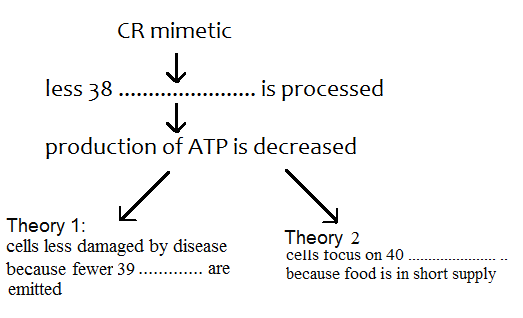
    The best-studied candidate for a caloric-restriction mimetic, 2DG (2-deoxy-D-glucose), works by interfering with the way cells process glucose, it has proved toxic at some doses in animals and so cannot be used in humans. But it has demonstrated that chemicals can replicate the effects of caloric restriction; the trick is finding the right one.

    Cells use the glucose from food to generate ATP (adenosine triphosphate), the molecule that powers many activities in the body. By limiting food intake, caloric restriction minimizes the amount of glucose entering cells and decreases ATP generation. When 2DG is administered to animals that eat normally, glucose reaches cells in abundance but the drug prevents most of it from being processed and thus reduces ATP synthesis. Researchers have proposed several explanations for why interruption of glucose processing and ATP production might retard aging. One possibility relates to the ATP-making machinery’s emission of free radicals, which are thought to contribute to aging and such age-related diseases as cancer by damaging cells. Reduced operation of the machinery should limit their production and thereby constrain the damage. Another hypothesis suggests that decreased processing of glucose could indicate to cells that food is scarce( even if it isn’t) and induce them to shift into an anti-aging mode that emphasizes preservation of the organism over such ‘luxuries’ as growth and reproduction.

    Questions 28-32

    Do the following statements agree with the claims of the writer in Reading Passage 3?

    Inboxes 28-32 on your answer sheet, write

    • YES if the statement t agrees with the claims of the writer
    • NO if the statement contradicts the claims of the writer
    • NOT GIVEN if it is impossible to say what the writer thinks about this
    1. Studies show drugs available today can delay the process of growing old.
    2. There is scientific evidence that eating fewer calories may extend human life.
    3. Not many people are likely to find a caloric-restricted diet attractive.
    4. Diet-related diseases are common in older people.
    5. In experiments, rats who ate what they wanted to lead shorter lives than rats on a low-calorie diet.
    Questions 33-37

    Classify the following descriptions as relating to

    1. caloric-restricted mimetic
    2. control monkeys
    3. neither caloric-restricted monkeys nor control monkeys

    Write the correct letter, A, B or C, in boxes 33-37 on your answer sheet.

    1. Monkeys were less likely to become diabetic.
    2. Monkeys experienced more chronic disease.
    3. Monkeys have been shown to experience a longer than average life span.
    4. Monkeys enjoyed a reduced chance of heart disease.
    5. Monkeys produced greater quantities of insulin.
    Questions 38-40

    Complete the flowchart below.

    Choose NO MORE THAN TWO WORDS from the passage for each answer.

    Write your answers in boxes 38-40 on your answer sheet.

    How a caloric-restriction mimetic works
    How a caloric-restriction mimetic works. Contains questions 38-40 in The search for the Anti-again Pill reading passage. IELTS 6 Academic Reading Practice Test 3
    Reading Passage 1 The Lumiere Brothers opened their Cinematographe Answers
    1. A
    2. I
    3. J
    4. E
    5. G
    6. yes
    7. not given
    8. not given
    9. no
    10. B
    11. C
    12. D
    13. D
    Reading Passage 2 Motivating Employees under Adverse Condition Answers
    1. VII
    2. III
    3. II
    4. IV
    5. I
    6. no
    7. not given
    8. no
    9. yes
    10. not given
    11. yes
    12. B
    13. C
    14. A
    Reading Passage 3 The Search for the Anti-aging Pill Answers
    1. no
    2. yes
    3. yes
    4. not given
    5. yes
    6. A
    7. B
    8. C
    9. A
    10. B
    11. glucose
    12. free radicals
    13. preservation
  • Cambridge IELTS 6 Academic Reading Test 4

    Reading Passage 1

    Doctoring Sales

    Cambridge IELTS Academic Reading Test 4 Doctoring Sales Reading Passage one with answers and explanations.
    Part of the image by Pexels.com

    Pharmaceuticals is one of the most profitable industries in North America. But do the drugs industry’s sales and marketing strategies go too far?

    1. few months ago Kim Schaefer, sales representative of a minor global pharmaceutical company, walked into a medical center in New York to bring information and free samples of her company’s latest products. That day she was lucky- a doctor was available to see her. ‘The last rep offered me a trip to Florida. What do you have?’ the physician asked. He was only half joking.
    2. What was on offer that day was a pair of tickets for a New York musical. But on any given day what Schaefer can offer is typical for today’s drugs rep -a car trunk full of promotional gifts and gadgets, a budget that could buy lunches and dinners for a small county, hundreds of free drug samples and the freedom to give a physician $200 to prescribe her new product to the next six patients who fit the drug’s profile. And she also has a few $ 1,000 honoraria to offer in exchange for doctors’ attendance at her company’s next educational lecture.
    3. Selling Pharmaceuticals is a daily exercise in ethical judgment. Salespeople like Schaefer walk the line between the common practice of buying a prospect’s time with a free meal, and bribing doctors to prescribe their drugs. They work in an industry highly criticized for its sales and marketing practices, but find themselves in the middle of the age-old chicken-or-egg question – businesses won’t use strategies that don’t work, so are doctors to blame for the escalating extravagance of pharmaceutical marketing? Or is it the industry’s responsibility to decide the boundaries?
    4. The explosion in the sheer number of salespeople in the Reid- and the amount of funding used to promote their causes- forces close examination of the pressures, influences and relationships between drug reps and doctors. Salespeople provide much-needed information and education to physicians. In many cases the glossy brochures, article reprints and prescriptions they deliver are primary sources of drug education for healthcare givers. With the huge investment the industry has placed in face-to-face selling, sales people have essentially become specialists in one drug or group of drugs – a tremendous advantage in getting the attention of busy doctors in need of quick information.
    5. But the sales push rarely stops in the office. The flashy brochures and pamphlets left by the sales reps are often followed up with meals at expensive restaurants, meetings in warm and sunny places, and an inundation of promotional gadgets. Rarely do patients watch a doctor write with a pen that isn’t emblazoned with a drug’s name, or see a nurse use a tablet not bearing a pharmaceutical company’s logo. Millions of dollars are spent by pharmaceutical companies on promotional products like coffee mugs, shirts, umbrellas, and golf balls. Money well spent? It’s hard to tell. I’ve been the recipient of golf balls from one company and I use them, but it doesn’t make me prescribe their medicine,’ says one doctor.’ I tend to think I’m not influenced by what they give me.’
    6. Free samples of new and expensive drugs might be the single most effective way of getting doctors and patients to become loyal to a product. Salespeople hand out hundreds of dollars’ worth of samples each week-$7.2 billion worth of them in one year. Though few comprehensive studies have been conducted, one by the University of Washington investigated how drug sample availability affected what physicians prescribe. A total of 131 doctors self-reported their prescribing patterns-the conclusion was that the availability of samples led them to dispense and prescribe drugs that differed from their preferred drug choice.
    7. The bottom line is that pharmaceutical companies as a whole invest more in marketing than they do in research and development. And patients are the ones who pay-in the form of sky-rocketing prescription prices for every pen that’s handed out, every free theatre ticket, and every steak dinner eaten. In the end, the fact remains that pharmaceutical companies have every right to make a profit and will continue to find new ways to increase sales. But as the medical world continues to grapple with what’s acceptable and what’s not, it is clear that companies must continue to be heavily scrutinized for their sales and marketing strategies.
    Questions 1-7

    Reading Passage 1 has seven paragraphs, A-G.

    Write the correct number, i-x, in boxes 1-7 on your answer sheet.

    Choose the correct heading for each paragraph from the list of headings below.

    List of Headings

    1. Not all doctors are persuaded
    2. Choosing the best offers
    3. Who is responsible for the increase in promotions?
    4. Fighting the drug companies
    5. An example of what doctors expect from drug companies
    6. Gifts include financial incentives
    7. Research shows that promotion works
    8. The high costs of research
    9. The positive side of drugs promotion
    10. Who really pays for doctors’ free gifts?
    1. Paragraph A
    2. Paragraph B
    3. Paragraph C
    4. Paragraph D
    5. Paragraph E
    6. Paragraph F
    7. Paragraph G
    Questions 8-13

    Do the following statements agree with the views of the writer in Reading Passage 1?

    In boxes 8-13 on your answer sheet, write

    • YES if the statement agrees with the views of the writer
    • NO if the statement contradicts the views of the writer
    • NOT GIVEN if it is impossible to say what the writer thinks
    1. Sales representatives like Kim Schaefer work to a very limited budget.
    2. Kim Schaefer’s marketing technique may be open to criticism on moral grounds.
    3. The information provided by drug companies is of little use to doctors.
    4. Evidence of drug promotion is clearly visible in the healthcare environment.
    5. The drug companies may give free drug samples to patients without doctors’ prescriptions
    6. It is legitimate for drug companies to make money.

    Reading Passage 2

    Do Literate Women Make Better Mothers?

    Cambridge IELTS 6 Academic Reading Test 4 Do Literate Women Make Better Mothers? Reading Passage 2 with answers and explanations.
    Part of the image by Pexels.com

    Children in developing countries are healthier and more likely to survive past the age of five when their mothers can read and write. Experts In public health accepted this idea decades ago, but until now no one has been able to show that a woman’s ability to read in Itself Improves her children’s chances of survival.

    Most literate women learnt to read In primary school, and the fact that a woman has had an education may simply indicate her family’s wealth or that It values Its children more highly. Now a long-term study carried out In Nicaragua has eliminated these factors by showing that teaching reading to poor adult women, who would otherwise have remained Illiterate, has a direct effect on their children’s health and survival.

    In 1979, the government of Nicaragua established a number of social programmes, including a National Literacy Crusade. By 1985, about 300,000 Illiterate adults from all over the country, many of whom had never attended primary school, had learnt how to read, write and use numbers.

    During this period, researchers from the Liverpool School of Tropical Medicine, the Central American Institute of Health In Nicaragua, the National Autonomous University of Nicaragua and the Costa Rican Institute of Health Interviewed nearly 3,000 women, some of whom had learnt to read as children, some during the literacy crusade and some who had never learnt at all. The women were asked how many children they had given birth to and how many of them had died In Infancy. The research teams also examined the surviving children to find out how well-nourished they were.

    The Investigators’ findings were striking. In the late 1970s, the infant mortality rate for the children of Illiterate mothers was around 110 deaths per thousand live births. At this point In their lives, those mothers who later went on to learn to read had a similar level Of child mortality (105/1000). For women educated in primary school, however, the Infant mortality rate was significantly lower, at 80 per thousand.

    In 1985, after the National Literacy Crusade had ended, the infant mortality figures for those who remained illiterate and for those educated In primary school remained more or less unchanged. For those women who learnt to read through the campaign, the infant mortality rate was 84 per thousand, an impressive 21 points lower than for those women who were still Illiterate. The children of the newly-literate mothers were also better nourished than those of women who could not read.

    Why are the children of literate mothers better off? According to Peter Sandiford of the Liverpool School of Tropical Medicine, no one Knows for certain. Child health was not on the curriculum during the women’s lessons, so fie and his colleagues are looking at other factors. They are working with the same group of 3,000 women, to try to find out whether reading mothers make better use of hospitals and clinics, opt for smaller families, exert more control at home, learn modern childcare techniques more quickly, or whether they merely have more respect for themselves and their children.

    The Nicaraguan study may have important implications for governments and aid agencies that need to know where to direct their resources. Sandiford says that there is increasing evidence that female education, at any age, is “an important health intervention in its own right’. The results of the study lend support to the World Bank’s recommendation that education budgets in developing countries should be increased, not just to help their economies, but also to improve child health.

    We’ve known for a long time that maternal education is important,’ says John Cleland of the London School of Hygiene and Tropical Medicine. ‘But we thought that even if we started educating girls today, we’d have to wait a generation for the pay off. The Nicaraguan study suggests we may be able to bypass that.’

    Cleland warns that the Nicaraguan crusade was special in many ways, and similar campaigns elsewhere might not work as well. It is notoriously difficult to teach adults skills that do not have an immediate impact on their everyday lives, and many literacy campaigns in other countries have been much less successful. ‘The crusade was part of a larger effort to bring a better life to the people,’ says Cleland. Replicating these conditions in other countries will be a major challenge for development workers.

    Questions 14-18

    Complete the summary using the list of words, A-J, below.

    Write the correct letters, A-J, in boxes 14-18 on your answer sheet.

    NB You may use any letter more than once.

    The Nicaraguan National Literacy Crusade aimed to teach large numbers of illiterate (14) ……………… to read and write. Public health experts have known for many years that there is a connection between child health and (15)……………… However, it has not previously been known whether these two factors were directly linked or not. This question has been investigated by (16)……………….. in Nicaragua. As a result, factors such as (17) …………………. and attitudes to children have been eliminated, audit has been shown that 18……………. can in itself improve infant health and survival.

    A child literacy B men C an international research teamD medical care
    E mortalityF maternal literacyG adults and childrenH paternal literacy 
    I a national literacy crusadeJ family health
    Questions 19-24

    Do the following statements agree with the claims of the writer in Reading Passage 2?

    In boxes 19-24 on your answer sheet, write:

    • YES if the statement agrees with the claims of the writer
    • NO if the statement contradicts the claims of the writer
    • NOT GIVEN if it is impossible to say what the writer thinks about this
    1. About a thousand or the women interviewed by the researchers had learnt to read they were children.
    2. Before the National Literacy Crusade, illiterate women had approximately the same levels of infant mortality as those who had learnt to read in primary school.
    3. Before and after the National Literacy Crusade, the child mortality rate for the illiterate women stayed at about 110 deaths for each thousand live births.
    4. The women who had learnt to read through the National Literacy Crusade showed the greatest change in infant mortality levels.
    5. The women who had learnt to read through the National Literacy Crusade had the lowest rates of child mortality.
    6. After the National Literacy Crusade, the children of the women who remained illiterate were found to be severely malnourished.
    Questions 25 and 26

    Choose TWO letters, A-E.

    Write the correct letters in boxes 25 and 26 on your answer sheet

    Which TWO important implications drawn from the Nicaraguan study are mentioned by the writer of the passage?

    1. It is better to educate mature women than young girls
    2. Similar campaigns in other countries would be equally successful.
    3. The effects of maternal literacy programmes can be seen very quickly
    4. Improving child health can quickly affect a country’s economy.
    5. Money spent on female education will improve child health.

    Reading Passage 3

    Persistent bullying is one of the worst experiences

    Cambridge IELTS 6 Academic Reading Test 4 Persistent bullying is one of the worst experiences Reading Passage 3 with answers and explanations.
    Part of the image by Pexels.com

    Persistent bullying is one of the worst experiences a child can face. How can it be prevented? Peter Smith, Professor of Psychology at the University of Sheffield, directed the Sheffield Anti-Bullying Intervention Project, funded by the Department for Education. Here he reports on his findings.

    1. Bullying can take a variety of forms, from the verbal -being taunted or called hurtful names- to the physical- being kicked or shoved- as well as indirect forms, such as being excluded from social groups. A survey I conducted with Irene Whitney found that in British primary schools up to a quarter of pupils reported experience of bullying, which in about one in ten cases was persistent. There was less bullying in secondary schools, with about one in twenty-five suffering persistent bullying, but these cases may be particularly recalcitrant.
    2. Bullying is clearly unpleasant and can make the child experiencing it feel unworthy and depressed. In extreme cases, it can even lead to suicide, though this is thankfully rare. Victimised pupils are more likely to experience difficulties with interpersonal relationships as adults, while children who persistently bully are more likely to grow up to be physically violent, and convicted of anti-social offences.
    3. Until recently, not much was known about the topic, and little help was available to teachers to deal with bullying. Perhaps as a consequence, schools would often deny the problem. ‘There is no bullying at this school’ has been a common refrain, almost certainly all true. Fortunately, more schools are now saying: There is not much bullying here, but when it occurs we have a clear policy for dealing with it.
    4. Three factors are involved in this change. First is an awareness of the severity of the problem. Second, a number of resources to help tackle bullying have become available in Britain. For example, the Scottish Collllcil for Research in Education produced a package of materials, Action Against Bullying, circulated to all schools in England and Wales as well as in Scotland in summer 1992, with a second pack, Supporting Schools Against Bullying, produced the following year. In Ireland, Guidelines on Countering Bullying Behaviour in Post-Primary Schools was published in 1993. Third, there is evidence that these materials work and that schools can achieve something. This comes from carefully conducted ‘before and after” evaluations of interventions in schools, monitored by a research team. In Norway, after an intervention campaign was introduced nationally, an evaluation of forty-two schools suggested that, over a two-year period, bullying was halved. The Sheffield investigation, which involved sixteen primary schools and seven secondary schools, found that most schools succeeded in reducing bullying.
    5. Evidence suggests that a key step is to develop a policy on bullying, saying clearly what is meant by bullying, and giving explicit guidelines on what will be done if it occurs, what record will be kept, who will be informed, what sanctions will be employed. The policy should be developed through consultation, over a period of time- not just imposed from the head teacher’s office! Pupils, parents and staff should feel they have been involved in the policy, which needs to be disseminated and implemented effectively. Other actions can be taken to back up the policy. There are ways of dealing with the topic through the curriculum, using video, drama and literature. These are useful for raising awareness, and can best be tied into early phases of development while the school is starting to discuss the issue of bullying. They are also useful in renewing the policy for new pupils or revising it in the light of experience. But curriculum work alone may only have short-term effects; it should be an addition to policy work, not a substitute. There are also ways of working with individual pupils, or in small groups. Assertiveness training for pupils who are liable to be victims is worthwhile, and certain approaches to group bullying such as ‘no blame’, can be useful in changing the behaviour of bullying pupils without confronting them directly, although other sanctions may be needed for those who continue with persistent bullying. Work in the playground is important, too. One helpful step is to train lunchtime supervisors to distinguish bullying from playful fighting and help them break up conflicts. Another possibility is to improve the playground environment so that pupils are less likely to be led into bullying from boredom or frustration.
    6. With these developments, schools can expect that at least the most serious kinds of bullying can largely be prevented. The more effort put in and the wider the whole school involvement, the more substantial the results are likely to be. The reduction in bullying – and the consequent improvement in pupil happiness- is surely a worthwhile objective.
    Questions 27-30

    Reading Passage 3 has six sections.

    Choose the correct heading for sections A-D from the list of headings below.

    Write the correct number, i-vii, in boxes 27-30 on your answer sheet.

    List of Headings

    1. The role of video violence
    2. The failure of government policy
    3. Reasons for the increased rate of bullying
    4. Research into how common bullying is in British schools
    5. The reaction from schools to enquiries about bullying
    6. The effect of bullying on the children involved
    7. Developments that have led to a new approach by schools
    1. Section A
    2. Section B
    3. Section C
    4. Section D
    Questions 31-34

    Choose the correct letter. A, B, C or D.

    Write the correct letter in boxes 31-34 on your answer sheet.

    1. A recent survey found that in British secondary schools
      1. there was more bullying than had previously been the case.
      2. there was less bullying than in primary schools.
      3. cases of persistent bullying were very common.
      4. indirect forms of bullying were particularly difficult to deal with.
    2. Children who are bullied
      1. are twice as likely to commit suicide as the average person.
      2. find it more difficult to relate to adults.
      3. are less likely to be violent in later life.
      4. may have difficulty forming relationships in later life.
    3. The writer thinks that the declaration ‘There is no bullying at this school’
      1. is no longer true in many schools.
      2. was not in fact made by many schools.
      3. reflected the school’s lack of concern.
      4. reflected a lack of knowledge and resources.
    4. What were the findings of research carried out in Norway?
      1. Bullying declined by 50% after an anti-bullying campaign.
      2. Twenty-one schools reduced bullying as a result of an anti-bullying campaign
      3. Two years is the optimum length for an anti-bullying campaign.
      4. Bullying is a less serious problem in Norway than in the UK.
    Questions 35-39

    Complete the summary below.

    Choose NO MORE THAN TWO WORDS from the passage for each answer

    Write your answers in boxes 35-39 on your answer sheet.

    What steps should schools take to reduce bullying?The most important step is for the school authorities to produce a (35) ………………….. which makes the school’s attitude towards bullying quite clear. It should include detailed 36 …………………… as to how the school and its staff will react if bullying occurs. In addition, action can be taken through the (37) ……………………… This is particularly useful in the early part of the process, as a way of raising awareness and encouraging discussion On its own, however, it is insufficient to bring about a permanent solution. Effective work can also be done with individual pupils and small groups. For example, potential (38) ……………………. of bullying can be trained to be more self-confident. Or again, in dealing with group bullying, a ‘no blame’ approach, which avoids confronting the offender too directly, is often effective. Playground supervision will be more effective if members of staff are trained to recognise the difference between bullying and mere (39) ……………………. .

    Question 40

    Choose the correct letter, A, B, C or D.

    Write the correct letter in box 40 on your answer sheet.

    Which of the following is the most suitable title for Reading Passage 3?

    1. Bullying: what parents can do
    2. Bullying: are the media to blame?
    3. Bullying: the link with academic failure
    4. Bullying: from crisis management to prevention
    Reading Passage 1 Doctoring Sales answers
    1. v
    2. vi
    3. iii
    4. ix
    5. i
    6. vii
    7. x
    8. NO
    9. YES
    10. NO
    11. YES
    12. NOT GIVEN
    13. YES
    Reading Passage 2 Do Literate Women Make Better Mothers? answers
    1. B
    2. F
    3. C
    4. J
    5. F
    6. NOT GIVEN
    7. NO
    8. YES
    9. YES
    10. NO
    11. NOT GIVEN
    12. C OR E (IN EITHER ORDERCE)
    13. C OR E (IN EITHER ORDERCE)
    Reading Passage 3 Persistent bullying is one of the worst experiences answers
    1. iv
    2. vi
    3. v
    4. vii
    5. B
    6. D
    7. D
    8. A
    9. policy
    10. (explicit) guidelines
    11. (school) curriculum
    12. victims
    13. playful fighting
    14. D
  • Cambridge IELTS 5 Academic Reading Test 2

    Reading Passage 1

    BAKELITE – The birth of modern plastics

    In 1907, Leo Hendrick Baekeland, a Belgian scientist working in New York, discovered and patented a revolutionary new synthetic material. His invention, which he named ‘Bakelite’, was of enormous technological importance, and effectively launched the modern plastics industry.

    The term ‘plastic’ comes from the Greek plassein, meaning ‘to mould’. Some plastics are derived from natural sources, some are semi-synthetic (the result of chemical action on a natural substance), and some are entirely synthetic, that is, chemically engineered from the constituents of coal or oil. Some are ‘thermoplastic’, which means that, like candlewax, they melt when heated and can then be reshaped. Others are ‘thermosetting’: like eggs, they cannot revert to their original viscous state, and their shape is thus fixed for ever, Bakelite had the distinction of being the first totally synthetic thermosetting plastic.

    The history of today’s plastics begins with the discovery of a series of semi-synthetic thermoplastic materials in the mid-nineteenth century. The impetus behind the development of these early plastics was generated by a number of factors – immense technological progress in the domain of chemistry, coupled with wider cultural changes, and the pragmatic need to find acceptable substitutes for dwindling supplies of ‘luxury’ materials such as tortoiseshell and ivory.

    Baekeland’s interest in plastics began in 1885 when, as a young chemistry student in Belgium, he embarked on research into phenolic resins, the group of sticky substances produced when phenol (carbolic acid) combines with an aldehyde (a volatile fluid similar to alcohol). He soon abandoned the subject, however, only returning to it some years later. By 1905 he was a wealthy New Yorker, having recently made his fortune with the invention of a new photographic paper. While Baekeland had been busily amassing dollars, some advances had been made in the development of plastics. The years 1899 and 1900 had seen the patenting of the first semi-synthetic thermosetting material that could be manufactured on an industrial scale. In purely scientific terms, Baekeland’s major contribution to the field is not so much the actual discovery of the material to which he gave his name, but rather the method by which a reaction between phenol and formaldehyde could be controlled, thus making possible its preparation on a commercial basis. On 13 July 1907, Baekeland took out his famous patent describing this preparation, the essential features of which are still in use today.

    The original patent outlined a three-stage process, in which phenol and formaldehyde (from wood or coal) were initially combined under vacuum inside a large egg-shaped kettle. The result was a resin known as Novalak, which became soluble and malleable when heated. The resin was allowed to cool in shallow trays until it hardened, and then broken up and ground into powder. Other substances were then introduced: including fillers, such as woodflour, asbestos or cotton, which increase strength and. moisture resistance, catalysts (substances to speed up the reaction between two chemicals without joining to either) and hexa, a compound of ammonia and formaldehyde which supplied the additional formaldehyde necessary to form a thermosetting resin. This resin was then left to cool and harden, and ground up a second time. The resulting granular powder was raw Bakelite, ready to be made into a vast range of manufactured objects. In the last stage, the heated Bakelite was poured into a hollow mould of the required shape and subjected to extreme heat and pressure; thereby ‘setting’ its form for life.

    The design of Bakelite objects, everything from earrings to television sets, was governed to a large extent by the technical requirements of the moulding process. The object could not be designed so that it was locked into the mould and therefore difficult to extract. A common general rule was that objects should taper towards the deepest part of the mould, and if necessary the product was moulded in separate pieces. Moulds had to be carefully designed so that the molten Bakelite would flow evenly and completely into the mould. Sharp corners proved impractical and were thus avoided, giving rise to the smooth, ‘streamlined’ style popular in the 1930s. The thickness of the walls of the mould was also crucial: thick walls took longer to cool and harden, a factor which had to be considered by the designer in order to make the most efficient use of machines.

    Baekeland’s invention, although treated with disdain in its early years, went on to enjoy an unparalleled popularity which lasted throughout the first half of the twentieth century. It became the wonder product of the new world of industrial expansion -‘the material of a thousand uses’. Being both non-porous and heat-resistant, Bakelite kitchen goods were promoted as being germ-free and sterilisable. Electrical manufacturers seized on its insulating: properties, and consumers everywhere relished its dazzling array of shades, delighted that they were now, at last, no longer restricted to the wood tones and drab browns of the pre-plastic era. It then fell from favour again during the 1950s, and was despised and destroyed in vast quantities. Recently, however, it has been experiencing something of a renaissance, with renewed demand for original Bakelite objects in the collectors’ marketplace, and museums, societies and dedicated individuals once again appreciating the style and originality of this innovative material.

    Questions 1-3

    Complete the summary.

    Choose ONE WORD ONLY from the passage for each answer.

    Write your answers in boxes 1-3 on your answer sheet.

    Some plastics behave in a similar way to (1) ……………….. in that they melt under heat and can be moulded into new forms. Bakelite was unique because it was the first material to be both entirely (2) ……………….. in origin, and thermosetting. There were several reasons for the research into plastics in the nineteenth century, among them the great advances that had been made in the field of (3) ……………….. and the search for alternatives to natural resources like ivory.

    Questions 4-8

    Complete the flow-chart.

    Choose ONE WORD ONLY from the passage for each answer.

    Write your answers in boxes 4-8 on your answer sheet.

    Questions 4 - 6 The Production of Bakelite Process. BAKELITE – The birth of modern plastics
    Questions 7 - 8 The Production of Bakelite Process. BAKELITE – The birth of modern plastics
    Questions 9-10

    Write your answers in boxes 9 and 10 on your answer sheet.

    Which TWO of the following factors influencing the design of Bakelite objects are mentioned in the text?

    1. the function which the object would serve
    2. the ease with which the resin could fill the mould
    3. the facility with which the object could be removed from the mould
    4. the limitations of the materials used to manufacture the mould
    5. the fashionable styles of the period
    Questions 11-13

    Do the following statements agree with the information given in Reading Passage 1?

    In boxes 11-13 on your answer sheet, write

    • TRUE                       if the statement is true according to the passage
    • FALSE                     if the statement is false according to the passage
    • NOT GIVEN          if the information is not given in the passage
    1. Modern-day plastic preparation is based on the same principles as that patented in 1907.
    2. Bakelite was immediately welcomed as a practical and versatile material.
    3. Bakelite was only available in a limited range of colours.

    Reading Passage 2

    John McCrone reviews recent research on humour

    The joke comes over the headphones: ‘Which side of a dog has the most hair? The left.’ No, not funny. Try again. ‘Which side of a dog has the most hair? The outside.’ Hah! The punchline is silly yet fitting, tempting a smile, even a laugh. Laughter has always struck people as deeply mysterious, perhaps pointless. The writer Arthur Koestler dubbed it the luxury reflex: ‘unique in that it serves no apparent biological purpose’.

    Theories about humour have an ancient pedigree. Plato expressed the idea that humour is simply a delighted feeling of superiority over others. Kant and Freud felt that joke-telling relies on building up a psychic tension which is safely punctured by the ludicrousness of the punchline. But most modern humour theorists have settled on some version of Aristotle’s belief that jokes are based on a reaction to or resolution of incongruity, when the punchline is either a nonsense or, though appearing silly, has a clever second meaning.

    Graeme Ritchie, a computational linguist in Edinburgh, studies the linguistic structure of jokes in order to understand not only humour but language understanding and reasoning in machines. He says that while there is no single format for jokes, many revolve around a sudden and surprising conceptual shift. A comedian will present a situation followed by an unexpected interpretation that is also apt.

    So even if a punchline sounds silly, the listener can see there is a clever semantic fit and that sudden mental ‘Aha!’ is the buzz that makes us laugh. Viewed from this angle, humour is just a form of creative insight, a sudden leap to a new perspective.

    However, there is another type of laughter, the laughter of social appeasement and it is important to understand this too. Play is a crucial part of development in most young mammals. Rats produce ultrasonic squeaks to prevent their scuffles turning nasty. Chimpanzees have a ‘play-face’ – a gaping expression accompanied by a panting ‘ah, ah’ noise. In humans, these signals have mutated into smiles and laughs. Researchers believe social situations, rather than cognitive events such as jokes, trigger these instinctual markers of play or appeasement. People laugh on fairground rides or when tickled to flag a play situation, whether they feel amused or not.

    Both social and cognitive types of laughter tap into the same expressive machinery in our brains, the emotion and motor circuits that produce smiles and excited vocalisations. However, if cognitive laughter is the product of more general thought processes, it should result from more expansive brain activity.

    Psychologist Vinod Goel investigated humour using the new technique of ‘single event’ functional magnetic resonance imaging (fMRl). An MRI scanner uses magnetic fields and radio waves to track the changes in oxygenated blood that accompany mental activity. Until recently, MRI scanners needed several minutes of activity and so could not be used to track rapid thought processes such as comprehending a joke. New developments now allow half-second ‘snapshots’ of all sorts of reasoning and problem-solving activities.

    Although Goel felt being inside a brain scanner was hardly the ideal place for appreciating a joke, he found evidence that understanding a joke involves a widespread mental shift. His scans showed that at the beginning of a joke the listener’s prefrontal cortex lit up, particularly the right prefrontal believed to be critical for problem solving. But there was also activity in the temporal lobes at the side of the head (consistent with attempts to rouse stored knowledge) and in many other brain areas. Then when the punchline arrived, a new area sprang to life -the orbital prefrontal cortex. This patch of brain tucked behind the orbits of the eyes is associated with evaluating information.

    Making a rapid emotional assessment of the events of the moment is an extremely demanding job for the brain, animal or human. Energy and arousal levels may need, to be retuned in the blink of an eye. These abrupt changes will produce either positive or negative feelings. The orbital cortex, the region that becomes active in Goel’s experiment, seems the best candidate for the site that feeds such feelings into higher-level thought processes, with its close connections to the brain’s sub-cortical arousal apparatus and centres of metabolic control.

    All warm-blooded animals make constant tiny adjustments in arousal in response to external events, but humans, who have developed a much more complicated internal life as a result of language, respond emotionally not only to their surroundings, but to their own thoughts. Whenever a sought-for answer snaps into place, there is a shudder of pleased recognition. Creative discovery being pleasurable, humans have learned to find ways of milking this natural response. The fact that jokes tap into our general evaluative machinery explains why the line between funny and disgusting, or funny and frightening, can be so fine. Whether a joke gives pleasure or pain depends on a person’s outlook.

    Humour may be a luxury, but the mechanism behind it is no evolutionary accident. As Peter Derks, a psychologist at William and Mary College in Virginia, says: ‘I like to think of humour as the distorted mirror of the mind. It’s creative, perceptual, analytical and lingual. If we can figure out how the mind processes humour, then we’ll have a pretty good handle on how it works in general.

    Questions 14-20

    Do the following statements agree with the information given in Reading Passage 2?

    In boxes 14-20 on your answer sheet, write

    • TRUE                     if the statement is true according to the passage
    • FALSE                   if the statement is false according to the passage
    • NOT GIVEN        if the information is not given in the passage
    1. Arthur Koestler considered laughter biologically important in several ways.
    2. Plato believed humour to be a sign of above-average intelligence.
    3. Kant believed that a successful joke involves the controlled release of nervous energy.
    4. Current thinking on humour has largely ignored Aristotle’s view on the subject.
    5. Graeme Ritchie’s work links jokes to artificial intelligence.
    6. Most comedians use personal situations as a source of humour.
    7. Chimpanzees make particular noises when they are playing.
    Questions 21-23

    The diagram below shows the areas of the brain activated by jokes.

    Label the diagram.

    Choose NO MORE THAN TWO WORDS from the passage for each answer.

    John McCrone reviews recent research on humour Questions 21-23.

21. Right Prefrontal Cortex lights up - area of brain linked to .........
22. .......... become active too
23. Orbital Prefrontal cortex is activated - involved with ........
    Questions 24-27

    Complete each sentence with the correct ending A-G below.

    Write the correct letter A-G in boxes 24-27 on your answer sheet.

    1. react to their own thoughts.
    2. helped create language in humans.
    3. respond instantly to whatever is happening.
    4. may provide valuable information about the operation of the brain.
    5. cope with difficult situations.
    6. relate to a person’s subjective views.
    7. led our ancestors to smile and then laugh.
      1. One of the brain’s most difficult tasks is to
      2. Because of the language they have developed, humans
      3. Individual responses to humour
      4. Peter Derks believes that humour

    Reading Passage 3

    The Birth of Scientific English

    World science is dominated today by a small number of languages, including Japanese, German and French, but it is English which is probably the most popular global language of science. This is not just because of the importance of English-speaking countries such as the USA in scientific research; the scientists of many non-English-speaking countries find that they need to write their research papers in English to reach a wide international audience. Given the prominence of scientific English today, it may seem surprising that no one really knew how to write science in English before the 17th century. Before that, Latin was regarded as the lingua franca for European intellectuals.

    The European Renaissance (c. 14th-16th century) is sometimes called the ‘revival of learning’, a time of renewed interest in the ‘lost knowledge’ of classical times. At the same time, however, scholars also began to test and extend this knowledge. The emergent nation states of Europe developed competitive interests in world exploration and the development of trade. Such expansion, which was to take the English language west to America and east to India, was supported by scientific developments such as the discovery of magnetism (and hence the invention of the compass), improvements in cartography and – perhaps the most important scientific revolution of them all – the new theories of astronomy and the movement of the Earth in relation to the planets and stars, developed by Copernicus (1473-1543).

    England was one of the first countries where scientists adopted and publicised Copernican ideas with enthusiasm. Some of these scholars, including two with interests in language -John Wall’s and John Wilkins – helped Found the Royal Society in 1660 in order to promote empirical scientific research.

    Across Europe similar academies and societies arose, creating new national traditions of science. In the initial stages of the scientific revolution, most publications in the national languages were popular works, encyclopaedias, educational textbooks and translations. Original science was not done in English until the second half of the 17th century. For example, Newton published his mathematical treatise, known as the Principia, in Latin, but published his later work on the properties of light – Opticks – in English.

    There were several reasons why original science continued to be written in Latin. The first was simply a matter of audience. Latin was suitable for an international audience of scholars, whereas English reached a socially wider, but more local, audience. Hence, popular science was written in English.

    A second reason for writing in Latin may, perversely, have been a concern for secrecy. Open publication had dangers in putting into the public domain preliminary ideas which had not yet been fully exploited by their ‘author’. This growing concern about intellectual property rights was a feature of the period – it reflected both the humanist notion of the individual, rational scientist who invents and discovers through private intellectual labour, and the growing connection between original science and commercial exploitation.

    There was something of a social distinction between ‘scholars and gentlemen’ who understood Latin, and men of trade who lacked a classical education. And in the mid-17th century it was common practice for mathematicians to keep their discoveries and proofs secret, by writing them in cipher, in obscure languages, or in private messages deposited in a sealed box with the Royal Society. Some scientists might have felt more comfortable with Latin precisely because its audience, though international, was socially restricted. Doctors clung the most keenly to Latin as an ‘insider language’.

    A third reason why the writing of original science in English was delayed may have been to do with the linguistic inadequacy of English in the early modern period. English was not well equipped to deal with scientific argument. First, it lacked the necessary technical vocabulary. Second, it lacked the grammatical resources required to represent the world in an objective and impersonal way, and to discuss the relations, such as cause and effect, that might hold between complex and hypothetical entities.

    Fortunately, several members of the Royal Society possessed an interest in language and became engaged in various linguistic projects. Although a proposal in 1664 to establish a committee for improving the English language came to little, the society’s members did a great deal to foster the publication of science in English and to encourage the development of a suitable writing style. Many members of the Royal Society also published monographs in English. One of the first was by Robert Hooke, the society’s first curator of experiments, who described his experiments with microscopes in Micrographia (1665). This work is largely narrative in style, based on a transcript of oral demonstrations and lectures.

    In 1665 a new scientific journal, Philosophical Transactions, was inaugurated. Perhaps the first international English-language scientific journal, it encouraged a new genre of scientific writing, that of short, focused accounts of particular experiments.

    The 17th century was thus a formative period in the establishment of scientific English. In the following century much of this momentum was lost as German established itself as the leading European language of science. It is estimated that by the end of the 18th century 401 German scientific journals had been established as opposed to 96 in France and 50 in England. However, in the 19th century scientific English again enjoyed substantial lexical growth as the industrial revolution created the need for new technical vocabulary, and new, specialised, professional societies were instituted to promote and publish in the new disciplines.

    Questions 28-34

    Complete the summary.

    Choose NO MORE THAN TWO WORDS from the passage for each answer.

    Write your answers in boxes 28-34 on your answer sheet.

    In Europe modem science emerged at the same time as the nation state. At first, the scientific language of choice remained (28) ……………….. It allowed scientists to communicate with other socially privileged thinkers while protecting their work from unwanted exploitation. Sometimes the desire to protect ideas seems to have been stronger than the desire to communicate them, particularly in the case of mathematicians and (29) ……………….. In Britain, moreover, scientists worried that English had neither the (30) ……………….. nor the (31) ……………….. to express their ideas.This situation only changed after 1660 when scientists associated with the (32) ……………….. set about developing English. An early scientific journal fostered a new kind of writing based on short descriptions of specific experiments. Although English was then overtaken by (33) ……………….. it developed again in the 19th century as a direct result of the (34) …………………

    Questions 35-37

    Do the following statements agree with the information given in Reading Passage 3?

    In boxes 35-37 on your answer sheet, write

    • TRUE                        if the statement is true according to the passage
    • FALSE                      if the statement is false according to the passage
    • NOT GIVEN           if the information is not given in the passage
    1. There was strong competition between scientists in Renaissance Europe.
    2. The most important scientific development of the Renaissance period was the discovery of magnetism.
    3. In 17th-century Britain, leading thinkers combined their interest in science with an interest in how to express ideas.
    Questions 38-40

    Complete the table.

    Choose NO MORE THAN TWO WORDS from the passage for each answer.

    Science written in the first half of the 17th century
    Language usedLatinEnglish
    Type of scienceoriginal(38)……………
    Examples(39)……………………….Encyclopedias
    Target audienceInternational scholars(40)………….. but socially wider
    Academic Reading Passage 1 BAKELITE – The birth of modern plastics Answers
    1. candlewax
    2. synthetic
    3. chemistry
    4. Novalak
    5. fillers
    6. hexa
    7. raw
    8. pressure
    9. B
    10. C
    11. true
    12. false
    13. false
    Academic Reading Passage 2 John McCrone reviews recent research on humour Answers
    1. false
    2. not given
    3. true
    4. false
    5. true
    6. not given
    7. true
    8. problem solving
    9. temporal lobes
    10. evaluating information
    11. C
    12. A
    13. F
    Academic Reading Passage 3 The Birth of Scientific English Answers
    1. D
    2. latin
    3. doctors
    4. technical vocabulary
    5. grammatical resources
    6. Royal Society
    7. German
    8. industrial revolution
    9. not given
    10. false
    11. true
    12. popular
    13. principia
    14. local audience
  • Cambridge IELTS 9 Academic Reading Test 4

    Cambridge IELTS 9 Academic Reading Test 4

    Reading Passage 1

    The Life and Work of Marie Curie

    The Life and Work of Marie Curie IELTS Academic Reading Passage 1 with answers and explanations.
    Part of the image by pixabay.com

    Marie Curie is probably the most famous woman scientist who has ever lived. Born Maria Sklodowska in Poland in 1867, she is famous for her work on radioactivity, and was twice a winner of the Nobel Prize. With her husband, Pierre Curie and Henri Raeqiierel, she was awarded the 1903 Nobel Prize for Physics, and was then sole winner of the 1911 Nobel Prize for Chemistry. She was the first woman to win a Nobel Prize.

    From childhood, Marie was remarkable for her prodigious memory, and at the age of 16 won a gold medal on completion of her secondary education. Because her father lost his savings through bad investment, she then had to take work as a teacher. From her earnings, she was able to finance her sister Bronia’s medical studies in Paris, on the understanding that Bronia would, in turn, later help her to get an education.

    ln 1891 this promise was fulfilled and Marie went to Paris and began to study at the Sorbonne (the University of Paris). She often worked far into the night and lived on little more than bread and butter and tea. She came first in the examination in the physical sciences in 1893, and in 1894 was placed second in the examination in mathematical sciences .It was not until the spring of that year that she was introduced to Pierre Curie.

    Their marriage in 1895 marked the start of a partnership that was soon to achieve results of world significance. Following Henri BecquereI‘s discovery in 1896 of a new phenomenon, which Marie later called ‘radioactivity’, Marie Curie decided to find out if the radioactivity discovered in uranium was to be found in other elements. She discovered that this was true for thorium.

    Turning her attention to minerals, she found her interest drawn to pitchblende, a mineral whose radioactivity, superior to that of pure uranium, could be explained only by the presence in thorium of small quantities of an unknown substance of very high activity. Pierre Curie joined her in the work that she had undertaken to resolve this problem and that led to the discovery of the new elements, polonium and radium. While Pierre Curie devoted himself chiefly to the physical study of the new radiations, Marie Curie struggled to obtain pure radium in the metallic state. This was achieved with the help of the chemist André-Louis Debierne, one of Pierre Curie’s pupils. Based on the results of this research, Marie Curie received her Doctorate of Science, and in 1903 Marie and Pierre shared with Becquerel the Nobel Prize for Physics for the discovery of radioactivity.

    The births of Marie’s two daughters, Irene and Eve, in 1897 and 1904 failed to internrupt her scientific work. She was appointed lecturer in physics at the Ecole Nor-male Supérieure for girls in Sevres, France (1900), and introduced a method of teaching based on experimental demonstrations. In December 1904 she was appointed chief assistant in the laboratory directed by Pierre Curie.

    The sudden death of her husband in 1906 was a bitter blow to Marie Curie but was also a turning point in her career: henceforth she was to devote all her energy to completing alone the scientific work that they had undertaken. On May 19, 1906, she was appointed to the professorship that had been left vacant on her husband’s death, becoming the first woman to teach at the Sorbonne. In 1911 she was awarded the Nobel Prize for Chemistry for the isolation of a pure form of radium.

    During World War I, Marie Curie, with the help of her daughter Irene, devoted herself to the development of the use of X—radiography, including the mobile units which came to be known as ‘little Curies’, used for the treatment of wounded soldiers. ln 1918 the Radium Institute, whose staff Irene had joined, began to operate in earnest, and became a centre for nuclear physics and chemistry. Marie Curie, now at the highest point of her fame and, from 1922, a member of the Academy of Medicine, researched the chemistry of radioactive substances and their medical applications.

    ln 1921, accompanied by her two daughters, Marie Curie made a triumphant journey to the United States to raise funds for research on radium. Women there presented her with a gram of radium for her campaign. Marie also gave lectures in Belgium, Brazil, Spain and Czechoslovakia and, in addition, had the satisfaction of seeing the development of the Curie Foundation in Paris, and the inauguration in 1932 in Warsaw of the Radium Institute, where her sister Bronia became the director.

    One of Marie Curie’s outstanding achievements was to have understood the need to accumulate intense radioactive sources not only to treat illness but also to maintain an abundant supply for research. The existence in Paris at the Radium Institute of stock of grams of radium made a decisive contribution to the success of the experiments undertaken in the years around 1930. This work prepared the way for the discovery of the neutron by Sir James Chadwick and, above all, for the discovery in 1934 by Irene and Frédéric Joliot- Curie of artificial radioactivity. A few months after this discovery, Marie Curie died as a result of leukaemia caused by exposure to radiation. She had often carried test tubes containing radioactive isotopes in her pocket, remarking on the pretty blue-green light they gave off.

    Her contribution to physics had been immense, not only in her own work, the importance of which had been demonstrated by her two Nobel Prizes, but because of her influence on subsequent generations of nuclear physicists and chemists.

    Questions 1-6

    Do the following statements agree with the information given in Reading Passage 1?

    In boxes 1-6 on your answer sheet. write:

    • TRUE. if the statement agrees with the information
    • FALSE. if the statement contradicts the information
    • NOT GIVEN if there is no information on this
    1. Marie Curie’s husband was a joint winner of both Marla‘s Nobel Prizes.
    2. Marie became interested in science when she was a child.
    3. Marie was able to attend the Sorbonne because of her sister’s financial contribution.
    4. Marie stopped doing research for several years when her children were born.
    5. Marie took over the teaching position her husband had held.
    6. Marie‘s sister Bronia studied the medical uses of radioactivity.
    Question 7-13

    Complete the notes below.

    Choose ONE WORD from the passage for each answer.

    Write your answers in boxes 7-13 on your answer sheet.

    Marie Curie’s research on radioactivity

    • When uranium was discovered to be radioactive. Marie Curie found that the element called (7) …………………… had the same property.
    • Marie and Pierre Curie‘s research into the radioactivity of the mineral known as (8) …………………… led to the discovery of two new elements.
    • In 1911, Marie Curie received recognition for her work on the element (9) ……………………Marie and Irene Curie developed X-radiography which was used as a medical technique for (10) ……………………
    • Marie Curie saw the importance of collecting radioactive material both for research and for cases of (11) ……………………
    • The radioactive material stocked in Paris contributed to the discoveries in the 1930s of the (12) …………………… and of what was known as artificial radioactivity.
    • During her research. Marie Curio was exposed to radiation and as a result, she suffered from (13) ……………………

    Reading Passage 2

    Young Children’s Sense of Identity

    Young Children’s Sense of Identity IELTS Acade,oc Reading Passage 2 with answers and explanations.
    Part of the image by pexels.com
    1. A sense of ‘self’ develops in young children by degrees. The process can usefully be thought of in terms of the gradual emergence of two somewhat separate features: the self as a subject, and the self as an object. William James introduced the distinction in 1892, and contemporaries of his, such as Charles Cooley, added to the developing debate. Ever since then psychologists have continued building on the theory.
    2. According to James, a child’s first step on the road to self-understanding can be seen as the recognition that he or she exists. This is an aspect of the self that he labeled ‘self-as-subject’, and he gave it various elements. These included an awareness of one’s own agency (i.e. one’s power to act) and an awareness of one’s distinctiveness from other people. These features gradually emerge as infants explore their world and interact with caregivers. Cooley (1902) suggested that a lot of the self-as-subject was primarily concerned with being able to exercise power. He proposed that the earliest examples of this are an infant’s attempts to control physical objects, such as toys or his or her own limbs. This is followed by attempts to affect the behavior of other people. For example, infants learn that when they cry or smile someone responds to them.
    3. Another powerful source of information for infants about the effects they can have on the world around them is provided when others mimic them. Many parents spend a lot of time, particularly in the early months, copying their infant’s vocalizations and expressions in addition, young children enjoy looking in mirrors, where the movements they can see are dependent upon their own movements. This is not to say that infants recognize the reflection as their own image (a later development). However, Lewis and Brooks-Gunn (1979) suggest that infants’ developing understanding that the movements they see in the mirror are contingent ­on their own, leads to a growing awareness that they are distinct from other people. This is because they, and only they can change the reflection in the mirror.
    4. This understanding that children gain of themselves as active agents continue to develop in their attempts to co-operate with others in play. Drum (1988) points out that it is in such day-to-day relationships and interactions that the child’s understanding of his or herself emerges. Empirical investigations of the self-as-subject in young children are, however, rather scarce because of difficulties of communication: even if young infants can reflect on their experience, they certainly cannot express this aspect of the self directly.
    5. Once Children have acquired a certain level of self-awareness, they begin to place themselves in a whole series of categories, which together play such an important part in defining them uniquely as ‘themselves’. This second step in the development of a full sense of self is what James called the ‘self-as-object’. This has been seen by many to be the aspect of the self which is most influenced by social elements, since it is made up of social roles (such as student, brother; colleague) and characteristics which derive their meaning from comparison or interaction with other people (such as trustworthiness, shyness, sporting ability).
    6. Cooley and other researchers suggested a close connection between a person’s own understanding of their identity and other people’s understanding of it. Cooley believed that people build up their sense of identity from the reactions of others to them, and from the view, they believe others have of them. He called the self- as-object the ’looking-glass self’, since people come to see themselves as they are reflected in others. Mead (1934) went even further, and saw the self and the social world as inextricably bound together. The self is essentially a social structure, and ­it arises in social experience. It is impossible to conceive of a self-arising outside of social experience.’
    7. Lewis and Brooks-Gunn argued that an important developmental milestone is reached when children become able to recognize themselves visually without the support of seeing contingent movement. This recognition occurs around their second birthday. In one experiment, Lewis and Brooks-Gunn (1979) dabbed some red powder on the noses of children who were playing in front of a mirror, and then observed how often they touched their noses. The psychologists reasoned that if the children knew what they usually looked like, they would be surprised by the unusual red mark and would start touching it. On the other hand, they found that children of 15 to 18 months are generally not able to recognize themselves unless other cues such as movement are present.
    8. Finally perhaps the most graphic expressions of self-awareness, in general, can be seen in the displays of rage which are most common from 18 months to 3 years of age. In a longitudinal study of groups of three or four children, Bronson (1975) found that the intensity of the frustration and anger in their disagreements increased sharply between the ages of 1 and 2 years. Often, the children’s disagreements involved a struggle over a toy that none of them had played with before or after the tug-of-war: the children seemed to be disputing ownership rather than wanting to play with it. Although it may be less marked in other societies, the link between the sense of ’self’ and of ‘ownership’ is a notable feature of childhood in Western societies.
    Questions 14-19

    Reading Passage 2 has eight paragraphs, A-H.

    Which paragraph contains the following information?

    Write the correct letter A-H, in boxes 14-19 on your answer sheet.

    NB You may use any letter more than once.

    1. An account of the method used by researchers in a particular study
    2. The role of imitation in developing a sense of identity
    3. The age at which children can usually identity a static image of themselves
    4. A reason for the limitations of scientific research into ‘self- as-subject’.
    5. Reference to a possible link between culture and a particular form of behavior
    6. Examples of the wide range of features that contribute to the sense of ‘self-as-object’.
    Questions 14-19

    Look at the following findings (Questions 20-23) and the list oi researchers below.

    Match each finding with the correct researcher or researchers, A-E.

    Write the correct letter A-E, in boxes 20-23 on your answer sheet.

    1. A sense of identity can never be formed without relationships with other people.
    2. A child’s awareness of self is related to a sense of mastery over things and people.
    3. At a certain age, children’s sense of identity leads to aggressive behavior.
    4. Observing their own reflection contributes to children‘s self-awareness.

    List of Researchers

    1. James
    2. Cooley
    3. Lewis and Brooks-Gunn
    4. Mead
    5. Bronson
    Questions 24-26

    Complete the summary below

    Choose ONE WORD ONLY from the passage for each answer

    Write your answers in boxes 24-26 on your answer sheet

    How children acquire a sense of identity

    First, children come to realize that they can have an effect on the world around them, for example by handling objects. or causing the image to move when they face a (24)……………………….. This aspect of self-awareness is difficult to research directly, because of (25)………………………. problems. Secondly. children start to become aware of how they are viewed by others. One important stage in this process is the visual recognition of themselves which usually occurs when they reach the age of two. In Western societies at least, the development of self awareness is often linked to a sense of (26)…………………………… , and can lead to disputes.

    Reading Passage 3

    The Development of Museums

    The Development of Museums IELTS 9 Test 4 Reading Passage 3 with answers & explanation.
    Part of the image by pexels.com
    1. The conviction that historical relics provide infallible testimony about the past is rooted in the nineteenth and early twentieth centuries, when science was regarded as objective and value-free. As one writer observes: ‘Although it is now evident that artifacts are as easily altered as chronicles, public faith in their veracity endures: a tangible relic seems ipso facto real! Such conviction was, until recently, reflected in museum displays. Museums used to look — and some still do — much like storage rooms of objects packed together in showcases: good for scholars who wanted to study the subtle differences in design, but not for the ordinary visitor to whom it all looked alike. Similarly, the information accompanying the objects often made little sense to the lay visitor. The content and format of explanations dated back to a time when the museum was the exclusive domain of the scientific researcher.
    2. Recently, however, attitudes towards history and the way it should be presented have altered. The key word in heritage display is now ‘experience’ the more exciting the better and, if possible, involving all the senses. Good examples of this approach in the UK are the Jorvik Centre in York; the National Museum of Photography, Elm ­­and Television in Bradford; and the Imperial War Museum in London. In the US the trend emerged much earlier. Williamsburg has been a prototype for many heritage developments in other parts of the world. No one can predict where the process will end. On so-called heritage sites, the re-enactment of historical events is increasingly popular, and computers will soon provide virtual reality experiences, which will present visitors with a vivid image of the period of their choice, in which they themselves can act as if part of the historical environment. Such developments have been criticised as an intolerable vulgarisation, but the success of many historical theme parks and similar locations suggests that the majority of the public does not share this opinion.
    3. In a related development, the sharp distinction between museum and heritage sites on the one hand, and theme parks on the other is gradually evaporating. They already borrow ideas and concepts from one another. For example, museums have adopted storylines for exhibitions, sites have accepted ‘theming’ as a relevant tool, and theme parks are moving towards more authenticity and research-based presentations, in zoos, animals are no longer kept in cages, but in great spaces, either in the open air or in enormous greenhouses, such as the jungle and desert environments. In Burgers’ Zoo In Holland, this particular trend is regarded as one of the major developments in the presentation of natural history in the twentieth century.
    4. Theme parks are undergoing other changes, too, as they try to present more serious social and cultural issues, and move away from fantasy. This development is a response to market forces and, although museums and heritage sites have a special rather distinct role to fulfill, they are also operating in a very competitive environment, where visitors make choices on how and where to spend their free time. Heritage and museum experts do not have to invent stories and recreate historical environments to attract their visitors: their assets are already in place. However, exhibits must be both based on artefacts and facts as we know them, and attractively presented. Those who are professionally engaged in the art of interpreting history are thus in a difficult position, as they must steer a narrow course between the demands of ’evidence’ and ‘attractiveness especially given the increasing need in the heritage industry for income-generating activities.
    5. It could be claimed that in order to make everything in heritage more `real`, historical accuracy must be increasingly altered. For example, Pithecanthropus erectus is depicted in an Indonesian museum with Malay facial features, because this corresponds to public perceptions. Similarly, in the Museum of Natural History in Washington, Neanderthal man is shown making a dominant gesture to his wife. Such presentations tell us more about contemporary perceptions of the world than about our ancestors. There is one compensation, however, for the professionals who make these interpretations: If they did not provide the interpretation, visitors would do it for themselves based on their own ideas misconceptions and prejudices. And no matter how exciting the result, it would contain a lot more bias than the presentations provided by experts
    6. Human bias is inevitable, but another source of bias in the representation of history has to do with the transitory nature of the materials themselves. The simple fact is that not everything from history survives the historical process. Castles, palaces and cathedrals have a longer lifespan than the dwellings of ordinary people. The same applies to the furnishings and other contents of the premises. In a town like Leyden in Holland, which in the seventeenth century was occupied by approximately the same number of inhabitants as today, people lived within the walled town, an area more than five times smaller than modern Leyden. In most of the houses, several families lived together in circumstances beyond our imagination. Yet in museums, line period rooms give only an image of the lifestyle of the upper class of that era. No wonder that people who stroll around exhibitions are filled with nostalgia; the evidence in museums indicates that life was so much better in the past. This notion is induced by the bias in its representation in museums and heritage centers.
    Questions 27-30

    Reading Passage has six paragraphs, A-F.

    Choose the correct heading for paragraphs B-E from the list of headings below.

    Write the correct number, i-vii, in boxes 1-4 on your answer sheet.

    Example Answer

    Paragraph A answer V
    1. Paragraph B
    2. Paragraph C
    3. Paragraph D
    4. Paragraph E

    List of Headings

    1. Commercial pressures on people in charge
    2. Mixed views on current changes to museums
    3. Interpreting the facts to meet visitor expectations
    4. The international dimensionv Collections of factual evidence
    5. Fewer differences between public attractions
    6. Current reviews and suggestions
    Questions 31-36

    Choose the correct letter A, B, C or D.

    Write the correct letter in boxes 31-36 on your answer sheet.

    1. Compared with today’s museums those of the past
      1. did not present history in a detailed way.
      2. were not primarily intended for the public.
      3. were more clearly organized.
      4. preserved items with greater care.
    2. According to the writer, current trends in the heritage industry
      1. emphasize personal involvement.
      2. have their origins in York and London,
      3. rely on computer images.
      4. reflect minority tastes.
    3. The writer says that museums, heritage sites and theme parks
      1. often work in close partnership.
      2. try to preserve separate identities.
      3. have similar exhibits.
      4. are less easy to distinguish than before.
    4. The writer says that in preparing exhibits for museums, experts
      1. should pursue a single objective.
      2. have to do a certain amount of language translation.
      3. should be free from commercial constraints.
      4. have to balance conflicting priorities.
    5. In paragraph E. the writer suggests that some museum exhibits
      1. fail to match visitor expectations.
      2. are based on the false assumptions of professionals.
      3. reveal more about present beliefs than about the past.
      4. allow visitors to make more use of their imagination.
    6. The passage ends by noting that our view of history is biased because
      1. we fail to use our imagination.
      2. only very durable objects remain from the past.
      3. we tend to ignore things that displease us.
      4. museum exhibits focus too much on the local area.
    Questions 37-40

    Do the following statements agree with the information given in Reading Passage 3?

    In boxes 37-40 on your answer sheet, write

    • TRUE                           if the statement agrees with the information
    • FALSE                         if the statement contradicts the information
    • NOT GIVEN              if there is no information on this
    1. Consumers prefer theme parks which avoid serious issues.
    2. More people visit museums than theme parks.
    3. The boundaries of Leyden have changed little since the seventeenth century.
    4. Museums can give a false impression of how life used to be.
    Reading Passage 1 The Life & Work of Marie Curie Answers
    1. false
    2. not given
    3. true
    4. false
    5. true
    6. not given
    7. thorium
    8. pitchblende
    9. radium
    10. soldiers
    11. illness
    12. neutron
    13. leukemia
    Reading Passage 2 Young Children’s Sense of Identity Answers
    1. G
    2. C
    3. G
    4. D
    5. H
    6. E
    7. D
    8. B
    9. E
    10. C
    11. mirror
    12. communication
    13. ownership
    Reading Passage 3 The Development of Museums Answers
    1. ii
    2. vi
    3. i
    4. iii
    5. B
    6. A
    7. D
    8. D
    9. C
    10. B
    11. false
    12. not given
    13. false
    14. true
  • Cambridge IELTS 9 Academic Reading Test 3

    Cambridge IELTS 9 Academic Reading Test 3

    Reading Passage 1

    Attitudes to Language

    Attitudes to Language IELTS Reading Passage 1 with Answers and Explanations. Part of Cambridge IELTS 9 Academic Reading Test 3.
    Part of the Image by Pixabay

    It is not easy to be systematic and objective about language study. Popular linguistic debate regularly deteriorates into invective and polemic. Language belongs to everyone, so most people feel they have a right to hold an opinion about it. And when opinions differ, emotions can run high. Arguments can start as easily over minor points of usage as over major policies of linguistic education.

    Language, moreover, is a very public behaviour, so it is easy for different usages to be noted and criticised. No part of society or social behaviour is exempt: linguistic factors influence how we judge personality, intelligence, social status, educational standards, job aptitude, and many other areas of identity and social survival. As a result, it is easy to hurt, and to be hurt, when language use is unfeelingly attacked.

    In its most general sense, prescriptivism is the view that one variety of language has an inherently higher value than others, and that this ought to be imposed on the whole of the speech community. The view is propounded especially in relation to grammar and vocabulary, and frequently with reference to pronunciation. The variety which is favoured, in this account, is usually a version of the ‘standard’ written language, especially as encountered in literature, or in the formal spoken language which most closely reflects this style. Adherents to this variety are said to speak or write ‘correctly’; deviations from it are said to be ‘incorrect!

    All the main languages have been studied prescriptively, especially in the 18th century approach to the writing of grammars and dictionaries. The aims of these early grammarians were threefold: (a) they wanted to codify the principles of their languages, to show that there was a system beneath the apparent chaos of usage, (b) they wanted a means of settling disputes over usage, and (c) they wanted to point out what they felt to be common errors, in order to ‘improve’ the language. The authoritarian nature of the approach is best characterised by its reliance on ‘rules’ of grammar. Some usages are ‘prescribed,’ to be learnt and followed accurately; others are ‘proscribed,’ to be avoided. In this early period, there were no half-measures: usage was either right or wrong, and it was the task of the grammarian not simply to record alternatives, but to pronounce judgement upon them.

    These attitudes are still with us, and they motivate a widespread concern that linguistic standards should be maintained. Nevertheless, there is an alternative point of view that is concerned less with standards than with the facts of linguistic usage. This approach is summarised in the statement that it is the task of the grammarian to describe, not prescribe to record the facts of linguistic diversity, and not to attempt the impossible tasks of evaluating language variation or halting language change. In the second half of the 18th century, we already find advocates of this view, such as Joseph Priestley, whose Rudiments of English Grammar (1761) insists that ‘the custom of speaking is the original and only just standard of any language! Linguistic issues, it is argued, cannot be solved by logic and legislation. And this view has become the tenet of the modern linguistic approach to grammatical analysis.

    In our own time, the opposition between ‘descriptivists’ and ‘prescriptivists’ has often become extreme, with both sides painting unreal pictures of the other. Descriptive grammarians have been presented as people who do not care about standards, because of the way they see all forms of usage as equally valid. Prescriptive grammarians have been presented as blind adherents to a historical tradition. The opposition has even been presented in quasi-political terms – of radical liberalism vs elitist conservatism.

    Questions 1-8

    Do the following statements agree with the claims of the writer in Reading Passage 1?

    In boxes 1-8 in your answer sheet, write:

    • YES                                if the statement agrees with the claims of the writer
    • NO                                  if the statement contradicts the claims of the writer
    • NOT GIVEN               if it is impossible to say what the writer thinks about this
    1. There are understandable reasons why arguments occur about language.
    2. People feel more strongly about language education than about small differences in language usage.
    3. Our assessment of a person’s intelligence is affected by the way he or she uses language.
    4. Prescriptive grammar books cost a lot of money to buy in the 18th century.
    5. Prescriptivism still exists today.
    6. According to descriptivists it is pointless to try to stop language change.
    7. Descriptivism only appeared after the 18th century.
    8. Both descriptivists and prescriptivists have been misrepresented.
    Questions 9-12

    Complete the summary using the list of words, A-l, below.

    The language debate

    According to (9) ………………. there is only one correct form of language. Linguists who take this approach to language place great importance on grammatical (10) ……………………. Conversely, the view of (11) ……………….., such as Joseph Priestley, is that grammar should be based on (12) ………………….

    1. descriptivists                     
    2. language expert                   
    3. popular speech                           
    4. formal language
    5. evaluation                         
    6. rules                                         
    7. modern linguists                       
    8. prescriptivists
    9. change
    Question 13

    Choose the correct letter A. B, C or D.

    What is the writer’s purpose in Reading Passage?

    1. to argue in favour of a particular approach to writing dictionaries and grammar books
    2. to present a historical account of differing views of language
    3. to describe the differences between spoken and written language
    4. to show how a certain view of language has been discredited

    Reading Passage 2

    Tidal Power

    Tidal Power IELTS Reading Passage 2 with Answers and Explanations. Pracitse IELTS Training Online.
    Part of the Image by Pixabay

    A Operating on the same principle as wind turbines, the power in sea turbines comes from tidal currents which turn blades similar to ships’ propellers, but, unlike wind, the tides are predictable and the power input is constant. The technology raises the prospect of Britain becoming self-sufficient in renewable energy and drastically reducing its carbon dioxide emissions. If tide, wind and wave power are all developed, Britain would be able to close gas, coal and nuclear power plants and export renewable power to other parts of Europe. Unlike wind power, which Britain originally developed and then abandoned for 20 years allowing the Dutch to make it a major industry, undersea turbines could become a big export earner to island nations such as Japan and New Zealand.

    B Tidal sites have already been identified that will produce one sixth or more of the UK’s power – and at prices competitive with modern gas turbines and undercutting those of the already ailing nuclear industry. One site alone, the Pentland Firth, between Orkney and mainland Scotland, could produce 10% of the country’s electricity with banks of turbines under the sea, and another at Alderney in the Channel Islands three times the 1,200 megawatts of Britain’s largest and newest nuclear plant, Sizewell B, in Suffolk. Other sites identified include the Bristol Channel and the west coast of Scotland, particularly the channel between Campbeltown and Northern Ireland.

    C Work on designs for the new turbine blades and sites are well advanced at the University of Southampton’s sustainable energy research group. The first station is expected to be installed off Lynmouth in Devon shortly to test the technology in a venture jointly funded by the department of Trade and Industry and the European Union. AbuBakr Bahaj, in charge of the Southampton research, said: The prospects for energy from tidal currents are far better than from wind because the flows of water are predictable and constant. The technology for dealing with the hostile saline environment under the sea has been developed in the North Sea oil industry and much is already known about turbine blade design, because of wind power and ship propellers. There are a few technical difficulties, but I believe in the next five to ten years we will be installing commercial marine turbine farms.’ Southampton has been awarded £215,000 over three years to develop the turbines and is working with Marine Current Turbines, a subsidiary of IT power, on the Lynmouth project. EU research has now identified 106 potential sites for tidal power, 80% round the coasts of Britain. The best sites are between islands or around heavily indented coasts where there are strong tidal currents.

    D A marine turbine blade needs to be only one third of the size of a wind generator to produce three times as much power. The blades will be about 20 metres in diameter, so around 30 metres of water is required. Unlike wind power, there are unlikely to be environmental objections. Fish and other creatures are thought unlikely to be at risk from the relatively slow-turning blades. Each turbine will be mounted on a tower which will connect to the national power supply grid via underwater cables. The towers will stick out of the water and be lit, to warn shipping, and also be designed to be lifted out of the water for maintenance and to clean seaweed from the blades.

    E Dr Bahaj has done most work on the Alderney site, where there are powerful currents. The single undersea turbine farm would produce far more power than needed for the Channel Islands and most would be fed into the French Grid and be re-imported into Britain via the cable under the Channel.

    F One technical difficulty is cavitation, where low pressure behind a turning blade causes air bubbles. These can cause vibration and damage the blades of the turbines. Dr Bahaj said: ‘We have to test a number of blade types to avoid this happening or at least make sure it does not damage the turbines or reduce performance. Another slight concern is submerged debris floating into the blades. So far we do not know how much of a problem it might be. We will have to make the turbines robust because the sea is a hostile environment, but all the signs that we can do it are good.’

    Questions 14-17

    Reading Passage 2 has six paragraphs, A-F.

    Which paragraph contains the following information?

    NB You may use any letter more than once.

    1. the location of the first test site
    2. a way of bringing the power produced on one site back into Britain
    3. a reference to a previous attempt by Britain to find an alternative source of energy
    4. mention of the possibility of applying technology from another industry
    Questions 18-22

    Choose FIVE Letters A-J.

    Which FIVE of the following claims about tidal power are made by the writer?

    1. It is a more reliable source of energy than wind power.
    2. It would replace all other forms of energy in Britain.
    3. Its introduction has come as a result of public pressure.
    4. It would cut down on air pollution.
    5. It could contribute to the closure of many existing power stations ln Britain.
    6. It could be a means of increasing national income.
    7. It could face a lot of resistance from other fuel industries.
    8. It could be sold more cheaply than any other type of fuel.
    9. It could compensate for the shortage of inland sites for energy production.
    10. It is best produced in the vicinity of coastlines with particular features.
    Questions 23-26

    Label the diagram below.

    Choose NO MORE THAN TWO WORDS from the passage for each answer.

    An Undersea Turbine

    Questions 23-26 Tidal power Reading Passage 2 Figure.

    Reading Passage 3

    Information Theory – The Bid Idea

    Information Theory – The Bid Idea Reading Passage 3 with Answers and Explanations. Cambridge IELTS 9 Test 3 Practice online.
    Part of the Image by Pixabay

    A In April 2002 an event took place which demonstrated one of the many applications of information theory. The space probe, Voyager I, launched in 1977, had sent back spectacular images of Jupiter and Saturn and then soared out of the Solar System on a one-way mission to the stars. After 25 years of exposure to the freezing temperatures of deep space, the probe was beginning to show its age. Sensors and circuits were on the brink of failing and NASA experts realised that they had to do something or lose contact with their probe forever. The solution was to get a message to Voyager I to instruct it to use spares to change the failing parts. With the probe 12 billion kilometres from Earth, this was not an easy task. By means of a radio dish belonging to NASA’s Deep Space Network, the message was sent out into the depths of space. Even travelling at the speed of light, it took over 11 hours to reach its target, far beyond the orbit of Pluto. Yet, incredibly, the little probe managed to hear the faint call from its home planet, and successfully made the switchover.

    B It was the longest-distance repair job in history, and a triumph for the NASA engineers. But it also highlighted the astonishing power of the techniques developed by American communications engineer Claude Shannon, who had died just a year earlier. Born in 1916 in Petoskey, Michigan, Shannon showed an early talent for maths and for building gadgets, and made breakthroughs in the foundations of computer technology when still a student. While at Bell Laboratories, Shannon developed information theory, but shunned the resulting acclaim. In the 1940s, he single-handedly created an entire science of communication which has since inveigled its way into a host of applications, from DVDs to satellite communications to bar codes – any area, in short, where data has to be conveyed rapidly yet accurately.

    C This all seems light years away from the down-to-earth uses Shannon originally had for his work, which began when he was a 22-year-old graduate engineering student at the prestigious Massachusetts Institute of Technology in 1939. He set out with an apparently simple aim: to pin down the precise meaning of the concept of ‘information’. The most basic form of information, Shannon argued, is whether something is true or false – which can be captured in the binary unit, or ‘bit’, of the form 1 or 0. Having identified this fundamental unit, Shannon set about defining otherwise vague ideas about information and how to transmit it from place to place. In the process he discovered something surprising: it is always possible to guarantee information will get through random interference – ‘noise’ – intact.

    D Noise usually means unwanted sounds which interfere with genuine information. Information theory generalises this idea via theorems that capture the effects of noise with mathematical precision. In particular, Shannon showed that noise sets a limit on the rate at which information can pass along communication channels while remaining error-free. This rate depends on the relative strengths of the signal and noise travelling down the communication channel, and on its capacity (its ‘bandwidth’). The resulting limit, given in units of bits per second, is the absolute maximum rate of error-free communication given signal strength and noise level. The trick, Shannon showed, is to find ways of packaging up – ‘coding’ – information to cope with the ravages of noise, while staying within the information-carrying capacity – ‘bandwidth’ – of the communication system being used.

    E Over the years scientists have devised many such coding methods, and they have proved crucial in many technological feats. The Voyager spacecraft transmitted data using codes which added one extra bit for every single bit of information; the result was an error rate of just one bit in 10,000 – and stunningly clear pictures of the planets. Other codes have become part of everyday life – such as the Universal Product Code, or bar code, which uses a simple error-detecting system that ensures supermarket check-out lasers can read the price even on, say, a crumpled bag of crisps. As recently as 1993, engineers made a major breakthrough by discovering so-called turbo codes – which come very close to Shannon’s ultimate limit for the maximum rate that data can be transmitted reliably, and now play a key role in the mobile videophone revolution.

    F Shannon also laid the foundations of more efficient ways of storing information, by stripping out superfluous (‘redundant’) bits from data which contributed little real information. As mobile phone text messages like ‘I CN C U’ show, it is often possible to leave out a lot of data without losing much meaning. As with error correction, however, there’s a limit beyond which messages become too ambiguous. Shannon showed how to calculate this limit, opening the way to the design of compression methods that cram maximum information into the minimum space.

    Questions 27-32

    Reading Passage 3 has six paragraphs, A-F.

    Which paragraph contains the following information?

    1. an explanation of the factors affecting the transmission of information
    2. an example of how unnecessary information can be omitted
    3. a reference to Shannon`s attitude to fame
    4. details of a machine capable of interpreting incomplete information
    5. a detailed account of an incident involving information theory
    6. a reference to what Shannon initially intended to achieve in his research
    Questions 33-37

    Complete the notes below.

    Choose NO MORE THAN TWO WORDS from the passage for each answer

    The Voyager l Space Probe

    The probe transmitted pictures of both (33) ……………….,and ……………. , then left the (34) ……………. The freezing temperatures were found to have a negative effect on parts of the space probe. Scientists feared that both the (35)……………….. and ………………… were about to stop working. The only hope was to tell the probe to replace them with (36)…………………….. – but distance made communication with the probe difficult. A (37)………………….. was used to transmit the message at the speed of light. The message was picked up by the probe and the switchover took place.

    Questions 38-40

    Do the following statements agree with the information given in Reading Passage 3?

    In boxes 38-40 on your answer sheet write

    • TRUE                      if the statement agrees with the information
    • FALSE                    if the statement contradicts the information
    • NOT GIVEN         if there is no information on this
    1. The concept of describing something as true or false was the starting point for Shannon in his attempts to send messages over distances.
    2. The amount of information that can be sent in a given time period is determined with reference to the signal strength and noise level.
    3. Products have now been developed which can convey more information than Shannon had anticipated as possible.
    Reading Passage 1 Attitudes to Language Answers
    1. yes
    2. no
    3. yes
    4. not given
    5. yes
    6. yes
    7. no
    8. yes
    9. H
    10. F
    11. A
    12. C
    13. B
    Reading Passage 2 Tidal Power Answers
    1. C
    2. E
    3. A
    4. C
    5. A
    6. D
    7. E
    8. F
    9. J
    10. maintenance
    11. slow (turning)
    12. low pressure
    13. cavitation
    Reading Passage 3 Information Theory – The Bid Idea Answers
    1. D
    2. F
    3. B
    4. E
    5. A
    6. C
    7. jupiter and saturn
    8. solar system
    9. sensors and circuits
    10. spares
    11. radio dish
    12. true
    13. true
    14. false
  • Cambridge IELTS 9 Academic Reading Test 2

    Cambridge IELTS 9 Academic Reading Test 2

    Reading Passage 1

    Children With Auditory Problems

    1. Hearing impairment or other auditory function deficit in young children can have a major impact on their development of speech and communication, resulting in a detrimental effect on their ability to learn at school. This is likely to have major consequences for the individual and the population as a whole. The New Zealand Ministry of Health has found from research carried out over two decades that 6-10% of children in that country are affected by hearing loss.
    2. A preliminary study in New Zealand has shown that classroom noise presents a major concern for teachers and pupils. Modern teaching practices, the organization of desks in the classroom, poor classroom acoustics, and mechanical means of ventilation such as air-conditioning units all contribute to the number of children unable to comprehend the teachers voice. Education researchers Nelson and Soli have also suggested that recent trends in learning often involve collaborative interactions of multiple minds and tools as much as individual possession of information. This all amounts to heightened activity and noise levels, which have the potential to be particularly serious for children experiencing auditory function deficit. Noise in classrooms can only exacerbate their difficulty in comprehending and processing verbal communication with other children and instructions from the teacher.
    3. Children with auditory function deficit are potentially failing to learn to their maximum potential because of noise levels generated in classrooms. The effects of noise on the ability of children to team effectively in typical classroom environments are now the subject of increasing concern. The International Institute of Noise Control Engineering(I-INCE), on the advice of the World Health Organization, has established an international working party, which includes New Zealand, to evaluate noise and reverberation control for school rooms.
    4. While the detrimental effects of noise in classroom situations are not limited to children experiencing disability, those with a disability that affects their processing of speech and verbal communication could be extremely vulnerable. The auditory function deficits in question include hearing impairment, autistic spectrum disorders (ASD) and attention deficit disorders MDD/ADHD).
    5. Autism is considered a neurological and genetic life-long disorder that causes discrepancies in the way information is processed. This disorder is characterized by interlinking problems with social imaginations, social communication and social interaction. According to Jenzen, this affects the ability to understand and relate in typical ways to people, understand events and objects in the environment, and understand or respond to sensory stimuli. Autism does not allow learning or thinking in the same ways as in children who are developing normally. Autistic spectrum disorders often result in major difficulties in comprehending verbal information and speech processing. Those experiencing these disorders often find sounds such as crowd noise and the noise generated by machinery painful and distressing. This is difficult to scientifically quantify as such extra-sensory stimuli vary greatly from one autistic individual to another. But a child who finds any type of noise in their classroom or learning space intrusive is likely to be adversely affected in their ability to process information.
    6. The attention deficit disorders are indicative of neurological and genetic disorders and are characterized by difficulties with sustaining attention, effort and persistence, organization skills and disinhibition. Children experiencing these disorders find it difficult to screen out unimportant information, and focus on everything in the environment rather than attending to a single activity. Background noise in the classroom becomes a major distraction, which can affect their ability to concentrate.
    7. Children experiencing an auditory function deficit can often find speech and communication very difficult to isolate and process when set against high levels of background noise. These levels come from outside activities that penetrate the classroom structure, from teaching activities, and other noise generated inside, which can be exacerbated by room reverberation. Strategies are needed to obtain the optimum classroom construction and perhaps a change in classroom culture and methods of teaching. ln particular, the effects of noisy classrooms and activities on those experiencing disabilities in the form of auditory function deficit need thorough investigation. It is probable that many undiagnosed children exist in the education system with ‘invisible’ disabilities. Their needs are less likely to be met than those of children with known disabilities.
    8. The New Zealand Government has developed a New Zealand Disability Strategy and has embarked on a wide-ranging consultation process. The strategy recognizes that people experiencing disability face significant barriers in achieving a full quality of life in areas such as attitude, education, employment and access to services. Objective 3 of the New Zealand Disability Strategy is to ’Provide the Best Education for Disabled People’ by improving education so that all children, youth learners and adult learners will have equal opportunities to learn and develop within their already existing local school. For a successful education, the learning environment is vitally significant, so any effort to improve this is likely to be of great benefit to all children, but especially to those with auditory function disabilities.
    9. A number of countries are already in the process of formulating their own standards for the control and reduction of classroom noise. New Zealand will probably follow their example. The literature to date on noise in school rooms appears to focus on the effects on schoolchildren in general, their teachers and the hearing impaired. Only limited attention appears to have been given to those students experiencing the other disabilities involving auditory function deficit. It is imperative that the needs of these children are taken into account in the setting of appropriate international standards to be promulgated in future.
    Questions 1-6

    Reading Passage 1 has nine sections, A-I.

    Which section contains the following information?

    Write the correct letter A-l, in boxes 1-6 on your answer sheet.

    1. an account of a national policy initiative
    2. a description of a global team effort
    3. a hypothesis as to one reason behind the growth in classroom noise
    4. a demand for suitable worldwide regulations
    5. a list of medical conditions which place some children more at risk from noise than others
    6. the estimated proportion of children in New Zealand with auditory problems.
    Questions 7-10

    Answer the questions below.

    Choose NO MORE THAN TWO WORDS AND/OR A NUMBER from the passage for each answer.

    Write your answers in boxes 7-10 on your answer sheet.

    1. For what period of time has hearing loss in schoolchildren been studied in New Zealand?
    2. In addition to machinery noise, what other type of noise can upset children with autism?
    3. What term is used to describe the hearing problems of schoolchildren which have not been diagnosed?
    4. What part of the New Zealand Disability Strategy aims to give schoolchildren equal opportunity?
    Questions 11-12

    Choose TWO letters, A-E

    Write the correct letters in boxes 11 and 12 on your answer sheet.

    The list below includes factors contributing to classroom noise.

    Which TWO are mentioned by the writer of the passage?

    1. current teaching methods
    2. echoing corridors
    3. cooling systems
    4. large class sizes
    5. loud-voiced teachers
    6. playground games
    Questions 13

    Choose the correct letter A, B. C or D.

    Write the correct letter in box 13 on your answer sheet. 

    1. What is the writer‘s overall purpose in writing this article?
      1. to compare different methods oi dealing with auditory problems
      2. to provide solutions for overly noisy learning environments
      3. to increase awareness of the situation oi children with auditory problems
      4. to promote New Zealand as a model for other countries to follow

    In boxes 1-7 on your answer sheet, write:

    • YES if the statement agrees with the claims of the writer
    • NO if the statement contradicts the claims of the writer
    • NOT GIVEN if it is impossible to say what the writer thinks about this
    Question 8-13

    Answer the Questions below:

    Choose NO MORE THAN TWO WORDS from the passage for each answer

    Write your answers in boxes 8-13 on your answer sheet.

    1. Before Perkin’s discovery, with what group in society was the colour purple associated?
    2. What potential did Perkin immediately understand that his new dye had?
    3. What was the name finally used to refer to the first color Perkin invented?
    4. What was the name of the person Perkin consulted before setting up his own dye works?
    5. In what country did Perkins newly invented colour first become fashionable?
    6. According to the passage, which disease is now being targeted by researchers using synthetic dyes?

    Reading Passage 2

    Venus in Transit

    June 2004 saw the first passage., known as a ‘transit` of the planet Venus across the face of the Sun in 122 years. Transits have helped shape our view of the whole Universe, as Heather Cooper and Nigel Henbest explain.

    1. On 8 June 2004, more than half the population of the world were treated to a rare astronomical event. For over six hours, the planet Venus steadily inched its way over the surface of the Sun. This “transit` of Venus was the first since 6 December 1882. On that occasion, the American astronomer Professor Simon Newcomb led a party to South Africa to observe the event. They were based at a girls’ school, where – if is alleged – the combined forces of three schoolmistresses outperformed the professionals with the accuracy of their observations.
    2. For centuries, transits of Venus have drawn explorers and astronomers alike to the four corners of the globe. And you can put it all down to the extraordinary polymath Edmond Halley. In November 1677, Halley observed a transit of the innermost planet Mercury, from the desolate island of St Helena in the South Pacific. He realized that from different latitudes, the passage of the planet across the Sun’s disc would appear to differ. By timing the transit from two widely-separated locations, teams of astronomers could calculate the parallax angle – the apparent difference in position of an astronomical body due to a difference in the observer’s position. Calculating this angle would allow astronomers to measure what was then the ultimate goal; the distance of the Earth from the Sun. This distance is known as the ‘astronomical unit` or AU.
    3. Halley was aware that the AU was one of the most fundamental of all astronomical measurements. Johannes Kepler, in the early 17th century, had shown that the distances of the planets from the Sun governed their orbital speeds, which were easily measurable. But no-one had found a way to calculate accurate distances to the planets from the Earth. The goal was to measure the AU; then, knowing the orbital speeds of all the other planets round the Sun, the scale of the Solar System would fall into place. However, Halley realized that Mercury was so far away that its parallax angle would be very difficult to determine. As Venus was closer to the Earth, its parallax angle would be larger and Halley worked out that by using Venus it would be possible to measure the Sun`s distance to 1 part in 500. But there was a problem: transits of Venus, unlike those of Mercury; are rare, occurring in pairs roughly eight years apart every hundred or so years. Nevertheless, he accurately predicted that Venus would cross the face of the Sun in both 1761 and 1769 – though he didn`t survive to see either.
    4. Inspired by Halley’s suggestion of a way to pin down the scale of the Solar System, teams of British and French astronomers set out on expeditions to places as diverse as India and Siberia. But things weren’t helped by Britain and France being at war. The person who deserves most sympathy is the French astronomer Guillaume Le Gentil. He was thwarted by the fact that the British were besieging his observation site at Pondicherry in India. Fleeing on a French warship crossing the Indian Ocean, Le Gentil saw a wonderful transit – but the ship`s pitching and rolling ruled out any attempt at making accurate observations. Undaunted, he remained south of the equator, keeping himself busy by studying the islands of Mauritius and Madagascar before setting off to observe the next transit in the Philippines. Ironically after travelling nearly 50,000 kilometres, his view was clouded out at the last moment, a very dispiriting experience.
    5. While the early transit timings were as precise as instruments would allow the measurements were dogged by the ‘black drop’ effect. When Venus begins to cross the Sun’s disc, it looks smeared not circular – which makes it difficult to establish timings. This is due to diffraction of light. The second problem is that Venus exhibits a halo of light when it is seen just outside the Sun’s disc. While this showed astronomers that Venus was surrounded by a thick layer of gases refracting sunlight around it, both effects made it impossible to obtain accurate timings.
    6. But astronomers labored hard to analyze the results of these expeditions to observe Venus transits. Jonathan Franz Encke, Director of the Belin Observatory, finally determined a value for the AU based on all these parallax measurements: 153340,000 km. Reasonably accurate for the time, that is quite close to today’s value of 149,597,870 km, determined by radar, which has now superseded transits and all other methods in accuracy. The AU is a cosmic measuring rod, and the basis of how we scale the Universe today. The parallax principle can be extended to measure the distances to the stars. If we look at a star in January – when Earth is at one point in its orbit – it will seem to be in a different position from where it appears six months later. Knowing the width of Earth`s orbit, the parallax shift lets astronomers calculate the distance.
    7. June 2004’s transit of Venus was thus more of an astronomical spectacle than a scientifically important event. But such transits have paved the way for what might prove to be one of the most vital breakthroughs in the cosmos – detecting Earth-sized planets orbiting other stars.
    Questions 14-17

    Reading Passage 2 has seven paragraphs, A-G.

    Which paragraph contains the following information?

    Write the correct letter A-G, in boxes 14-17 on your answer sheet.

    1. examples of different ways in which the parallax principle has been applied
    2. a description of an event which prevented a transit observation
    3. a statement about potential future discoveries leading on from transit observations
    4. a description of physical states connected with Venus which early astronomical instruments failed to overcome
    Questions 18-21

    Look at the following statements (Questions 18-21) and the list of people below.

    Match each statement with the correct person, A, B, C or D.

    Write the correct letter A, B, C or D. in boxes 18-21 on your answer sheet.

    1. He calculated the distance of the Sun from the Earth based on observations of Venus with a fair degree of accuracy.
    2. He understood that the distance of the Sun from the Earth could be worked out by comparing observations of a transit.
    3. He realized that the time taken by a planet to go round the Sun depends on its distance from the Sun.
    4. He witnessed a Venus transit but was unable to make any calculations.

    List of People

    1. Edmond Halley
    2. Johannes Kepler
    3. Guillaume Le Gentil
    4. Johann Franz Encke
    Questions 22-26

    Do the following statements agree with the information given in Reading Passage 2?

    Write answers in boxes 22-26 on your answer sheet. write

    • TRUE if the statement agrees with the information
    • FALSE if the statement contradicts the information
    • NOT GIVEN if there is no information on this
    1. Halley observed one transit of the planet Venus.
    2. Le Gentil managed to observe a second Venus transit.
    3. The shape of Venus appears distorted when it starts to pass in front of the Sun.
    4. Early astronomers suspected that the atmosphere on Venus was toxic.
    5. The parallax principle allows astronomers to work out how far away distant stars are from the Earth.

    Reading Passage 3

    A Neuroscientist Reveals How to Think Differently

    In the last decade, a revolution has occurred in the way that scientists think about the brain. We now know that the decisions humans make can be traced to the firing patterns of neurons in specific parts of the brain. These discoveries have led to the field known as neuroeconomics, which studies the brain’s secrets to success in an economic environment that demands innovation and being able to do things differently from competitors. A brain that can do this is an iconoclastic one. Briefly, an iconociost is a person who does something that others say can’t be done.

    This definition implies that iconoclasts are different from other people, but more precisely, it is their brains that are different in three distinct ways: perception, fear response, and social intelligence. Each of these three functions utilizes a different circuit in the brain. Naysayers might suggest that the brain is irrelevant, that thinking in an original, even revolutionary way is more a matter of personality than brain function. But the field of neuroeconomics was born out of the realization that the physical workings of the brain place limitations on the way we make decisions. By understanding these constraints, we begin to understand why some people march to a different drumbeat.

    The first thing to realize is that the brain suffers from limited resources. It has a fixed energy budget, about the same as a 40 watt light bulb, so it has evolved to work as efficiently as possible. This is where most people are impeded from being an iconoclast. For example, when confronted with information streaming from the eyes, the brain will interpret this information in the quickest way possible. Thus it will draw on both past experience and any other source of information, such as what other people say, to make sense of what it is seeing. This happens all the time. The brain takes shortcuts that work so well we are hardly ever aware of them. We think our perceptions of the world are real, but they are only biological and electrical rumblings. Perception is not simply a product of what your eyes or ears transmit to your brain. More than the physical reality of photons or sound waves, perception is a product of the brain.

    Perception is central to iconoclasm. Iconoclasts see things differently to other people. Their brains do not fall into efficiency pitfalls as much as the average person’s brain. Iconoclasts, either because they were born that way or through learning, have found ways to work around the perceptual shortcuts that plague most people. Perception is not something that is hardwired into the brain. It is a learned process, which is both a curse and an opportunity for change. The brain faces the fundamental problem of interpreting physical stimuli from the senses.

    Everything the brain sees, hears, or touches has multiple interpretations. The one that is ultimately chosen is simply the brain’s best theory. ln technical terms, these conjectures have their basis in the statistical likelihood of one interpretation over another and are heavily influenced by past experience and, importantly for potential iconoclasts what other people say.

    The best way to see things differently to other people is to bombard the brain with things it has never encountered before. Novelty releases the perceptual process from the chains of past experience and forces the brain to make new judgments. Successful iconoclasts have an extraordinary willingness to be exposed to what is fresh and different. Observation of iconoclasts shows that they embrace novelty while most people avoid things that are different.

    The problem with novelty, however, is that it tends to trigger the brain’s fear system. Fear is a major impediment to thinking like an iconoclast and stops the average person in his tracks. There are many types of fear, but the two that inhibit iconoclastic thinking and people generally find difficult to deal with are fear of uncertainty and fear of public ridicule. These may seem like trivial phobias. But fear of public speaking, which everyone must do from time to time, afflicts one-third of the population. This makes it too common to be considered a mental disorder. It is simply a common variant of human nature, one which iconoclasts do not let inhibit their reactions.

    Finally, to be successful iconoclasts, individuals must sell their ideas to other people. This is where social intelligence comes in. Social intelligence is the ability to understand and manage people in a business setting. ln the last decade, there has been an explosion of knowledge about the social brain and how the brain works when groups coordinate decision making. Neuroscience has revealed which brain circuits are responsible for functions like understanding what other people think, empathy, fairness, and social identity. These brain regions play key roles in whether people convince others of their ideas. Perception is important in social cognition too. The perception of someone’s enthusiasm, or reputation, can make or break a deal. Understanding how perception becomes intertwined with social decision making shows why successful iconoclasts are so rare.

    Iconoclasts create new opportunities in every area from artistic expression to technology to business They supply creativity and innovation not easily accomplished by committees. Rules aren’t important to them. Iconoclasts face alienation and failure, but can also be a major asset to any organization. It is crucial for success in any field to understand how the iconoclastic mind works.

    Questions 27-31

    Choose the correct letter A, B, C or D.

    Write the correct letter in boxes 27-31 on your answer sheet.

    1. Neuroeconomics is a field of study which seeks to
      1. cause a change in how scientists understand brain chemistry.
      2. understand how good decisions are made in the brain.
      3. understand how the brain is linked to achievement in competitive fields.
      4. trace the specific firing patterns of neurones in different areas of the brain.
    2. According to the writer, iconoclasts are distinctive because
      1. they create unusual brain circuits.
      2. their brains function differently.
      3. their personalities are distinctive.
      4. they make decisions easily.
    3. According to the writer, the brain works efficiently because
      1. it uses the eyes quickly.
      2. it interprets data logically.
      3. it generates its own energy.
      4. it relies on previous events.
    4. The writer says that perception is
      1. combination of photons and sound waves.
      2. reliable product of what your senses transmit.
      3. result of brain processes.
      4. process we are usually conscious of.
    5. According to the writer an iconoclastic thinker
      1. centralizes perceptual thinking in one part of the brain.
      2. avoids cognitive traps.
      3. has a brain that is hardwired for learning.
      4. has more opportunities than the average person.
    Questions 32-37

    Do the following statements agree with the claims of the writer in Reading Passage 3?

    In boxes 32-37 on your answer sheet, write:

    • YES. if the statement agrees with the claims of the writer
    • NO if the statement contradicts the claims of the writer
    • NOT GIVEN if is impossible to say what the writer thinks about this
    1. Exposure to different events forces the brain to think differently.
    2. iconoclasts are unusually receptive to new experiences.
    3. Most people are too shy to try different things.
    4. If you think in an iconoclastic way, you can easily overcome fear.
    5. When concern about embarrassment matters less, other fears become irrelevant.
    6. Fear of public speaking is a psychological illness.
    Questions 38-40

    Complete each sentence with the correct ending, A-E, below.

    Write the correct letter A-E, in boxes 38-40 on your answer sheet.

    1. Thinking like a successful iconoclast is demanding because it.
    2. The concept of the social brain is useful to iconoclasts because it.
    3. Iconoclasts are generally an asset because their way of thinking.
      1. requires both perceptual and social intelligence skills.
      2. focuses on how groups decide on an action.
      3. works in many fields, both artistic and scientific.
      4. eaves one open to criticism and rejection.
      5. involves understanding how organizations manage people.
    Reading Passage 1 Children With Auditory Problems Answers
    1. H
    2. C
    3. B
    4. I
    5. D
    6. A
    7. two decades
    8. crowd (noise)
    9. invisible (disabilities)
    10. objective 3
    11. A
    12. C
    13. C
    Reading Passage 2 Venus in Transit Answers
    1. F
    2. D
    3. G
    4. E
    5. D
    6. A
    7. B
    8. C
    9. false
    10. false
    11. true
    12. not given
    13. true
    Reading Passage 3 A Neuroscientist Reveals How to Think Differently Answers
    1. C
    2. B
    3. D
    4. C
    5. B
    6. yes
    7. yes
    8. not given
    9. no
    10. not given
    11. no
    12. A
    13. B
    14. C