Category: IELTS Academic Writing Tests

  • Cambridge IELTS 11 Academic Writing Test 2

    Writing Task 1

    You should spend about 40 minutes on this task. Write about the following topic:

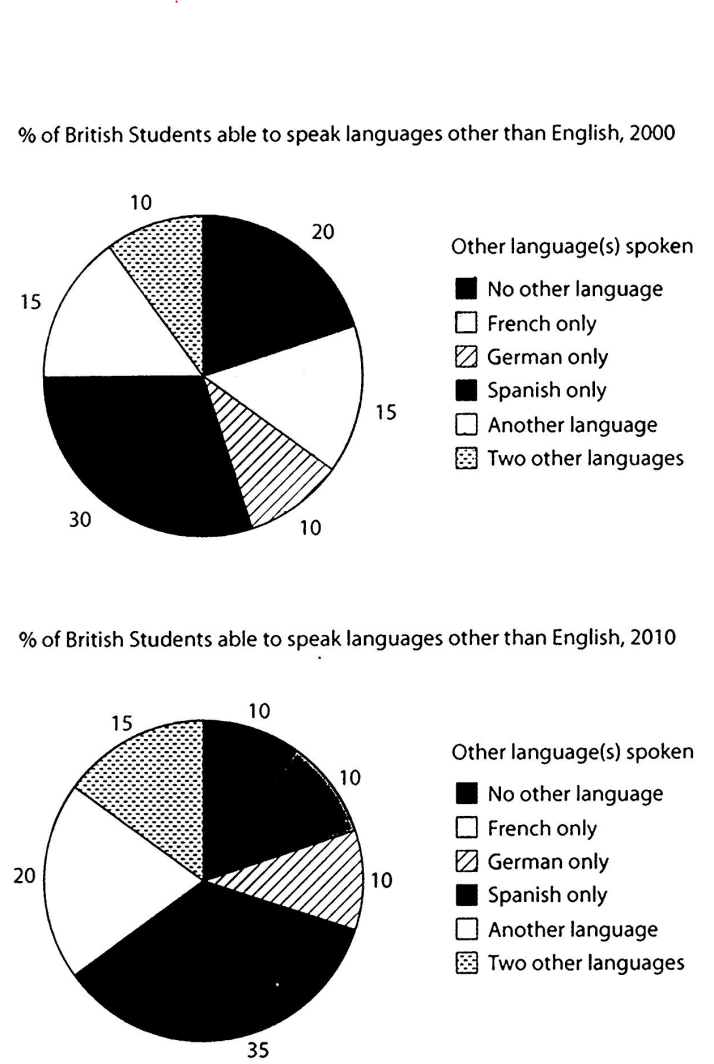
    The charts below show the proportions of British students at one university in England who were able to speak other languages in addition to English, in 2000 and 2010.


    Summarise the information by selecting and reporting the main features, and make comparisons where relevant.


    Write at least 150 words.
    IELTS 11 Test 2 Writing Task 1 (aided version No color for people with disabilities)

    Writing Task 2

    You should spend about 40 minutes on this task.

    Write about the following topic:

    Some people claim that not enough of the waste from homes is recycled. They say that the only way to increase recycling is for governments to make it a legal requirement.

    To what extent do you agree or disagree with this statement?

    Give reasons for your answer and include any relevant examples from your own knowledge or experience.

    Write at least 250 words.

    Cambridge IELTS 11 Academic Writing Test 2 Task 2 Model Answer (282 words)

    The pie charts illustrate the linguistic diversity among British students at a particular English university in 2000 and 2010. A noticeable trend is the increase in multilingual capabilities over this decade.

    In 2000, a significant majority, 30%, of students were monolingual, speaking only English. By contrast, this figure plummeted to just 15% by 2010. French was the second most common language spoken exclusively by students in both years (15% in 2000 and 10% in 2010). The proportion of German-only speakers remained constant at a modest 10%.

    A striking development is observed in the category of students proficient in two or more languages other than English. In 2000, only a small fraction (10%) fell into this category; however, by 2010, this segment had surged to constitute the largest group at an impressive 35%.

    Spanish-only speakers represented a consistent minority across both years at just under one-tenth of the student population.

    In summary, while there was a marked decline in monolingual English-speaking students from one-third to just over one-seventh over ten years, there was an equally notable rise in polyglots fluent in two or more additional languages from one-tenth to over one-third.

    Cambridge IELTS 11 Academic Writing Test 2 Task 1 Model Answer (190 words)

    I partially agree with the statement that government intervention could play a crucial role in increasing recycling rates, but I believe it is not the only solution. While legislation can set a framework and provide incentives for recycling, a holistic approach involving public awareness, education, and community engagement is equally essential.

    Firstly, government regulations can be effective in promoting recycling by imposing penalties for non-compliance and offering incentives for businesses and individuals who actively participate in recycling programs. For instance, some countries have successfully implemented laws that require the separation of recyclables from general waste, encouraging citizens to be more mindful of their waste disposal habits.

    However, a legal requirement alone might not be sufficient. Public awareness and education are pivotal in changing people’s attitudes towards recycling. Governments should invest in campaigns that inform citizens about the environmental benefits of recycling, the impact of waste on ecosystems, and the importance of reducing, reusing, and recycling materials. Additionally, community involvement through workshops and local initiatives can foster a sense of responsibility and commitment to sustainable waste management.

    Moreover, infrastructure plays a significant role in facilitating recycling. Governments should invest in efficient waste collection and recycling facilities, making it convenient for people to participate in recycling programs. Accessible recycling bins in public spaces, clear guidelines on what can be recycled, and collaboration with private sectors for innovative recycling solutions are all critical components of a comprehensive strategy.

    In conclusion, while government regulations are important, a multi-faceted approach involving public education, community engagement, and infrastructure development is necessary to create a sustainable and effective recycling system. A combination of legal requirements and proactive public involvement can maximize the impact on waste reduction and environmental conservation.
  • Cambridge IELTS 11 Academic Writing Test 1

    Writing Task 1

    You should spend about 40 minutes on this task. Write about the following topic:

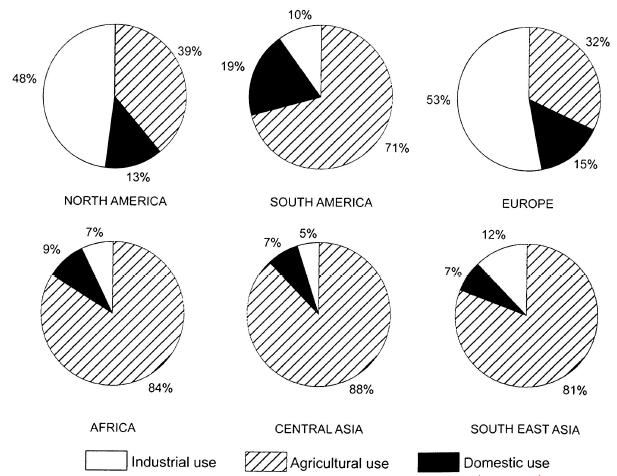
    The chart below shows the percentage of water used for different purposes in six areas of the world.


    Summarise the information by selecting and reporting the main features, and make comparisons where relevant.


    Write at least 150 words.

    Cambridge IELTS 11 Writing Test 1 Task 1 The chart below shows the percentage of water used for different purposes in six areas of the world.

    Writing Task 2

    You should spend about 40 minutes on this task.

    Write about the following topic:

    Governments should spend money on railways rather than roads.

    To what extent do you agree or disagree with this statement?

    Give reasons for your answer and include any relevant examples from your own knowledge or experience.

    Write at least 250 words.

    Cambridge IELTS 11 Academic Writing Test 1 Task 1 Model Answer (212 words)

    The chart illustrates the distribution of water usage across three different sectors: industrial, agricultural, and domestic in six distinct regions of the world.

    In North America, water is almost equally distributed among industrial (48%), agricultural (39%), and domestic (13%) purposes. Europe follows a similar pattern with a slightly higher emphasis on domestic use at 53%, while industrial and agricultural uses are at 32% and 15% respectively.

    South America stands out with its heavy reliance on water for agriculture at 71%, leaving only 19% for domestic use and a mere 10% for industrial purposes. Central Asia mirrors this trend but has an even higher dependence on agricultural water use at an impressive 88%.

    Africa’s water usage pattern aligns more with South America and Central Asia; however, it has a slightly lower percentage allocated to agriculture (84%) but compensates with higher domestic use (9%).

    South East Asia presents a balanced scenario similar to Europe but leans more towards domestic consumption which stands at 81%. Industrial use is minimal at just 7%, akin to Africa’s statistics.

    In summary, there’s a clear divide where Africa, Central Asia, and South America are heavily reliant on water for agricultural purposes while Europe, North America, and South East Asia have more balanced distributions with significant allocations towards domestic consumption.

    Cambridge IELTS 11 Academic Writing Test 1 Task 2 Model Answer (282 words)

    The question of whether governments should prioritize spending on railways rather than roads is a complex one, and opinions may vary based on specific circumstances and priorities. While both railways and roads are crucial components of transportation infrastructure, the optimal allocation of resources depends on various factors such as population density, geographical features, and economic considerations.

    One argument in favor of investing in railways is their potential for efficiency and sustainability. Rail transport tends to be more energy-efficient and environmentally friendly compared to road transportation. Trains can carry large volumes of goods and passengers over long distances with lower energy consumption per ton-mile or passenger-mile. Moreover, railways can alleviate congestion on roads, reduce air pollution, and contribute to a more sustainable transportation system.

    On the other hand, roads are often more versatile and accessible than railways. They provide door-to-door connectivity, allowing for more flexible point-to-point transportation. In regions with dispersed populations or where the terrain is challenging, investing in road infrastructure might be a more practical choice. Additionally, roads can be crucial for economic development, as they facilitate the movement of goods, services, and people, supporting local businesses and industries.

    Countries like Japan and several European nations have successfully integrated extensive railway networks into their transportation systems, promoting efficiency and reducing environmental impacts. However, in countries with vast landscapes or lower population densities, investing in road infrastructure may be a more pragmatic approach.

    In conclusion, the allocation of resources between railways and roads should be based on a careful assessment of specific geographical, economic, and environmental factors. Both modes of transportation play vital roles, and a balanced approach that considers the unique needs of each region is likely the most effective strategy.

  • Cambridge IELTS 9 Academic Writing Test 2

    Task 1

    You should spend about 20 minutes on this task.

    The chart below shows the total number of minutes (in billions) of telephone calls in the UK, divided into three categories, from 1995-2002.

    Summarise the information by selecting and reporting the main features, and make comparisons where relevant.

    Write at least 150 words.

    Task 2

    You should spend about 40 minutes on this task.

    Write about the following topic:

    Some people believe that unpaid community service should be a compulsory part of high school programmes (for example working for a charity, improving the neighbourhood or teaching sports to younger children).

    To what extent do you agree or disagree?

    Give reasons for your answer and include any relevant examples from your own knowledge or experience.

    Write at least 250 words.

    Cambridge IELTS 9 Academic Writing Test 2 Task 1 Model Answer (159 words)

    The chart shows the time spent by UK residents on different types of telephone calls between 1995 and 2002.

    Local fixed line calls were the highest throughout the period, rising from 72 billion minutes in 1995 to just under 90 billion in 1998. After peaking at 90 billion the following year, these calls had fallen back to the 1995 figure by 2002.

    National and international fixed line calls grew steadily from 38 billion to 61 billion at the end of the period in question, though the growth slowed over the last two years.

    There was a dramatic increase in mobile calls from 2 billion to 46 billion minutes. This rise was particularly noticeable between 1999 and 2002, during which time the use of mobile phones tripled.

    To sum up, although local fixed line calls were still the most popular in 2002, the gap between the three categories had narrowed considerably over the second half of the period in question.

    Cambridge IELTS 9 Academic Writing Test 2 Task 1 Model Answer (278 words)

    The idea of making unpaid community service a compulsory part of high school education sparks considerable debate. Some believe it fosters social responsibility, while others argue it adds unnecessary pressure on students. On balance, I support integrating community service into high school programs for several key reasons.

    Firstly, mandatory community service promotes social responsibility and civic engagement. By participating in activities such as working for a charity or improving their neighborhood, students gain a firsthand understanding of societal needs and the importance of contributing to their communities. For instance, helping at a local shelter can develop empathy and a sense of civic duty.

    Secondly, community service provides valuable life skills beyond the classroom. It enhances teamwork, communication, and problem-solving abilities. Teaching sports to younger children, for example, can build leadership and organizational skills. These experiences not only enrich students’ personal development but also enhance their resumes, giving them an edge in college or job applications.

    However, it’s crucial to balance this requirement with students’ academic and personal commitments. Schools should offer flexible programs that allow students to select activities aligned with their interests and manage their time effectively. Proper support and guidance are also essential to ensure meaningful engagement rather than a burdensome obligation.

    While critics argue that compulsory service undermines voluntary spirit, this can be mitigated through effective implementation. Emphasizing the benefits and framing service as an educational opportunity can motivate students to participate willingly and derive satisfaction from their contributions.

    In conclusion, making unpaid community service a mandatory part of high school education offers significant benefits by fostering civic responsibility and practical skills. With thoughtful implementation, it can be a valuable component of holistic student development.

  • Cambridge IELTS 9 Academic Writing Test 1

    Writing Task 1

    You should spend about 40 minutes on this task. Write about the following topic:

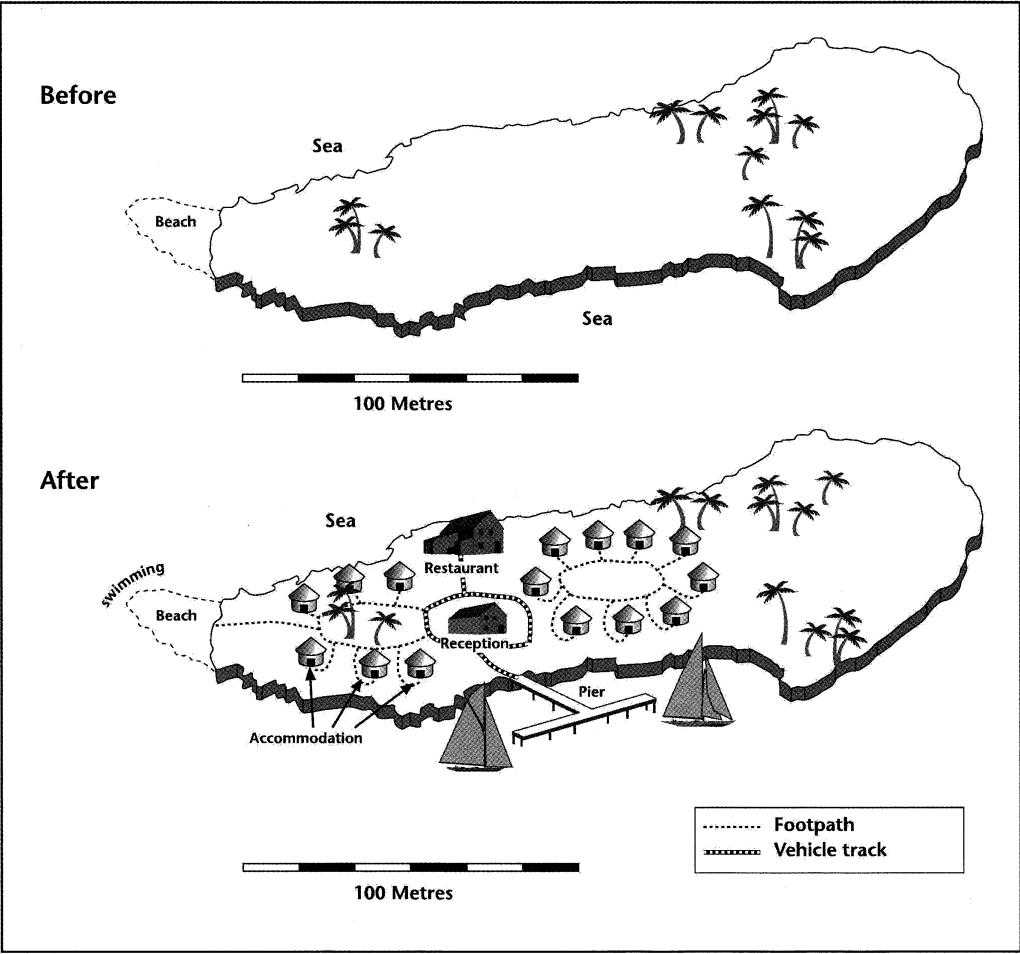
    The two maps below show an island, before and after the construction of some tourist facilities.

    Summarise the information by selecting and reporting the main features, and make comparisons where relevant.

    Write at least 150 words.

    Map of Island tourist facilities construction Cambridge IELTS 9 Academic Writing Test 1

    Writing Task 2

    You should spend about 40 minutes on this task. Write about the following topic:

    Some experts believe that it is better for children to begin learning a foreign language at primary school rather than secondary school

    Do the advantages of this outweigh the disadvantages?

    Give reasons for your answer and include any relevant examples from your own knowledge or experience.

    Write at least 250 words.

    Cambridge IELTS 9 Academic Writing Test 1 Task 2 Model Answer (166 words)

    The two maps illustrate an island before and after the development of tourist facilities.

    In the initial state, the island is largely undeveloped, featuring a natural landscape with some trees, a beach on the western side, and no significant infrastructure.

    Post-development, the island undergoes substantial changes, becoming a tourist destination with various amenities. The central part of the island now hosts several accommodations arranged in a circular pattern around a newly established reception area. A restaurant is constructed to the north of the reception. Footpaths link the reception with the accommodations and the restaurant, while vehicle tracks connect the reception to a newly built pier on the southern coast.

    Additional accommodations are added near the pier, and two sailboats are docked beside it. The beach area is designated for swimming. Despite these developments, the island retains some of its natural greenery, particularly towards the eastern end.

    Overall, the transformation enhances the island’s infrastructure significantly, making it suitable for tourists while maintaining parts of its natural environment.

    Cambridge IELTS 9 Academic Writing Test 1 Task 2 Model Answer (267 words)

    Traditionally, children have begun studying foreign languages at secondary school, but introducing them earlier is recommended by some educationalists. This policy has been adopted by some educational authorities or individual schools, with both positive and negative outcomes.

    The obvious argument in its favour is that young children pick up languages much more easily than teenagers. Their brains are still programmed to acquire their mother tongue, which facilitates learning another language, and unlike adolescents, they are not inhibited by self-consciousness.

    The greater flexibility of the primary timetable allows for more frequent, shorter sessions and for a play-centred approach, thus maintaining learners’ enthusiasm and progress. Their command of the language in later life will benefit from this early exposure, while learning other languages subsequently will be easier for them. They may also gain a better understanding of other cultures.

    There are, however, some disadvantages. Primary school teachers are generalists, and may not have the necessary language skills themselves. If specialists have to be brought in to deliver these sessions, the flexibility referred to above is diminished. If primary language teaching is not standardised, secondary schools could be faced with a great variety of levels in different languages within their intake, resulting in a classroom experience which undoes the earlier gains. There is no advantage if enthusiastic primary pupils become demotivated as soon as they change schools. However, these issues can be addressed strategically within the policy adopted.

    Anything which encourages language learning benefits society culturally and economically, and early exposure to language learning contributes to this. Young children’s innate abilities should be harnessed to make these benefits more achievable.

  • Cambridge IELTS 10 Academic Writing Test 4

    Writing Task 1

    You should spend no more than 20 minutes on this task.

    The charts below show what UK graduate and postgraduate students who did not go into full-time work did after leaving college in 2008.

    Summarise the information by selecting and reporting the main features, and make comparisons where relevant.

    You should write at least 150 words.

    Writing Task 2

    You should spend no more than 40 minutes on this task.

    Write about the following topic.

    Countries are becoming more and more similar because people are able to buy the same products anywhere in the world.

    Do you think this is a positive or negative development?

    Give reasons for your answer and include any relevant examples from your own knowledge or experience.

    You should write at least 250 words.

  • Cambridge IELTS 10 Academic Writing Test 3

    Writing Task 1

    You should spend no more than 20 minutes on this task.

    The table below shows the sales made by a coffee shop in an office building on a typical weekday.

    Summarize the information by selecting and reporting the main features, and make comparisons where relevant. Vou should write at least 150 words.

    Writing Task 2

    You should spend no more than 40 minutes on this task. Write about the following topic.

    Some people believe that good leaders are born, whereas others hold the opinion that leadership qualities could be obtained during life. Who represents the good leader qualities indeed?

    Give reasons for your answer and include any relevant examples from your own knowledge or experience. Vou should write at least 250 words.

  • Cambridge IELTS 10 Academic Writing Test 2

    Writing Task 1

    You should spend no more than 20 minutes on this task.

    The table below shows the sales made by a coffee shop in an office building on a typical weekday.

    Summarize the information by selecting and reporting the main features, and make comparisons where relevant.

    You should write at least 150 words.

    CoffeeTeaPastriesSandwiches
    7:30-10:3026511027550
    10:30-2:301855095200
    2:30-5:301453515010
    5:30-8:302007580110

    Writing Task 2

    You should spend no more than 40 minutes on this task. Write about the following topic.

    More and more people are relying on the private car as their major meant of transportations. Describe some of the problems overreliance on cars can cause, and suggest at least one possible solution.

    Give reasons for your answer and include any relevant examples from your own knowledge or experience. Vou should write at least 250 words.

    The two tables contain sales data for Fairtrade coffee and bananas in 1999 and 2004, in five nations of Europe.

    The first table shows low-level coffee sales increasing in all five countries, albeit to widely varying degrees. In two places sales increased by the same small amount: 1.8-2 million euros in Denmark, and 0.8.1 million in Sweden. The increment was slightly larger in Belgium, from 1-1.7 million euros. Meanwhile, in Switzerland sales doubled from 3-6 million euros. Finally, in the UK there was an enormous increase, from 1.5-20 million euros.

    In the second table, it is Switzerland which stands out as buying far more Fairtrade bananas than the other four countries. Swiss sales figures jumped from 15—47 million euros across these five years, while in the UK and Belgium sales only grew from 1-5.5 and from 0.6-4 million euros respectively. Sweden and Denmark showed a different pattern, with falls in banana sales from 1.8-1 and 2-0.9 million euros.

    Comparing the two tables, it is clear that in 1999 Fairtrade coffee sales ranged from 0.8-3 million euros in these five countries, while banana sales also mostly clustered between 0.6 and 2 million euros, with Switzerland the outlier at a huge 15 million euros. By 2004, sales figures for both products had risen across the board, except for Sweden and Demark which recorded drops in banana sales.

  • Cambridge IELTS 10 Academic Writing Test 1

    Writing Task 1

    You should spend no more than 20 minutes on this task.

    The charts below show the percentage of food budget the average family spent on restaurant meals in different years. The graph shows the number of meals eaten in fast food restaurants and sit-down restaurants.

    Summarize the information by selecting and reporting the main features, and make comparisons where relevant. Vou should write at least 150 words.

    Writing Task 2

    You should spend no more than 40 minutes on this task. Write about the following topic.

    By punishing murderers with the death penalty, society is also guilty of committing murder. Therefore, life in prison is a better punishment for murderers.

    To what extent do you agree or disagree with this statement?

    Give reasons for your answer and include any relevant examples from your own knowledge or experience. Vou should write at least 250 words.

    One important stage in a child’s growth is certainly the development of a conscience, which is linked to the ability to tell right from wrong. This skill comes with time and good parenting, and my firm conviction is that punishment does not have much of a role to play in this. Therefore I have to disagree almost entirely with the given statement.

    To some extent the question depends on the age of the child. To punish a very young child is both wrong and foolish, as an infant will not understand what is happening or why he or she is being punished. Once the age of reason is reached however, a child can be rewarded for good behaviour and discouraged from bad. This kind but firm approach will achieve more than harsh punishments, which might entail many negative consequences unintended by the parents.

    To help a child learn the difference between right and wrong, teachers and parents should firstly provide good role modelling in their own behaviour. After that, if sanctions are needed, the punishment should not be of a physical nature, as that merely sends the message that it is acceptable for larger people to hit smaller ones -an outcome which may well result in the child starting to bully others. Nor should the punishment be in any way cruel.

    Rather, teachers and parents can use a variety of methods to discipline their young charges, such as detention, withdrawal of privileges, and time-out. Making the punishment fit the crime is a useful notion, which would see children being made to pick up rubbish they have dropped, clean up graffiti they have drawn, or apologise to someone they have hurt. In these ways responsibility is developed in the child, which leads to much better future behaviour than does punishment.